
My day job is in the world of Open Education and in those circles there is talk of “all the opens” – open source software, open data, open science, open access publishing, etc etc etc. All good stuff.
But in the first one on the list, and where much of this started, the usual frame of open source are the tech geeks working together on software. In one of those series of unlikely events, I was digging into the world of open source by ordinary folks, people who put it to use for their work, learn largely on their own how to build technologies that do real world stuff for them, and free them of the binds of commercial or pre-packaged systems.
And it all started with goats.
Note: This was pretty much drafted as a discussion post in the OEG Connect community space I run for OEGlobal. While its Yet Another Blog Post To Be Done about “building online communities” it feel like I am 90% of the noise there, it almost becomes another blog-like space. Shrug.
At OEGlobal have been working with Andrés Segura-Castillo on an effort of Systemic Inquiry for our organization. Since 2009 Andrés has accomplished an impressive array of research in education and computational fields at UNED, the state distance university in Costa Rica.
For me, a good environment of meetings is one where there is at least, after the work part, a bit of fun or discussion of things outside the agendas. I am fuzzy on how this came up, I think I might have talked about the metaphor of gardening we put to use for this year’s Open Education Awards for Excellence and mentioning the home Cori and I live on a rural acreage.
Andrés then shared that he and his wife live on a rural property in Costa Rica, where they are deploying sustainable land practices… and also his joy of tending his herd of goats. Goats! Thus in later meetings, there was always time to ask about the latest goat story, we make use of the GOAT acronym, and I even tossed in a version of those British Virgin Media O2 ads with a call to “Be More Goat.”
Ha ha.
As Andrés described yesterday another funny story of his goats escaping an enclosure to eat plantains or coming to their front door to announce they were “out”, it reminded me of a message earlier this year from longtime, tech oriented friends in Colorado (USA) who run a ranch that specializes in the breeding and care of a breed of rare black Welsh sheep.
Ken and Oogie are folks I met online in the 1990s, ironically via a common interest in multimedia with the use of (drum roll for old technology platforms) Macromedia Director. They did contract work for the military when they lived near San Diego, but sometime later they picked up and found a ranch in Paonia Colorado, what they call Desert Weyr. I’ve driven up and stayed with them several times and got to see first hand the work it takes to run an sustainable operation like that.
They put their analytical minds and Figure Stuff Out approach to their ranch work. Breeding a rare sheep breed involved collecting and analyzing data, and I forget most of the details they shared, but the lambing period was intense. Monitoring their flock’s vital signs was instrumental to success.

Plus, there was always farm equipment to fix. Ken, ever the hacker, shared his home designed weather systems and how he stored data published to a web site. In 2014 he even did some mods for my Storybox.
Thus I thought of them with that OEG Connect post with a title “Open as in Farmiing”. And like my blog style here, I often reach for photos in my posts. Shrug, As usual I reached into my own flickr photo collection, which is so much more fulfilling that getting some cartoonish gack from GenAI. Isn’t the world a better metaphor than cartoon slop that looks like all the other slop?

My friends had developed themselves a technology using RFID chips attached to the sheep’s collars that they had made an Android app for reading data and recording vital health data for each sheep, all very important in their breeding program. They showed me a prototype when I visited in 2014, then it was called LambTrakker.

The idea was out in the pasture with the sheep, Oogie and Ken could record physical data about each sheep (vital signs, other observations) by scanning the ID with an Android device, an enter that data. Later they wouldtransfer it to their home built database system
It’s funny as a core of those old Macromedia Director nerds still stay in touch via an email list. It was there Oogie recently shared that their original LambTrakker software was now a more generalized and one that is completely open source.
The project is called AnimalTrakker
The purpose of AnimalTrakker® is to provide software and data analysis tools that aid in the management of livestock. Our mission is to bring animal management solutions to all who work with animals, whether veterinarian, small farmer, or commercial rancher. Our goal is to make it easier for you to provide your animals with a healthy and comfortable life, all while they provide food, fiber, and other products for human use. Currently, AnimalTrakker® can track sheep, goats, cattle, horses, donkeys, and pigs.
AnimalTrakker® is free and built from open-source, transparent, easily audited software. We feel that every user should be able to edit and modify the software to suit their specific needs. We believe in a future free from control, overreach, and excessive monetization, and AnimalTrakker® is our commitment to that future.
This is very much the spirit of openness, right? Developed by specialists, using existing open source components and then shared back? The software is available on GitLab plus a very comprehensive set of support materials (that leads me to see this is put on the web using the Obsidian notes platform and published with its built in Obsidian Publish, neat discovery on the side).
I have to say the opportunity to see the sheep operation was amazing (and Paonia is a beautiful corner of northwest Colorado, a fun town too). Okay I can brag that one of my CC licensed sheep photos appears on the front page of the AnimalTrakker site. And look, it’s attributed. How about that?
While exploring the AnimalTrakker site I found or just got curious about more examples, and landed on FarmOS:
FarmOS is a web-based application for farm management, planning, and record keeping. It is developed by a community of farmers, developers, researchers, and organizations with the aim of providing a standard platform for agricultural data collection and management.
The farmOS server is built on top of Drupal, which makes it modular, extensible, and secure. The farmOS Field Kit app provides offline data entry via a progressive web app (PWA) at farmOS.app.
Both are licensed under the GNU General Public License, which means they are free and open source. All code is available in the farmOS GitHub organization.
There is a I bet a whole raft of open source tools developed by people who work the land.
So I am curious to hear of more examples of open source or just open practices in other corners outside our usual aim towards education, beyond the open source developer specialists. I know there are many in the health sector.
And this was the question I posted in OEG Connect.
I am eagerly waiting for someone to chime in with a contribution.
Well, I waited about 3 hours, and added one myself. See, alot of my community activity is me talking to me, sometimes through different accounts.
It was while writing about the farming/rancher use of open source, I remembered an example more close to home.
Diabetes.
I have been living with Type 1 diabetes since I was 7, and I remember some 10 years ago reading about a diabetic who had hacked together their own technology as an “artificial pancreas” combining an insulin pump connected to devices the measure blood sugar levels.
With some digging I found that this was a diabetic named Dana Lewis, who shared a photo of her system on some platform that rhymes with “bitter” (screen shot only). I recognize the Medtronic Mini Med insulin pump (first one I had) with a Raspberry Pi being at the heart.
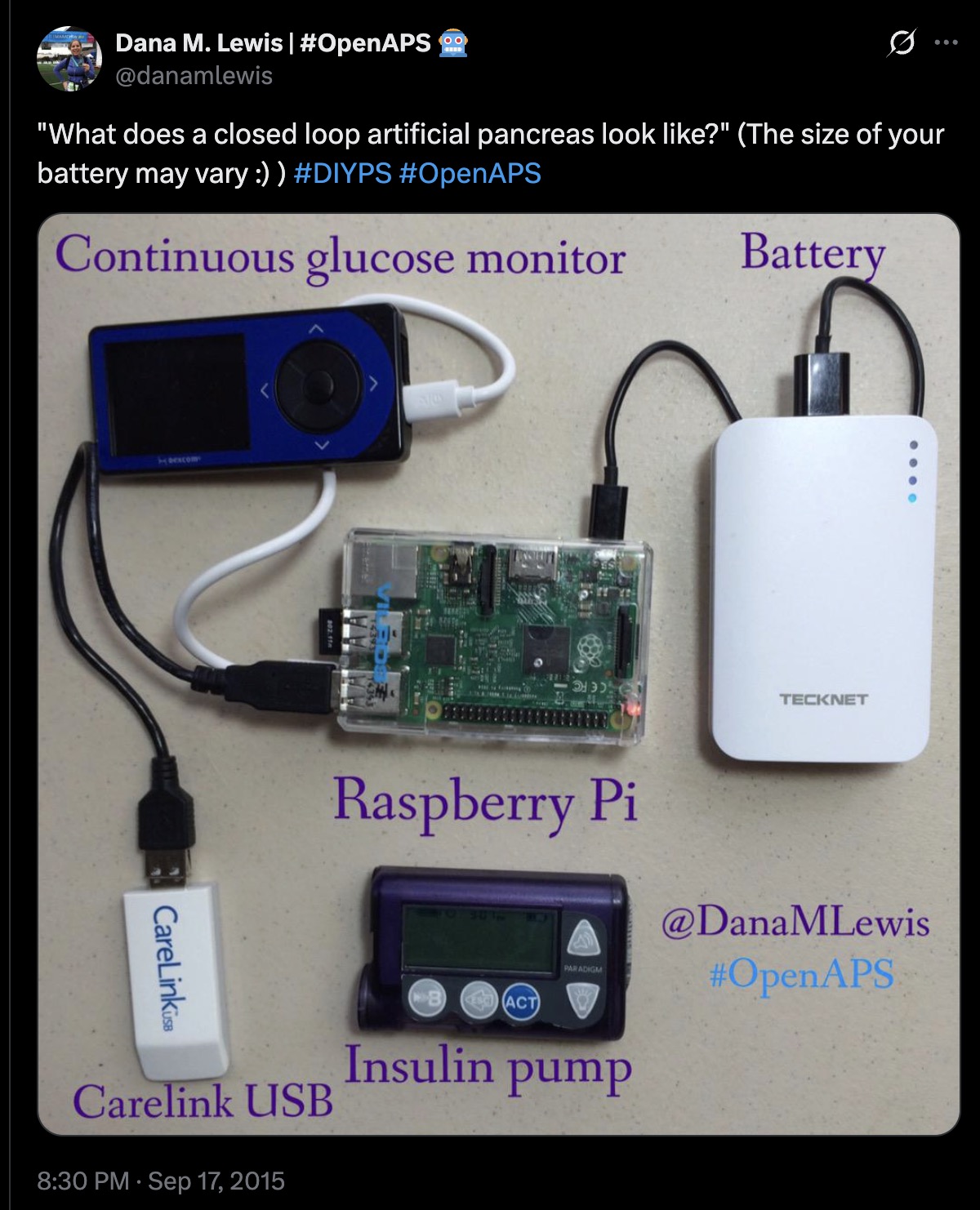
Dana published this as an open book (using gitbooks) Automated Insulin Delivery — How artificial pancreas “closed loop” systems can aid you in living with diabetes, which is available at https://www.artificialpancreasbook.com/
Automated insulin delivery is a technology for managing type 1 diabetes that goes by many names: hybrid or full closed loop, artificial pancreas system (APS), “looping”, and more. But whatever you call them, automated insulin delivery systems are not all the same. You have choices, ranging from the type of insulin pump body and CGM you want to use, to the algorithm and controller, to the interoperability and remote monitoring options, and more. Like switching from multiple daily injections to an insulin pump, switching from manual diabetes to automated insulin delivery has a learning curve.
It’s certainly one you can tackle. After all, you’re already tackling type 1 diabetes! You already have the base knowledge and experience you need to succeed with a closed loop system, if it’s right for you. But you might be wondering how to get ahead of your learning curve before you start or even choose an APS. Or maybe you’ve started and want to dig even deeper into optimizing how an automated insulin delivery system fits into your lifestyle. This book was written for you! It leverages the collective knowledge of the early adopters of do-it-yourself and commercial systems from the past five years and packages it into easy, understandable guides and lessons learned.
https://www.artificialpancreasbook.com/
The book is available on Amazon — “a physical, printed book that’s available through self-publishing. It’s priced so that every 2 copies purchased will fund an author-priced copy that I will donate to hospitals.”
Woah.
But it is also available freely as a downloadable PDF or just the GitBook version as a web site–
so you can review portions of the content anytime, and see any changes over time. There will also be additional links and videos with more content. The website and its content are open source, so if you see any typos or have suggestions, you can make those suggestions or edits directly!
Now who has a real sense of “open”?
The story was that major companies that profit from the money made in diabetes care systems kept pressure on not to allow more devices to come on the market or want to control the prices (that’s just my memory” but organize under the hashtag #WeAreNotWaiting as in “We are not waiting for government or commercial entities to create the health care we need.”
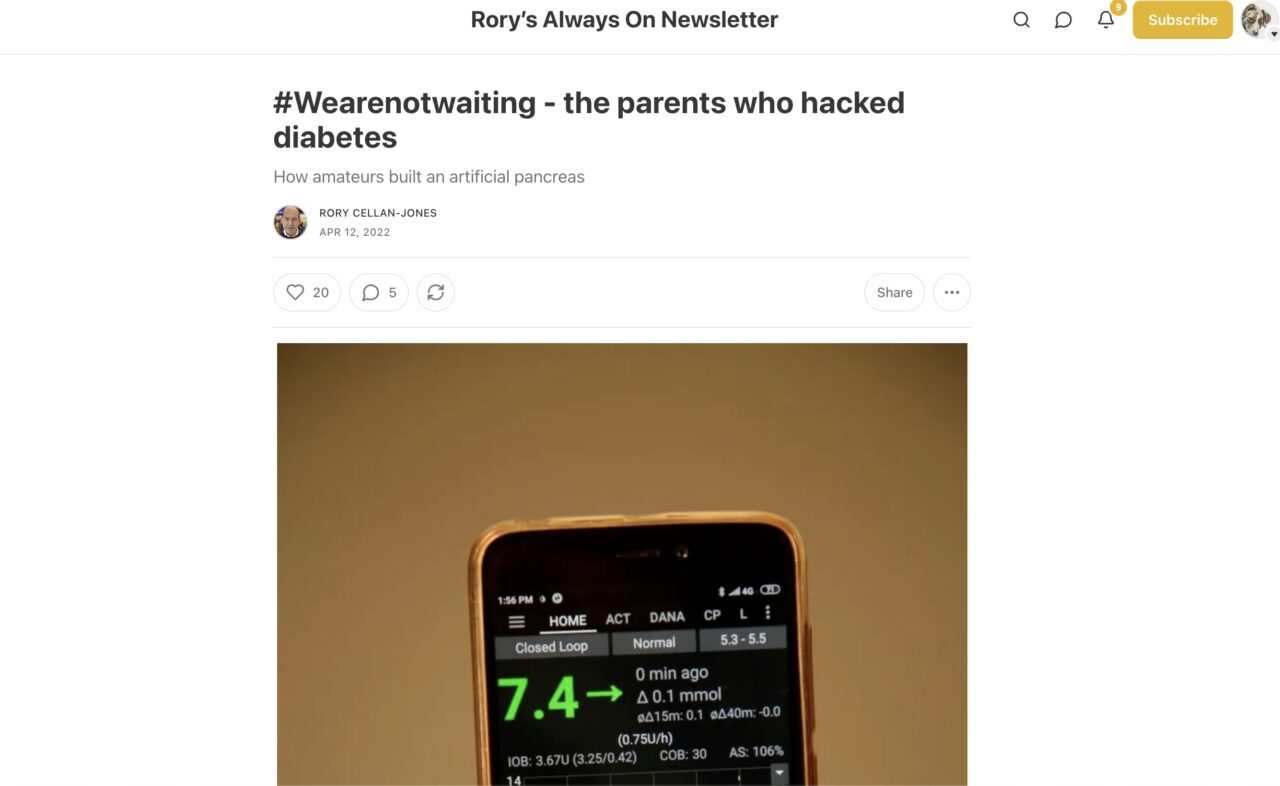
See for example (there are many) #Wearenotwaiting – the parents who hacked diabetes
There is the Nightscout Foundation that supports and organizes efforts by people building their a suite of open source medical devices for diabetes care. NightScout is just one:
Nightscout (also known as CGM in the Cloud) is an open-source cloud application used by people with diabetes and parents of kids with diabetes to visualize, store and share the data from their Continuous Glucose Monitoring sensors in real-time. Once setup, Nightscout acts as a central repository of blood glucose and insulin dosing/treatment data for a single person, allowing you to view the CGM graph and treatment data anywhere using just a web browser connected to the internet.
There are several parts to this system. You need somewhere online to store, process and visualize this data (a Nightscout Site), something to upload CGM data to your Nightscout (an Uploader), and then optionally you can use other devices to access or view this data (one – or more – Follower).
Also related is The Open Artificial Pancreas System project (#OpenAPS) which was founded
The Open Artificial Pancreas System project (#OpenAPS) is an open and transparent effort to make safe and effective basic Artificial Pancreas System (APS) technology widely available to more quickly improve and save as many lives as possible and reduce the burden of Type 1 diabetes.
OpenAPS means basic overnight closed loop APS technology is more widely available to anyone with compatible medical devices who is willing to build their own system.
We believe that we can make safe and effective APS technology available more quickly, to more people, rather than just waiting for current APS efforts to complete clinical trials and be FDA-approved and commercialized through traditional processes. And in the process, we believe we can engage the untapped potential of dozens or possibly hundreds of patient innovators and independent researchers and also make APS technology available to hundreds or thousands of people willing to participate as subjects in clinical trials.
These are all efforts using the ideas of open source / open access / open data but also are able to organize and coordinate efforts via the open internet.
So from goats to sheep to insulin pumps, a thread of open source that is done by people, born of interest, ideation, and the drive to make the world better. Just standing in a field of grass, saying, “Hey!”
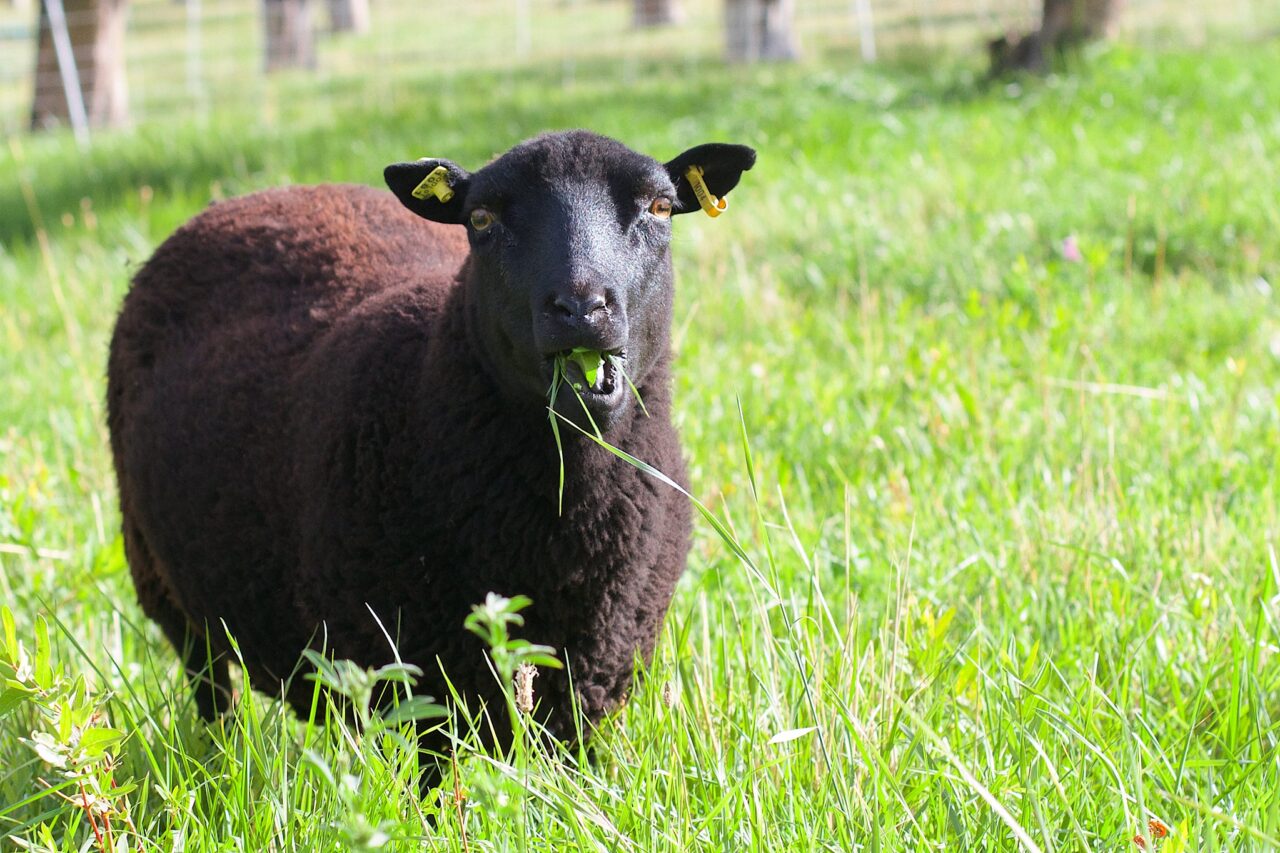
Featured Image: Hey! flickr photo by cogdogblog shared under a Creative Commons (BY 2.0) license – one of the black welsh sheep bred at Desert Weyr, Colorado.


So fun to see this link. Thanks for the shout out about AnimalTrakker®
Hi Oogie, so funny you saw my post! Say hi to Ken, I ought to email ya.
When I was living in Calgary in the 1980s, someone put a stove into the field beside the highway leading to Banff, pulled down the front door, and attached a sign, ‘open range’.
Open has always been around. The non-natural state is closed, fenced, and restricted. When I was a kid I roamed freely through all the farms and forests around my home. Today I could never do that (though I do take advantage of the open road in order to cycle throughout Eastern Ontario).
The first really important sense of ‘open’ for me was the library. It was there I was exposed to my first science fiction, was first exposed to the idea of a life as an explorer dedicated to discovery – which is how I see myself to this day.
I think the way we’ve limited the way we see open to a few scattered and very niche applications speaks volumes about the increasingly artificial state of society.
You said it, Stephen. Open is natural on the land. I collected many of those Open Range signs in my driving travels, including ones that had bumps
https://www.flickr.com/photos/cogdog/36126095345
I agree to that we are farther than ever from the dream of “open as default” its left to individuals to operate that way (e.g. musicians you release their music to the public domain). I’m reminded to of a visit to Scotland when John Johnston took me for a walk out in the open spaces. I hesitated when we opened the gate on farmland, but he told me the tradition that even private land was open to walkers if they respected it, kept gates as they found them.
The 2003 Land Reform act made open the default for walkers https://www.ramblers.org.uk/go-walking-hub/simple-guide-scottish-access-rights
Saskatchewan pulled the access to private land back in 2021 https://www.saskatchewan.ca/government/news-and-media/2021/december/16/new-trespass-legislation-coming-into-force-on-january-1-2022
Wish we could Be More Scotland!