
Who would not answer “yes” when asked if they would like a dose of serendipity. A word that conjures a bit of magic. A rather well worn tag around here.
So I am coming back again to relish in my own weird obsession, not saving vats of time asking LLMs to do my tasks but worse, spraying that time with my web flashlight down public domain rabbit holes.
Flynn’s Free to Use Browser Extension (keeping it propped up)
Since some time in maybe 2018, my web browsing experience has enabled bits of that magic through a browser gizmo created by a student intern name Flynn Shannon at the Library of Congress, called the Free to Use Browser Inspection. Indeed I have been a tad enthusiastic about it, and have made a few small technical guess fixes to keep it running for me.
Why?
Each time I open a new tab, rather than blank space or some Google junk, I get a random public domain photo from the Library of Congress. Often I just go on to my tasks, but many other times, my curiosity is drawn in to strange old machines, historic street scenes, oddly dressed people, mimetic architecture, places I have been to, it’s hard to pin down the why. Many times it is the expression on the face of a person, I cannot help but wonder who they are and what they are doing. Like:
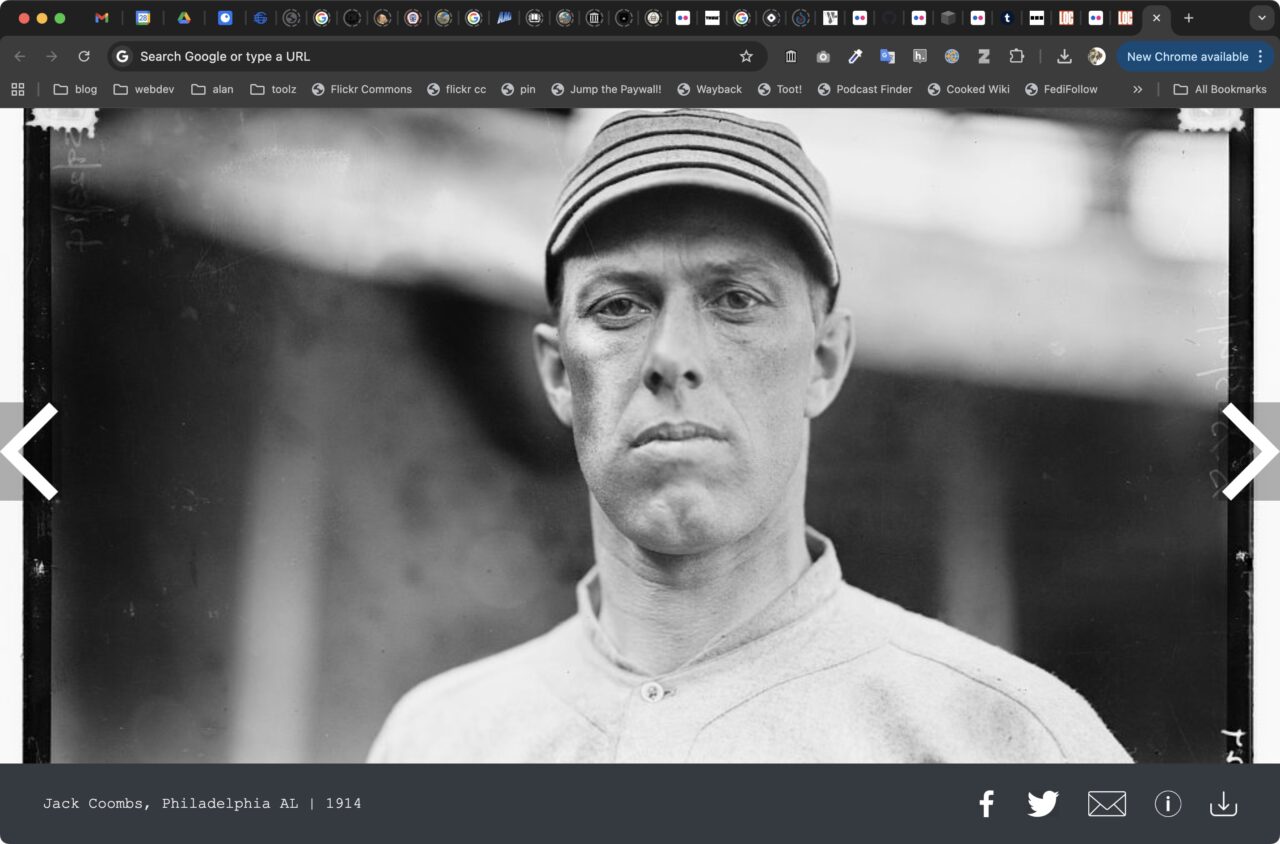
When the curiosity clicks, I click the name in the bottom left to see the entry for this image in the Library of Congress. I generally use this as the jump point, I have my own browser bookmarklet tool that lets me in one click run a search on Jack Coombs in the flickr commons. From there I can get to the same photo in flickr.
Why flickr? While I do adore flickr on its own, from here I can do things like use my own Flickr CC Attribution Helper to get the code to insert the image in one copy/paste to my WordPress site along with a fully formed TASL-y attribution. But more importantly, in many cases, the comments in flickr, some 17+ years old, share much more information about what’s in the photo.
I rare cases, like this one of Jack Coombs, the only comment links to some of his other photos, like this one of him on the field. From there I can find links to his Wikipedia article to learn his nickname was COlby Jack and even another comment that identifies the stadium:
The building in the background shows that this was taken at Hilltop Park in New York.
en.wikipedia.org/wiki/Hilltop_Park
Home of the Yankees, and briefly the Giants, it was demolished in 1914.
Sure I could just ask GenAI “Who is Jack Coombs?” and it would spit out a recasting of Wikipedia. But in my efforts of rabbit holing, I am not looking for facts and answers, I am looking for serebdipty and stuff I am into expecting.
This is how I end up losing time in Public Domain Rabbit Holes. I seek not any treatment. That time is not lost, its full of magic. I leave with an aura of appreciation and hope for the fragile web.
Lance Vibes His Own Serendipity Machine
My other atypical obsession is I still read a lot of blogs… via their RSS feeds. How web old am I? In the miix I caught a post by Lance Eaton (his blog, not his stacksub thing) that grabbed my attention because he described his hunger for some kind of machine to send serendipity from the far reaches of the Internet Archive.
Another thing that inspired this new series is that I like the Internet Archive but exploring it can be a challenge. There’s a lot of content, and it’s not easy to find thing or rather find things at random. I feel like I have to dig in and that feels a little less serendipitous for how I might like to engage with it. With the help of AI, I built a small web program that would send me to a random detail page on the Internet Archive.
https://www.byanyothernerd.com/2026/01/internet-archive-artifact-000.html
So indeed he vibe Claude coded an archive roulette which is… set up as a browser extension that appears in a new tab.
Eerily familiar? Was he reading my blog? Nope, he was just thinking in parallel spaces. You can download Archive Roulette from his github repo, and just like the Free to Use Browser extension, it is loaded in Chrome as an unpacked extension (do not sweat that techie vocabulary likely hoping I will impress you with my fading prowess it is super easy to set up).
Browser extension for exploratory discovery of Internet Archive materials with quality filtering
https://github.com/leaton79/archive-roulette
A Chrome extension that transforms your new tab page into a serendipity engine for digital history. Discover random photographs, audio recordings, videos, books, vintage magazines, historical newspapers, and software from the Internet Archive’s vast collections.
And it works rather slickly. Each new tab gets the roulette interface. You can create filters for type of media (like I tested with a date range of 1800-1920 for images withe keyword Manhattan) as well as specific collections.
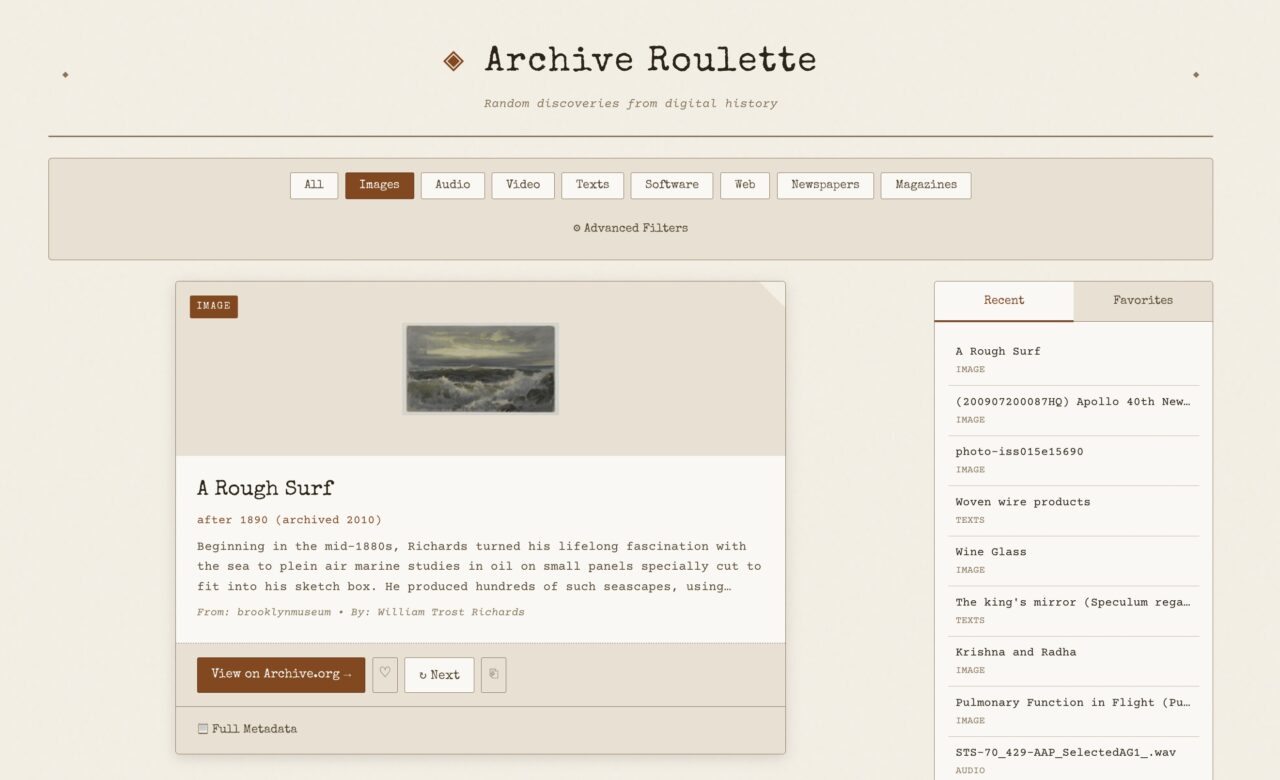
This tool is admittedly impressive, it keeps a running log of recent finds, and you can use a heart button to favorite them. The variety, when you do not use any filters, is quite.. variable! Because of how vast the Internet Archive works.
And I am even more impressed with Lance’s efforts to use the tool once a week as a series to publish not just an image of what he found, but his thoughts and rabbit holing like querying into the item. I mean look how deep Lance goes in writing about an 1899 book by a gynecologist who wrote about the health benefits of bicycling. That’s about as obscure as you can get, right?
In exploring this text, my mind goes in two directions. The first is seeing this text as a prime example of how social norms and conventions were woven into the medicalization of bodies that were taking place in the 1800s. Neesen is tying together ailments, morality, and expertise, and through that, casting more control of women, even when he endorses the idea that women should ride bicycles
https://www.byanyothernerd.com/2026/01/internet-archive-artifact-0002.html
I look forward to the rest of the series. And given my own interest in Daily Things for a Year I am in awe of Lance’s 365 efforts – poems, short stories, photographs, books, articles, even stickmen.
Multiple Machines Loaded
I’m going to keep my trusty old extension active now, but because I can flick extensions on an off, I cam keeping Lance’s Archive Roulette in my box of Extensions. I feel fairly sure there is a future time I will find a use for it.
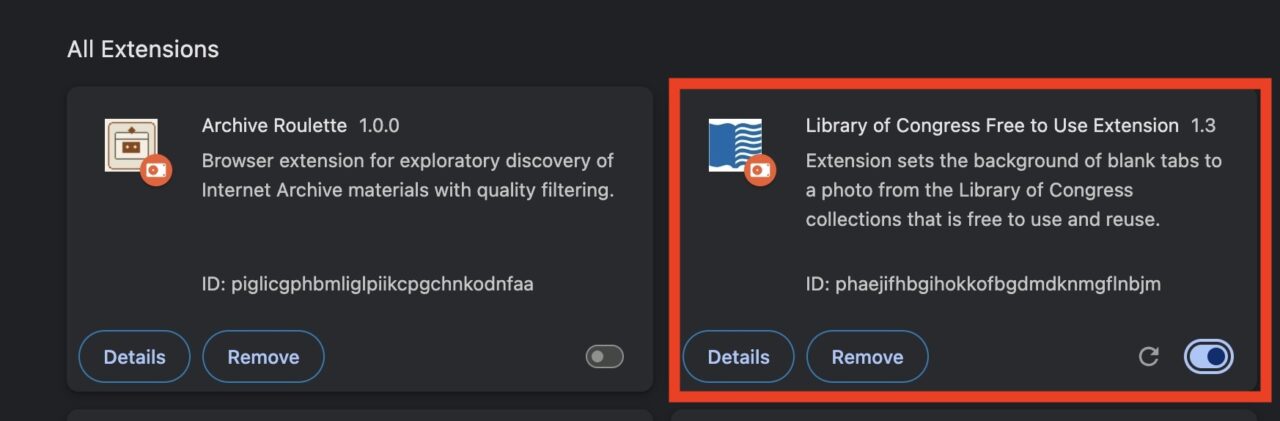
Despite my own lack of interest in making things the vibe way I have no problem using stuff other folks make.
The Serendipity of Finding an Image to Represent Serendipity Machines
As a further example of my time inefficient ways, I started looking for an image to use from my own flickr collection, the usual starting route. A search in Google Images with options on for CC licensed really was sparse (I am finding it less and less useful), so I did end up trying Openverse with a search on serendipity machine that brought a series of ones in that I liked, such as these kind of steampunkish type images

There’s no info, and these are from a guy named Tim. But I was curious if I could rabbit hole some more with a web search on Aleks Arcadia Serendipity Machine that had a lot of misses, but even with Google being “so terrible” the first result got my going to a summary of a University of Canbridge talk in 2011 on The Serendipity Engine by Dr Aleks Krotoski (good timing as the web banner says the site disappears on July 1):
The Serendipity Engine is a physical manifestation of theoretical and technological interventions that can be used to enhance serendipity on the World Wide Web. It is a working machine that uses bike parts, flower pots, cake, pulleys, lightbulbs and other concrete objects to articulate the processes that could be translated into digital “solutions” that will re-engineer the potential dystopian social trajectories of current (social) software trends. It has been theorised, devised, designed, developed and welded together by Dr Aleks Krotoski and Dr Katrina Jungnickel.
Each of the components of The Serendipity Engine highlights problems observed by digital theorists, designers and technologists with the way the Web currently works – linguistic barriers, echo chambers – by proposing one vision of how the technology can be re-tooled to increase serendipitous encounters. The aim of the machine is to inspire insight into the social and cultural effects of the decisions that developers make – often for commercial reasons and at the (explicit or implicit) requests of consumers – through simple, lateral demonstration.
https://talks.cam.ac.uk/talk/index/34581
Wow, that is exactly what I hoped to fine, a real machine that creates web serendipity. That talk site had a link to the web site for Aleks Krotoski (double thumbs up the 2011 link is still valid) with a lot of interesting stuff, but I did not quickly find the “engine”. Thus it was another search on better words Aleks Krotoski Serendipity Engine with much better results, articles, videos, but what looked promising was a tumblr site about the project overflowing with many interesting links about serendipity many getting my pinboard treatment.
Somewhere in there I spotted a link to what would be the website about the project http://theserendipityengine.com/ alas which is no more, but I found remnants in the wayback machine.
Hmm, I was way off track. Rabbit holing means sometimes doubling back so I returned to the Aleks Krotoski site and spotted a social link to her flickr account. The last photo posted was 2013. But if anyone has photos of the machine, I’d think it would be the co-inventor.
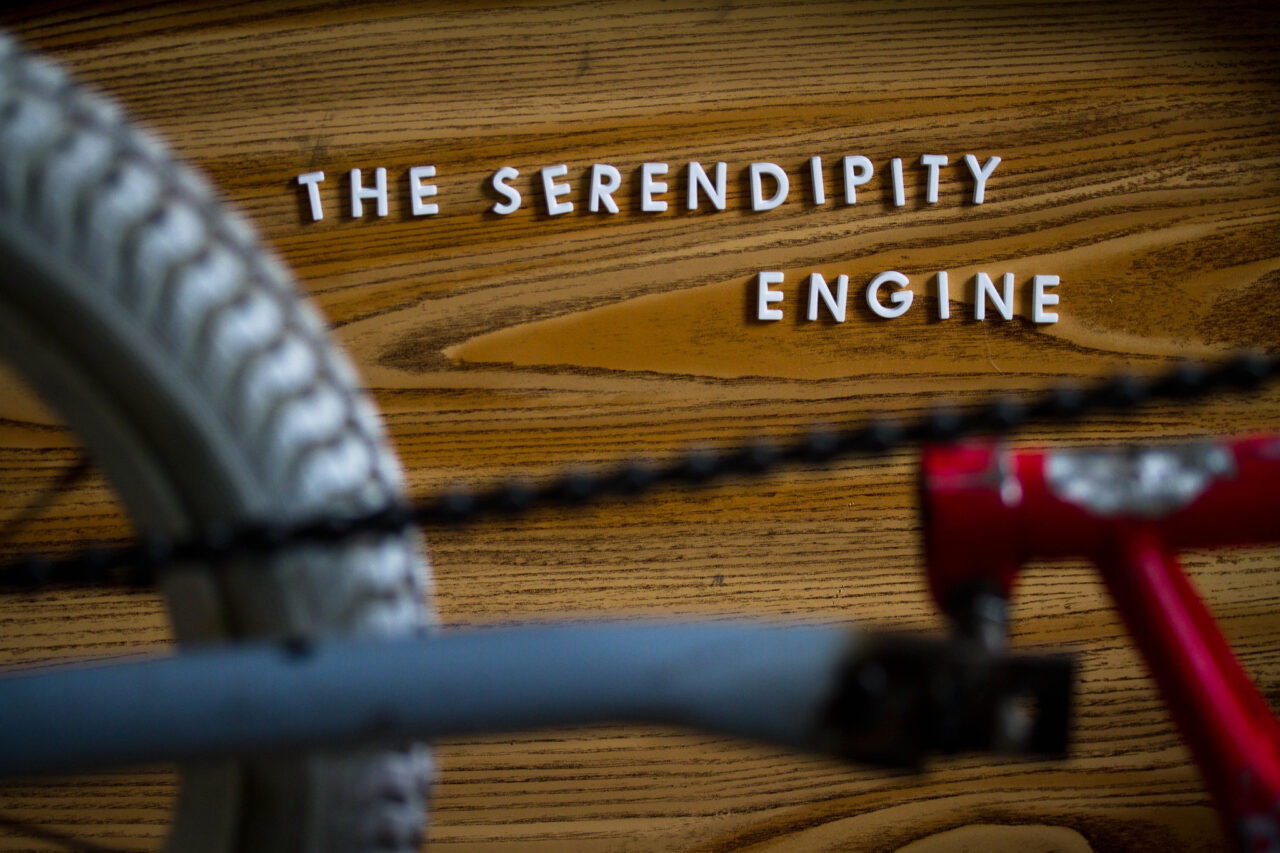
Hmm I spotted her road trip in 2013 to the Grand Canyon, she was just a few hours from where I was living then. Better than that, I could use flickr to search her photos for serendipity and BINGO, that first image was the one I wanted for my feature image for this overly long and maybe tedious post. And it is CC licensed. And it has bike parts.
Again, again, and again. Lots of folks want magic machines to hand them answers and stuff. Many times I get much more out of my time inefficient way of search, wonder, sidetrack, distract and … wandering in downtown Serendipity-ville.
Feature Image: the serendipity engine (title suitcase) flickr photo by Aleks Krotoski shared under a Creative Commons (BY-NC-SA 2.0) license
 Share this barking on social media
@barking most interesting that this post got interest from a developer of a new service that they shared with me by email. This blogging thing works! Do you think it will ever catch on? (Me commenting to my own blog) (someone had to write comments$
Remote Reply
Original Comment URL
Your Profile
Why do I need to enter my profile?
This site is part of the ⁂ open social web, a network of interconnected social platforms (like Mastodon, Pixelfed, Friendica, and others). Unlike centralized social media, your account lives on a platform of your choice, and you can interact with people across different platforms.
By entering your profile, we can send you to your account where you can complete this action.