
For an ever diminishing number of web heads, this phrase will generate a connotation with not even an explanation or link needed — “Bags of Gold.”
Anyone?
I for one was in that Robson Square conference room in Vancouver at the 2009 OpenEd Conference, for Gardner Campbell’s talk on No Digital Facelifts: Thinking the Unthinkable About Open Educational Experiences. I can actually pick out of the recording my own cheers and laughter from the audience in this opening moment of Gardner’s talk.
It was the most exuberant, optimistic of web times, and likely looks naive in bitter hindsight. But I’d rather have lived that than not.
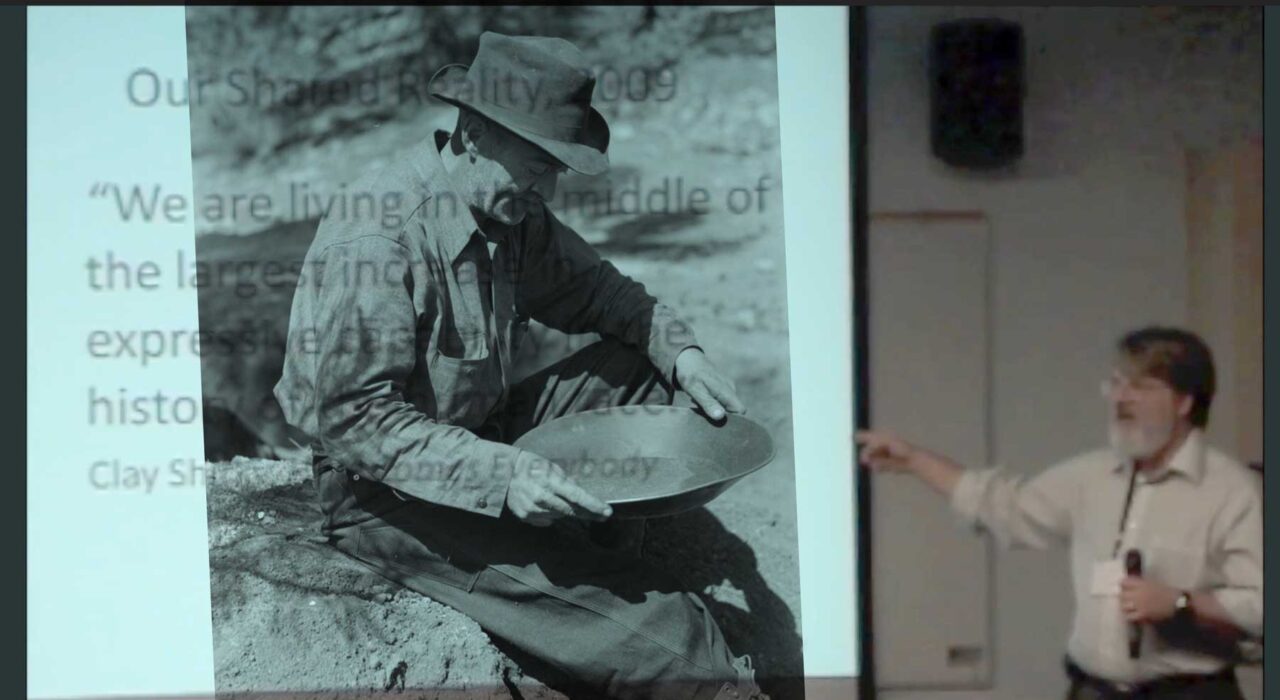
Gardner’s slide had a quote from Clay Shirky’s book (it’s stilll on my shelf) Here Comes Everybody about “living in the middle of the largest increase in expressive capability in the history of the human race”. With his ever poetic oration, Gardner stated:
It’s as of day after day I say “I have a bag of gold would you like a bag of gold?”
And people say “Where do find time for bags of gold?” “Oh no, another currency to master!” “Gold? Is that sustainable?”
No, you spend it. “Well what would you spend it on?” What would you like to spend it on? “I don’t have time for your philosophical questions, Gardner!”
It’s a bag of gold. What part of that do you not understand?
Gardner Campbell, OpenEd 2009 No Digital Facelifts
As it did so often, Bags of Gold took off and morphed through the cult of DS106 as remix, to animated text versions, to cover songs, to even more weirder remixes. It was part of the typical ds106 course for the part about personal cyber infrastructure.
The Bag No More
Alas the old stories. Yawn, eh? There is no bag of gold anymore, it’s something, well more fecal, right?
I note that Chris Lott mused in 2022 well before me What Happened to the Bags of Gold?
But here I am, looking around at veritable mountains of gold that not only remain undisturbed, but for many seem to have disappeared beyond the broad horizons bounding a flatland of ephemerality characterized by relentless consumerism, individual rootlessness, and a weird kind of collective amnesia… all yoked firmly to what Langdon Winner called “technological somnambulism.”
https://staff.washington.edu/clott/2022/what-happened-to-the-bags-of-gold/
So gold is not gone, but it is again, us? as in Pogo from 1970.
Yet I find specks and glints and hints of internet gold almost daily. It’s out there, often in my mind the corners yo will hear called the #SmallWeb. The gold is way way way out on the x axis of the long tail, maybe even farther out than ever before.
And yes, some like Stephen Downes and Doug Belshaw are trying to tune their RSS feed consumption to increase the flow. People desire the machinery to allegdly address a signal noise issue.
Indeed I get some of my gold specks in feeds and socials. But the most interesting ones are not handed to me on some conveyer belt, they are ones that I end up as the old site goes Stumbling Upon, and often it is 3, 4, 12 links beyond the first one I looked at.
That’s the magic. That’s what it makes most delightful, when you click a link, see something, and momentarily stop breathing. You might even utter a Neoi like “woah”.
It’s the finding it yourself, not having it handed to you, that makes for me, the true gold. The other stuff is often pyrite or maybe just some gold paint.
Let me stop blabbing and give some examples. At least as best I can recollect them.
From Profile to Open Source Pinball Map
Yeah people will pile up their “important links” on some tree, mostly links to their socials. Selfie links. But i have found consistently, that people have a different place to put links to their projects, hobbies, passions, in different places.
I find these often in people’s email footers. I have a little habit of actually scanning what people put into their footers. Sure, its usually the professional links to publications or cvs, but often, I will find what I call a passion link.
The same thing happens on some people’s social media profiles. Many of the big mall sites give you maybe one link, one of many reasons I love Mastodon, is you get four slots.
So sometimes, if I am seeing stuff in a stream maybe from a person I do not know, e.g. reposted by someone I do, I get idly curious about them. A profile is a bit of a calling card.
I cannot even remember the account or name of one I looked at recently. The icon I think was a man in banana suit? He had links to his web site, and maybe code repos, but I saw this one, and got curious.
The Flip is a not yet built “playable museum” of pinball that some people are organizing in Chicago. Now I have just some childhood memories of playing pinball, but I know a few friends that are rather gonzo about it. Heck one even made it his business.
But then I scroll down the page, because the gold is found by scanning for sideways link destinations- I am in Pinball Map, a kind of user contributed global map of where specific pinball machines are found.
Or as it says on its GitHub repo “Founded in 2008, Pinball Map is an open source, crowdsourced worldwide map of public pinball machines.”
So I do not see any machines mapped in Moose Jaw, but quite a few in nearby Regina.
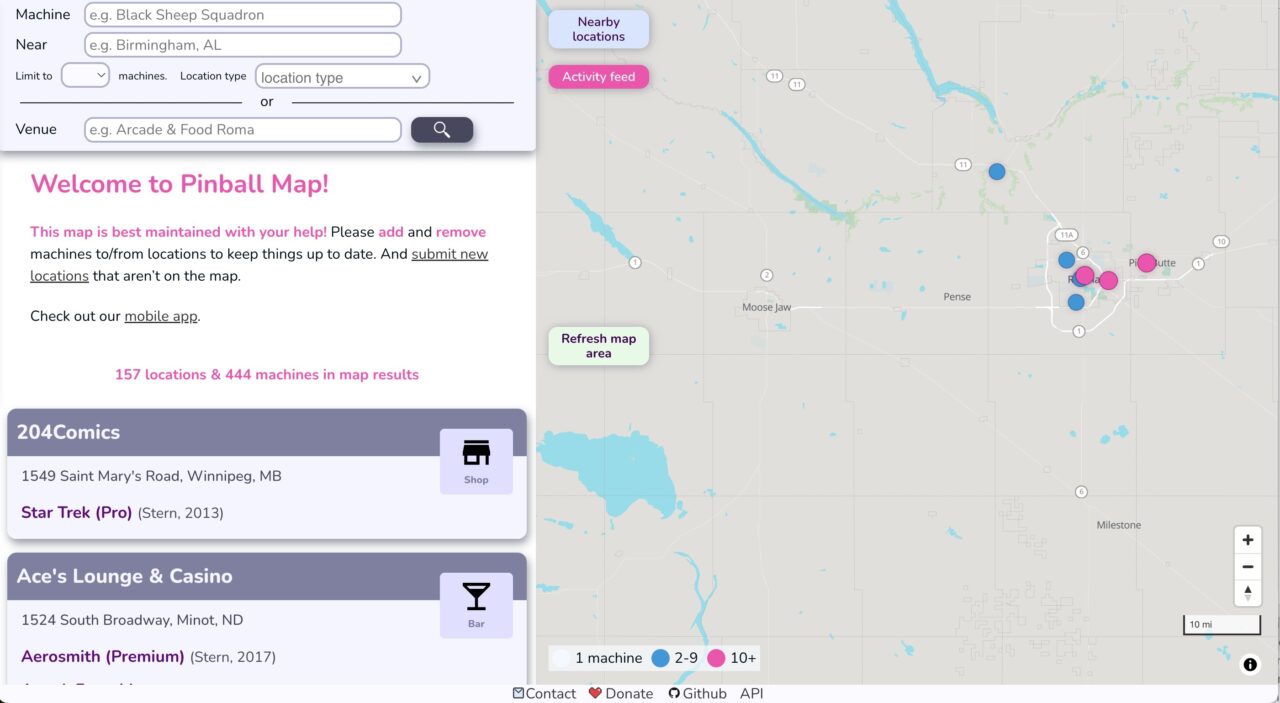
Now I know hardly enough to search for specific machines, but when I see this kind of dedication and focus to map something that is pretty specialized AND it is open source, this is shiny web gold.
I would have never even known this existed had I not gone curiosity wandering.
I Was Not Even Looking for a Golden Essay on Community Making
Well actually I was last month when I organized an Open Education Week session OEWeek Live! Open Conversation on Online Communities. Wish I had this gold fleck.
It’s like Tom Woodward’s comment to my post about RSS Readers, Currents, Streams, and Puddles, where as opposed to some folks who see unread posts as a problem:
I always saw lots of unread items as a good thing.
They weren’t 100s of obligations but 100s of opportunities for something awesome. I was always sad when I got through everything.
Tom Woodward
I have a folder in my Feed reader from a handful of sites I call them together “Neat Stuff”. Right now, I have 225 unread items, and like Tom, zero anguish. But recently in a moment of just needing some scan time… okay tis happens a lot in the middle of the night. Sometimes the dogs wake me up, sometimes its my diabetes with low or high blood sugar. But I am sitting downstairs at like 3:30am waiting, so I flip open my unread folders and scan, and something jumps out.
I won’t even draw a red box around it, but its one of the “unread” ones because I clicked on a title
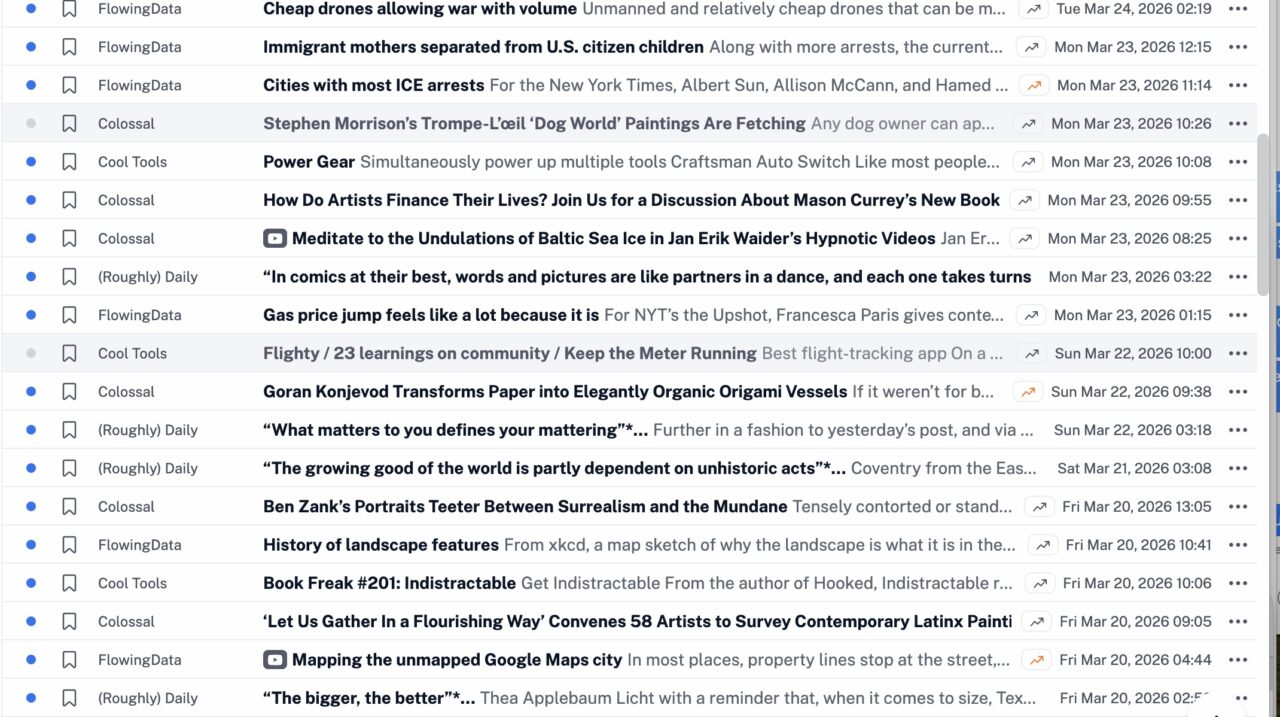
It’s from Cool Tools and the title is “Flighty / 23 learnings on community / Keep the Meter Running” — had I not been thinkling this month about community, O might have gone on by. But oh am I glad the gold speck flickered.
First of all I remembered that Cool Tools is a long long long running series of mentions of… net stuff on Kevin Kelly’s web site. It’s been around since like 1892 (Kidding). Even looking at the main site, I see today (March 31) a book cover I recognize. I have I think 2 copies of Tacopedia.
But I am distracted. The link I followed started with a review of a Flight app I was not looking for, but the second link… well I just have to quote what I read.
I am so grateful when someone who is truly adept in their field shares their learnings, and Patricia Mou’s essay is a decade’s worth of wisdom in community building and holding space. My own personal journey with community has been about repairing what went wrong in the church structures I grew up in, so I feel very lucky now to be a facilitator and spaceholder within a few small webs of community, both online and in person. This essay reaffirms that, when it’s done well, community can be both life-changing and world-changing. The learnings that resonate most for me are: You will become everyone’s mother and father whether you want to or not. / You cannot ask for transcendence from a nervous system that hasn’t yet landed. / Light structure is what makes deep emergence possible. / What your community doesn’t talk about shapes it as much as what it does. — CD
https://kk.org/cooltools/flighty-23-learnings-on-community-keep-the-meter-running/
This is the best kind of web summary. It’s not some GenAI bubbly goo, it’s got a real human’s perspective and connection, why they wrote it up (no idea who CD is I guess Kelly has writers). This is te style I have always respected about Stephen I am Retiring in A Week Downes, that he always has an opinion. I do not have to agree, but I can see why he thought the site is worth listing.
Anyhow, this post on 23 learnings on building community and holding space is actually more than a fleck or speck of gold, its a real solid nugget. I was further snagged by a good tagline “re-composting learnings from failure, utopia, and everything in between.”
And yes, like the pinball map, I have not gone deep yet, but this list, which feels like its born from a real practice and experience, is fresh and intriguing. Right there, item 1 “You are not creating a community or holding a container from nothing: you are becoming a vessel for something that already wants to exist.” I want to sit longer with this (longer than I did at 3:30am).
How would I have ever even come across it where I not scanning a long list of “neat stuff” link titles? What did this one pop out?
Whether I know or not matters little. The best gold comes when you are not even prospecting for it.
Go to the Top of the Domain, Riley
Links are most typically delete. You click, you scan, maybe you bookmark, maybe you share. Are you done?
I am not. One of the venerable lessons from Mike Caulfields 4 Moves (I forget which letter it is) is to explore the site that contains the link. Who is behind it? What else do they have? What do they link to? If you found one thing “neat” 4 directories deep, there’s likely more.
So I often peel the URLs back to see who’s house it is on.
Somewhere (forget, was it Mastodon?) I was a link to this nifty use of Wikipedia data, call it In Every Language. It displays on load a randomly chosen Wikipedia topic, and below, it shows the topics representative image from as many different language wikipedia sites it can find (did you know there were like 300 language versions). I find it an interesting study in how visual representations occur.
Like the topic Library, which shows up in 146 languages, and has many different photos representing libraries.
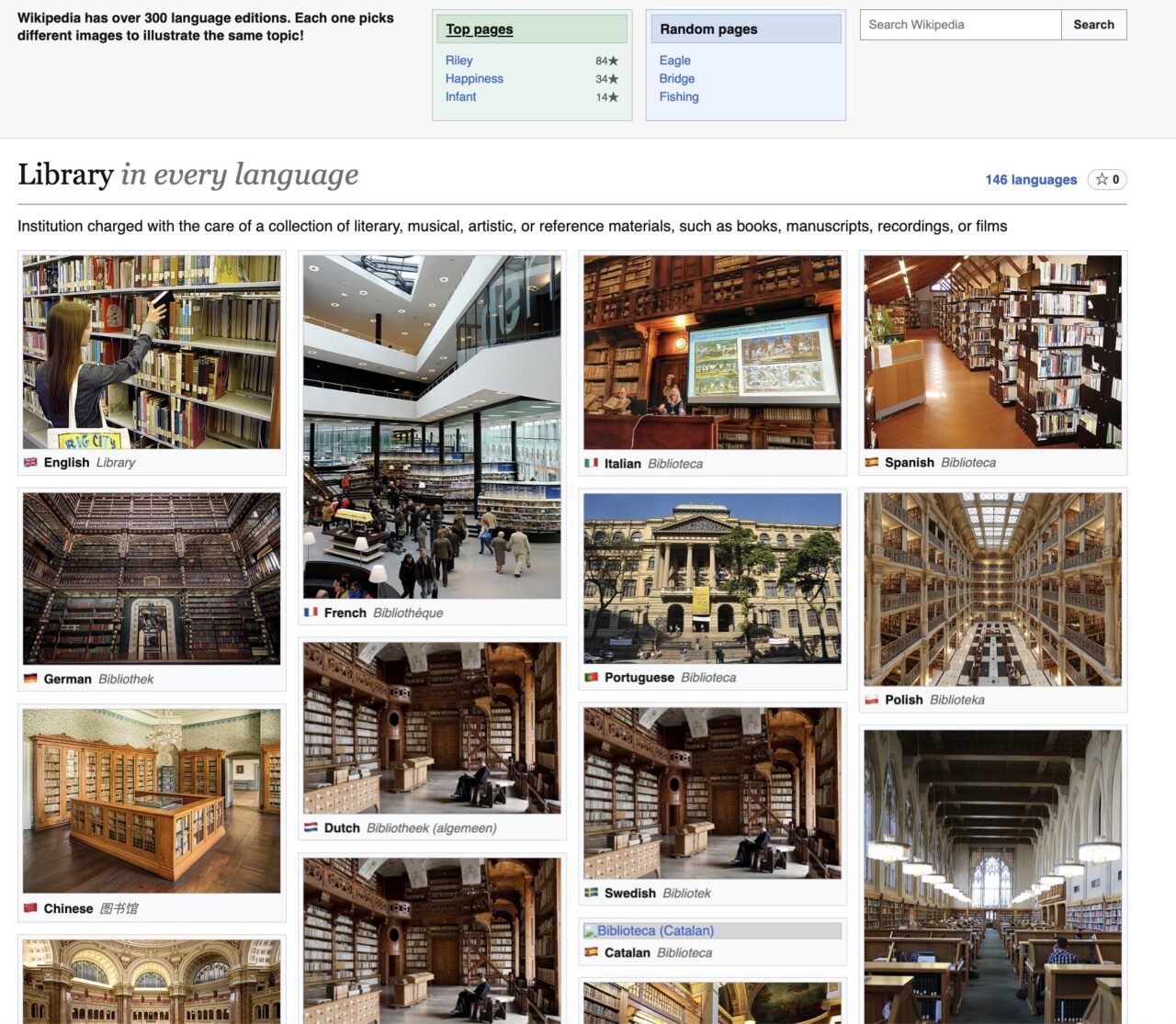
Neat, eh?
I made it one of the weekly discussion starters I put into our OEG Connect Community (so far I have zero non Alan responses, see why I need the 23 learnings on building community and holding space??). I also slipped it into a future DS106 Daily Create.
So I am looking at the URL https://walzr.com/in-every-language/ and my curiosity is… what or who is walzr.com? Hmmm there must my some way to find out.
Well walzr is… Riley Walzr, and what a neat little collection of small web style sites he made, a lot of them leveraging open APIs. There’s one to watch random YouTube videos that got uploaded with no name. Riley did that mock version of gmail that makes it just like you are reading Epstein’s inbox (that got some virality, right?). Lunches.fyi gives the menus from tech company cafeterias. Papers from Today shows the cover images of major newspapers and lets you look back at past dates.
There is all kinds of gold hanging put here, that you would never know from just following one link handed to you.
Gone Gold Panning
As long as I find these specks I am not so worried about the so called web end game. And yes, as a former Geology student, I do have actual gold panning experience (once to Bumble Bee Creek in Arizona).
Similar technique, slow, steady, sift.
Gold is in the creek.
Featured Image: Single frame of Gardner Campbell in No Digital Facelifts: Thinking the Unthinkable about Open Educational Experiences from YouTube. Superimposed on top is public domain photo from the Library of Congress Gold prospector examining a pan to see how much gold it contains. Pinos Altos, New Mexico.
 Share this barking on social media
The point about finding value in the long tail of the web really resonated with me. I’ve spent years trying to filter through the noise online before stumbling upon this book by Barney Hunter, which teaches a similar method of slow, steady sifting rather than rushing for quick results. It’s refreshing to see that approach applied both to physical gold panning and digital discovery.
Thanks for stopping by! I had to look up books by Barney Hunter, are you saying its the one about “Metal Detecting For Profit”? Hmmmm. Is this the one you are suggesting?
Regardless, the value is actually in the time slow down and focus on panning that what you get out of the tray. Mindfulness is the real prophet.