
Some obsessions are healthy. That’s what we re-assure ourselves. Thanks of course to the King of the Blog Jim Groom for posting today a photo to jump started this post.

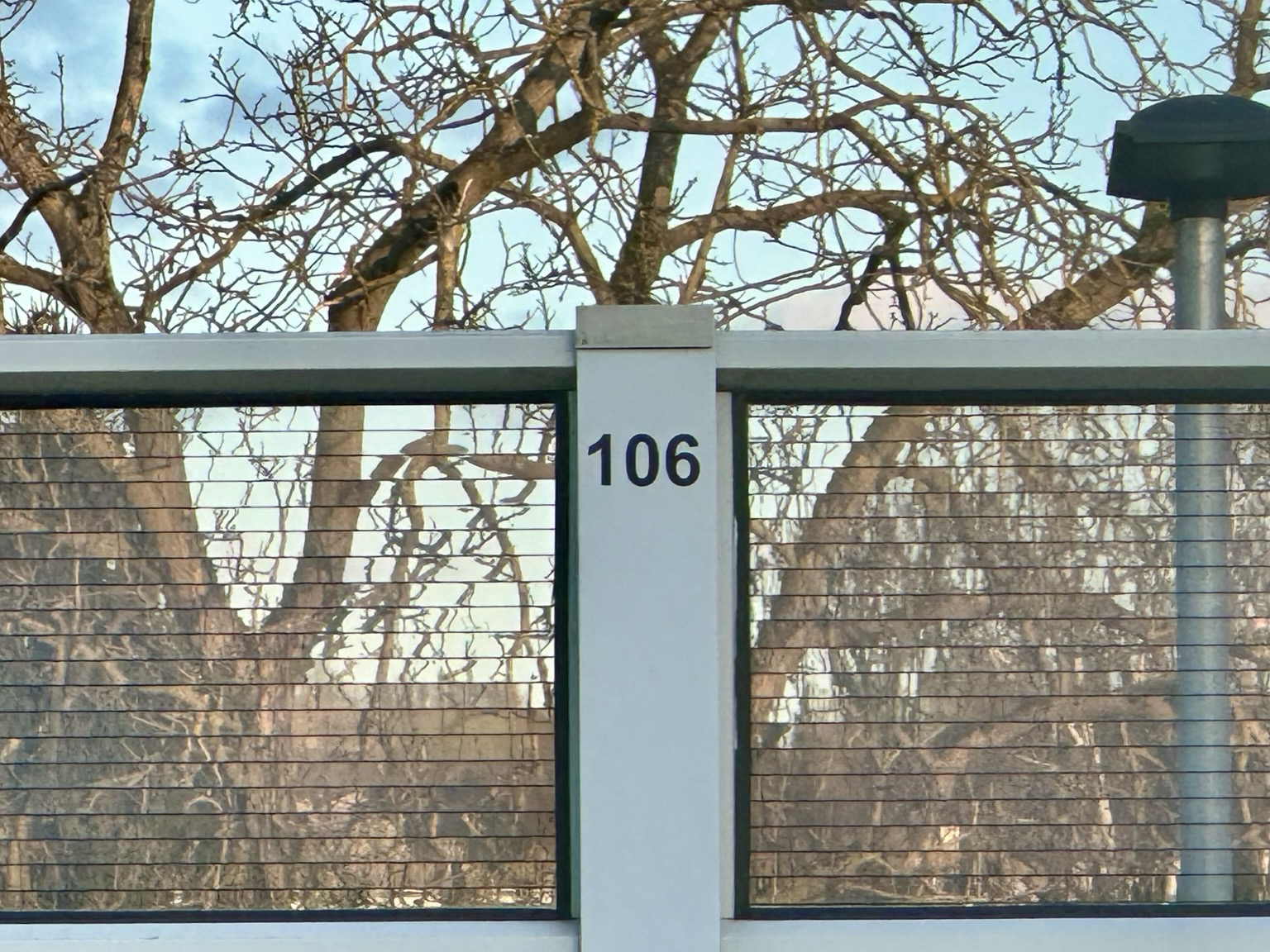
If you are confused, well, better just stay that way. But Jim shows the ds106 call sign but noting where it lives in the world.
Since 2011 I have been tuning my senses to finding the numbers 106 out in the world… 411 times says my flickr tag. Just a quick scan:
It was December 2010 this affliction started, in the incubation time of the first open version of the course Jim had taught (openly) earlier in the year at University of Mary Washington as a course named DS106 (see my take Spiraling Down Minuscule DS106 History Details). Ideas were hatched in a Skype call, Jim ran off to Italy for a vacation, Martha Burtis was building the first DS106 Assignment Bank. I am pretty sure Tom Woodward tossed out the first call to Say it Like Peanut Butter.
And for some stupid reason, I was running. Literally. I was in training for the Phoenix Rock and Roll Marathon. On December 18 I was running on a canal path in Mesa Arizona and noticed a number on trail post. I stopped. It was THE number. This is my first 106 photo, insanely edited to make it psychedelic.

And thus it became my thing to always have 106 in my mind out in the world, like a back ground whisper, and to seek all the places I could see it. Road signs. License plates. Numbers on a scale. Store labels. On clocks. Room numbers. And then go farther or weirder, arrange it out of snow or dog bones, or juniper berries. Nabbing it on an odometer. Wrangle it out of a car with two number 53s on it. Stretch it as seeing 10-6. Finding it backwards. Or clockwise. Or done wrong. Or through math.
It’s endless.
And it too made it into the assignment bank as CogDog’s Illustrate 106.
Yeah, it’s a weird obsession, but I find it’s also a fantastic incentive to spend some time noticing details in the world. Heck I already wrote this blog post before (and yes, there is some numerical discrepancies in the count, sue me)
And I am not alone! In her own episode of the Teaching in Higher Education podcastm Bonni Stachowiak talsk about her fascination with the number 208… in episode 208. I still regret the day I narrowly missed catching a 208208 on the odometer of Red Dog the truck.
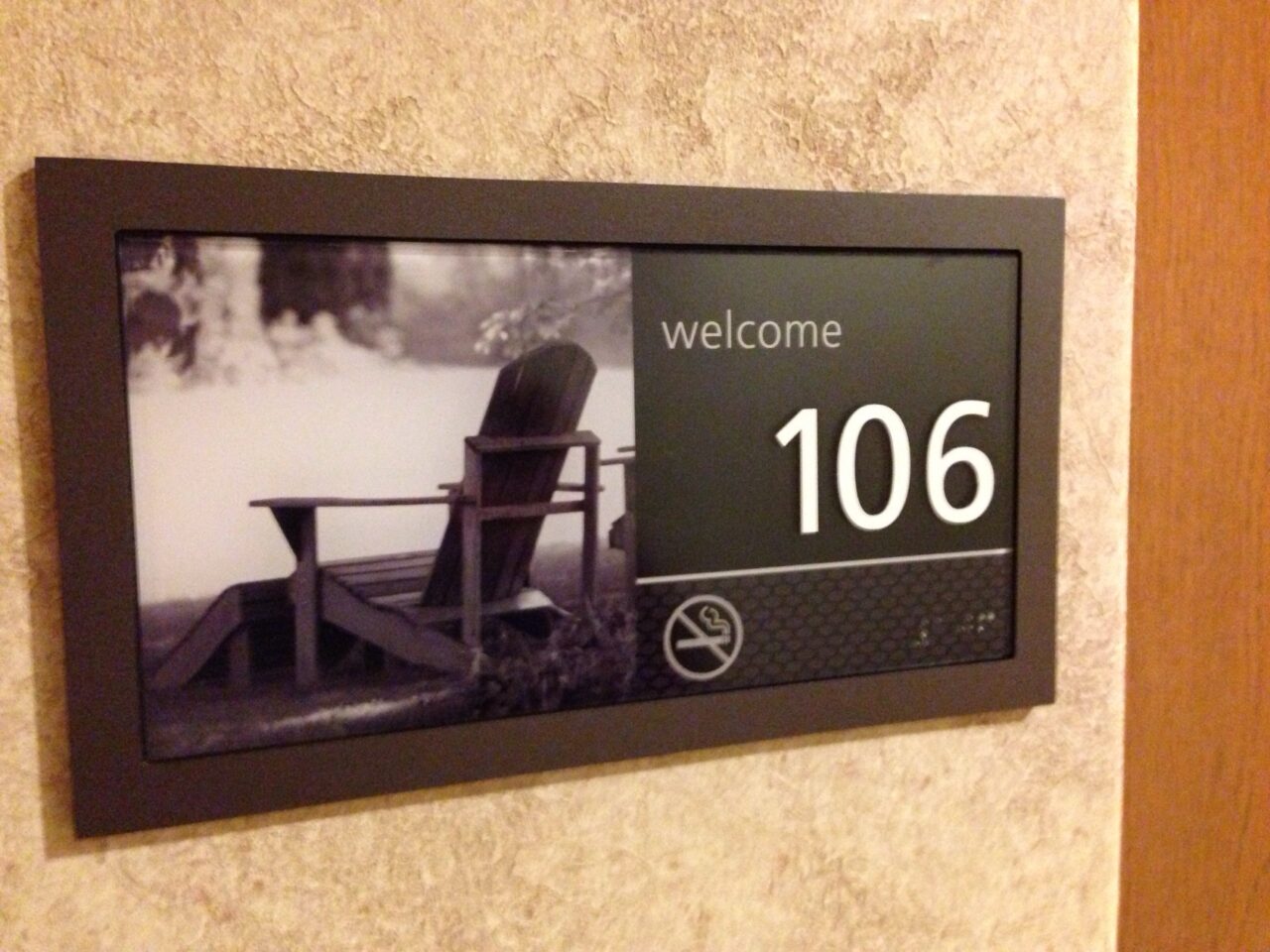
I have no real rationale way to explain it, but it means much to me, that I wont’s stop. The first 106 spotted in December 2010 is booked at the most recent one form January 17, 2026, a hotel room sign in Regina, the night Cori and I got stranded there in an ice storm.
With some help, that is a span of 5509 days or 132,216 hours or 475,977,600 seconds.
I bet I could find a 106 in there 😉
Thanks Jim, for the nudge to think about my 106 mania.
Featured Image: Room #ds106 flickr photo by cogdogblog shared under a Creative Commons (BY 2.0) license.


@barking 411 #ds106 photos is pretty darn impressive.
But, three 106s ?
My one good one!
Remote Reply
Original Comment URL
Your Profile
Why do I need to enter my profile?
This site is part of the ⁂ open social web, a network of interconnected social platforms (like Mastodon, Pixelfed, Friendica, and others). Unlike centralized social media, your account lives on a platform of your choice, and you can interact with people across different platforms.
By entering your profile, we can send you to your account where you can complete this action.
@toddconaway
This is spectacular.
@barking
Remote Reply
Original Comment URL
Your Profile
Why do I need to enter my profile?
This site is part of the ⁂ open social web, a network of interconnected social platforms (like Mastodon, Pixelfed, Friendica, and others). Unlike centralized social media, your account lives on a platform of your choice, and you can interact with people across different platforms.
By entering your profile, we can send you to your account where you can complete this action.
@bonni208 Alan is the king but I am trying. My phone has a few good ones. My favorite is my grandfather’s blue book notes from Philosophy 106 he took at UCLA in 1929. Crazy. @barking
Remote Reply
Original Comment URL
Your Profile
Why do I need to enter my profile?
This site is part of the ⁂ open social web, a network of interconnected social platforms (like Mastodon, Pixelfed, Friendica, and others). Unlike centralized social media, your account lives on a platform of your choice, and you can interact with people across different platforms.
By entering your profile, we can send you to your account where you can complete this action.
@toddconaway @barking
1929? Incredible. Thanks for sharing these.
Remote Reply
Original Comment URL
Your Profile
Why do I need to enter my profile?
This site is part of the ⁂ open social web, a network of interconnected social platforms (like Mastodon, Pixelfed, Friendica, and others). Unlike centralized social media, your account lives on a platform of your choice, and you can interact with people across different platforms.
By entering your profile, we can send you to your account where you can complete this action.
@toddconaway @bonni208 @barking All the best went to UCLA 🙂
Remote Reply
Original Comment URL
Your Profile
Why do I need to enter my profile?
This site is part of the ⁂ open social web, a network of interconnected social platforms (like Mastodon, Pixelfed, Friendica, and others). Unlike centralized social media, your account lives on a platform of your choice, and you can interact with people across different platforms.
By entering your profile, we can send you to your account where you can complete this action.
@jimgroom @bonni208 @barking these are cool.
A couple of my heroes went to UCLA. My dad and Jim Morrison. I can’t think of any other people I like who went to UCLA?
Interestingly, both my grandfather and my dad attended USC and UCLA. They both became dentists.
@toddconaway @bonni208 @barking Hmmm, there may be one person you’re missing besides Francis Ford Coppola ….
@jimgroom @bonni208 @barking no. I don’t think so. I was trying to think of famous punk rockers. Or educators. Or even just people on the internet. Couldn’t think of a single person…
@toddconaway @jimgroom @bonni208 @barking
Luckily we have Wikipedia and let it TELL us who went to UCLA ?
https://en.wikipedia.org/wiki/University_of_California,_Los_Angeles
H.R. Haldeman
John Erlichman,… BOTH graduates of UCLA ?
@toddconaway @jimgroom @bonni208 @barking
.John Williams is laureate conductor at the Boston Pops Orchestra and Academy Award-winning composer of the Star Wars film score. Actors Ben Stiller, Jack Black, Tim Robbins, James Franco, George Takei, Mayim Bialik, Sean Astin, Holland Roden, Danielle Panabaker, and Milo Ventimiglia are also UCLA alumni. Popular music artists Sara Bareilles, the Doors, Linkin Park, and Maroon 5 all attended UCLA.
@toddconaway @jimgroom @bonni208 @barking
And there's even a special category for Astronauts ??
https://en.wikipedia.org/wiki/List_of_astronauts_educated_at_the_University_of_California,…
Scroll down to UCLA when you get there.
@carpetbomberz well, @jimgroom may not be an astronaut, but he sure is a space cadet. Even if he did go to UCLA.
@bonni208 @barking
@toddconaway @bonni208 @barking You are not nice.
I didn’t realize that my reply to Todd (on Mastodon) would show up here. Must have been the @barking mention or something. At any rate, I was so relating to your post in ways most people wouldn’t understand and then saw mention of another great number (208). I see 106s and 208s everywhere. The best 106 I ever saw was when we were at a campground and our spot/lodge was 106. I hoped we would get it the next time we stayed there. Alas, we were not that fortunate.
@barking It’s the best kind of mania! The fact that you have a verifiable “it all began here” is even better. I want to print and frame that psychedelic 106 now. You definitely infected me with this affliction. For the record my 106 was at the train station outside Rust, Germany in Europepark. They are everywhere!
Also, inspiring a blog post is the highest of honors. Again, those throwaway posts often travel further than you think.
Remote Reply
Original Comment URL
Your Profile
Why do I need to enter my profile?
This site is part of the ⁂ open social web, a network of interconnected social platforms (like Mastodon, Pixelfed, Friendica, and others). Unlike centralized social media, your account lives on a platform of your choice, and you can interact with people across different platforms.
By entering your profile, we can send you to your account where you can complete this action.
I tried leaving a comment on your Mastodon post to see if that would pull in here—THE DREAM! But what happens to a dream deferred? Does it just keep on blogging? I. hope so.
Anyway, for the record, I love that you found ground zero for the 106 image mania. The whole idea of obsession over something random, like a number, rather than a word packed with all kinds of pre-conceived ideas (EDUPUNK anyone?) made all the difference, I think. The basic ideas behind ds106 were consistent, but it left all that holier than thou shit at the door. That is probably why ds106 still resonates, and even if not as many people are joining the party on the regular anymore, it was still pure in their heart—any that might be best we can hope on this internet of ours.
Anyway, NOBODY keeps the flame along like the dog. And while I would like to think I am the king of blogs, I cower when we talk blog post numbers. I am still that grasshopper look for anice blade of grass to catch-up up. Until then, I’ll be here keeping you honest.
DS106 is the purest and healthiest of obsessions! Perhaps its better that it remains at the Steve Martin like “Let’s Get Small” level. Which leads me to feel good that the Small Web / Indie Web is still a happening undercurrent to the thick industrial web sludge we see most often.
Also, your Mastodon comments came through, I forget I have to approve the first ones to open the gate.
The Bloghicans keep on, together.