
This is the time of year for bloggers to be doing their year end deep reflection recaps, tallying up the numbers of posts, comments, and meticulously charting their data trends for how many eyeballs glanced at their pages. Or its making a list of the “best”posts from the year or how many books, films, music was attended to.
And yes, this pot has done the kettle color analysis before, but not feeling it in the last drip drops of 2025.
In light of all, I am thinking about personally, how motivating that wide eyed sense of wonder/curiosity/interest at the world, be it the one outside or the one you magically fell into on the web. That sparky sense of excitement discovery, or just a mundane Neo-like deeply introspective uttering “woah.”
Maybe its just me, but as much as my first click on that app I installed from a floppy disk with the word “Mosaic” scribbled on it, I find on a regular basis that tingly sense of magic.
This was more or less the entire topic back in 2014 when I did get those junket invites to fly to a different city and spew in front of a small audience. This one came via George Siemens when he was doing the LinkLab at UT Arlington, before his star rose to the heavens of Matter Spacing ASU-GSV Importance.
I did the talk on Do You Ever Wonder Whatever Happened to Wonder? which pretty much is the same thing, but this was maybe at the time of near peak optimism for what the open web could be for education, society, the world. Before… well as Paul Harvey always said, you know the rest of the story. Ot maybe you don’t.
But in some ways it was the same thing I had always done, really one could go a long way given the fact that relatively few people had seen much of or looked deeply at the World Wide Web, me being old enough to remember when you had to include all three W words to name it. You just had to show “cool sites” or later it was “[Not So] Stupid Browser Tricks” and even more stranger:
Yet it never was about the “tricks” it was really aimed to generate some sense of excitement and ignite people to think about what might be possible, as largely there was these concerns/fears/tribulations of “Information Overload” (funny in looking up that Wikipedia link, seeing an adjacent synonym I had missed – infobesity) (what happened there just now is exactly what I am writing about, I search to find a relevant hyperlink reference, and right next to it I see stuff that lights up my curiosity).
I had long used in talks about this new web thing, a pair of flickr photos, here at least is one use from 2007 for the Being There talk at UMW Faculty Academy– you could face this overload scented unknown future with a sense of dread…

Or you could look at that same future with a wide eyed sense of… wonder.

I can admit myself, maybe some on 2025, I felt a tad bit more of the former than the latter. Just a tad.
Again, I am nostalgia whinging for the past, but I will contend, at least for myself, this can still work.
So that was the gist I stretched out longer for the 2014 talk at UT Arlington – kudos to them for preserving or forgetting to vaporize the web page for my talk and maybe (without listening) the recording on YouTube. I’d say much of the old web you can find now is there because no one remembers its there.
I framed this talk around a discovery somewhere (on the web) that an influence on Tim Berners-Lee to invite the web thing was a Victorian era book in his parents library called Enquire Within Upon Everything (still on the web as public domain). Essentially it was a world of information in a book “linked” via an index to page numbered content.
In fact a beta version of the web was something Berners-Lee created in 1980 called… Enquire.
Around 1980, approximately 10,000 people were working at CERN with different hardware, software and individual requirements. Much work was done by email and file exchange, which the scientists used to keep track of different parts of intersecting projects. Berners-Lee started to work for 6 months on 23 June 1980 at CERN, where he developed ENQUIRE as a personal organizational tool. The requirements for setting up a new system were compatibility with different networks, disk formats, data formats, and character encoding schemes, which made any attempt to transfer information between dissimilar systems, a daunting and generally impractical task. When Berners-Lee built ENQUIRE, he was not aware of the prior ideas about Memex, NLS and Project Xanadu developed by Vannevar Bush, Douglas Engelbart and Ted Nelson. Only after his work on ENQUIRE, as Berners-Lee began to refine his ideas, did the work of these predecessors help to confirm the legitimacy of his concept.
https://www.dl1.en-us.nina.az/ENQUIRE.html
The way I imagined it, young TBL in his family library exploring an old book of encyclopedia information filled him, maybe, with a sense of wonder the was idling in his spirit in the 1980s.
In another era, a book called “Enquire Within Upon Everything” embodied the best technology to organize, via a crude hypertext system, a collection of knowledge. In the hands of a young boy growing up in the 1960s, the book inspired a spirit of magic, wonder, and the vision of an open portal to the world of information. When that boy grew up, he invented the World Wide Web. Tim Berners-Lee’s original vision for the web was it “being so generally used that it became a realistic mirror of the ways in which we work and play and socialize. That was that once the state of our interactions was on line, we could then use computers to help us analyze it, make sense of what we are doing, where we individually fit in, and how we can better work together.”
As a space of both discovered and undiscovered potential, the web at this moment beckons as a seemingly infinite place where we ought to revel with that same sense of wonder. Our educational careers begin in kindergarten, where we instinctually know the value of sharing and fear not what we don’t know. Somewhere between there and graduate school, we lose track of wonder, worrying more about theft of intellectual property or questioning the value of what we do. The ecology of an Enquire Within Upon Everything open web undermines this attitude and rekindles that sense of wonder. It’s all about creating more potential serendipity. Let’s celebrate stories of what happens when educators share something openly on the web.
emphasis of my own words added by me from https://cog.dog/show/2014/09/15/wonder/
This was all very much the thread of things through all the iterations of Amazing Stories of Openness, so I accept I am pretty much a one web trick pony.
So while I nod at the concept of Dead Internet Theory and read ongoingly about the death of the web and the death of search and the death of creativity I experience something different almost every day, stuff I track as cooltech or just what I stumble upon (not the site but the expression) all the time as I read things on the web or listen to podcasts and find myself, jumping into the web rabbit hole of seeking to know more or getting my curiosity piqued from a browser extension that slips a random public domain image into every new tab.
If I was one of those meticulous note makers, I would track examples, but I have to rely on recent memory. Some are as simple as listening to a podcast where podcasters where talking about podcasts, and seeking one show out mentioned, all of that opening more doorways as I now listen regularly to Phonograph.
Or for another one of those blog posts bouncing upstairs that I hope I can wring out, I am thinking about the zealous overfocus I see people have on only seeing writuing as valuable if it gets eyeballs. It got me thinking to the audio salad days of ds106radio– I am fairly sure it was Brian Lamb or maybe Scottlo who would boast of aiming to do Radio Shows where Nobody Listened, that a high water mark was zero listeners.
It was rather humous to see Google AI summarize it so smugly as if it was there.
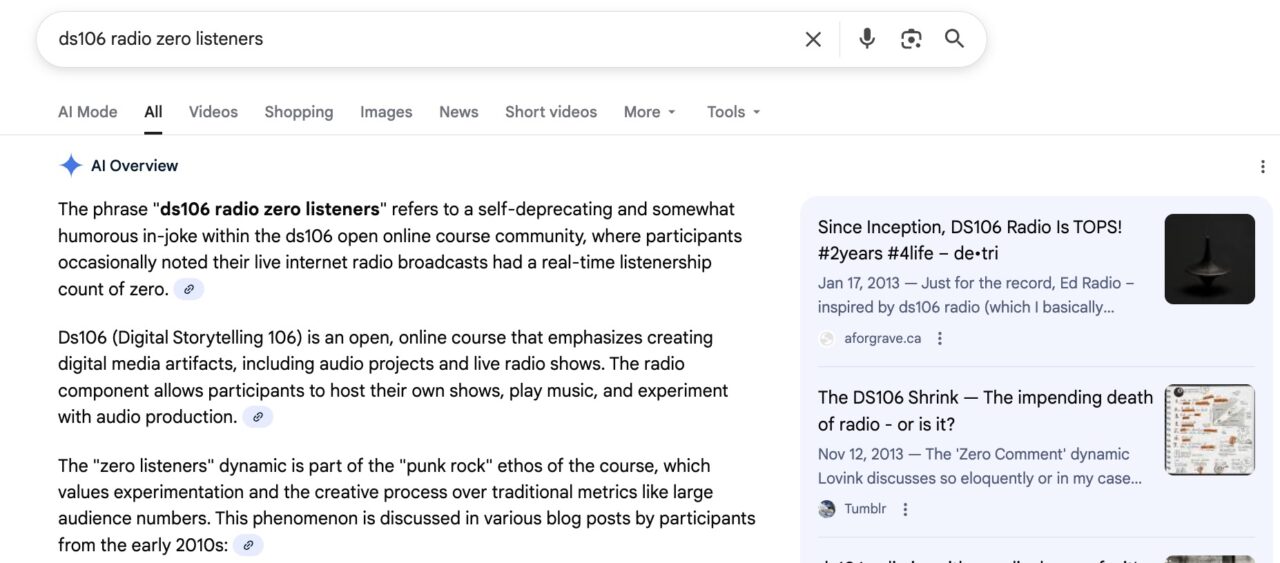
I guess there’s a reference that Stephen Downes made in a comment to a 2011 post by Jim Groom that used the “zero listener” phrase, so see, Stephen, you win.
But here is the wonder path I fell into, I got to a 2020 post by Jim about Chatting with Bryan Mathers about #ds106radio on #ds106radio. Aaron Davis left a comment with a wonder-sparking gem:
I was intrigued by the discussion of aesthetic and the need for authenticity. I have also been left thinking about the saying:
You’ve gotta dance like there’s nobody watching,
Love like you’ll never be hurt,
Sing like there’s nobody listening,
And live like it’s heaven on earth.Maybe a couple of things to add to that is:
Blog like no-one is reading
Talk on radio like there is no audience.
That saying really feels write, and Aaron even saved me the trouble of looking for the source because he hyperlinked it (and yes I wonder about whatever happened to hyperlinking but TANPFAD, That’s Another Post for Another Day).
I think I have read/heard the quote (or just remember reading Jim’s post), but the curiosity was for the author listed as “William W. Purkey” – who is he? Apparently he was an author and educator who passed away at 95 and founded something called “Invitational Education”
With profound sadness, we announce the passing of Dr. William Purkey, esteemed educator, author, and the pioneering founder of Invitational Education, at the age of 95 on 7th of April, 2024. Dr. Purkey’s innovative vision and compassionate approach to education have left an indelible mark on the field, influencing countless educators and students across the globe.
https://brocku.ca/education/2024/04/12/celebrating-the-life-and-legacy-of-dr-william-purkey/
First time I have come across “Invitational Education” — but more (one more link away)
Invitational Education is an ethical theory of professional and personal practice that influences the well-being of all who are involved in educating— students, teachers, administrators, support staff, and parents—and that intentionally seeks to create, sustain, and enhance total learning environments based on trust, respect, optimism, and care. The five assumptions of Invitational Education both focus and constrain educators to operate democratically.
https://www.invitationaleducation.org/about
Is it hooey or what I don’t know, this was not too deep an explore, but it ended up far from what I started looking for. All of this happens in the less optimal path of following my own information trails rather than having the whole process of AI collapsing “discovery, synthesis, and explanation into one interaction.”
Just one more. In one bit of thinking about the discombobulating array of communication spaces, I have an idea that its not just the implosion of one bird icon-ed platform, but the amount of time energy people put now into messaging- texting, private channels, all the slack back channel stuff. I really was looking for some data on the historical use of text messaging, and along the way found a reference to the first text message every sent.
A Smithsonian article from 2012 marks the 20th year of the first text message of Merry Christmas sent by “a software engineer named Neil Papworth”. No link there to click, but the link in my mind, like a Wikipedia red link calling, is a question, “Who is Neil Papworth?”
In about 7 seconds of typing and clicking in the Web Search Thing Which Supposedly is Dead, I get immediately to a vintage early web era site https://neilpapworth.com/ (note the url links ending in .htm)– last updated December 2012:
In 1991, I moved to Sema Group Telecoms, and it’s with them that on December 3rd, 1992, I sent the world’s first ever text message. I was part of the team developing a Short Message Service Centre (SMSC) for our customer, Vodafone UK, and was chosen to go to their Newbury site to install, integrate and test the software and get it all working. Initially the idea was for them to use it essentially as a paging service – no-one had any idea how gigantic the texting phenomenon would become.
Since mobile phones didn’t yet have keyboards, I typed the message out on a PC. It read, “Merry Christmas,” and I sent it to Richard Jarvis of Vodafone, who was enjoying his office Christmas party at the time.
https://neilpapworth.com/index.htm
I’m sure Neil did more, but he’s made a mark on history with that Merry Xmas message- look at his press page! And his FAQ clearly makes clear his contribution “Did you invent text messaging? No, I simply sent the first text message. The Short Message Service (SMS) was defined by the GSM Association. I helped develop and test the software, got it working on site, and had the honour of sending the first one to prove that it was working!”
Neil Papworth, in the right place at the right time, and gets a mark in history. I love that this little web site, nit touched since 2012 is still out there. That it can sit there as a personal representation, that it can be on the web without a need to be plastered with ads or requiring signing in with your email (harvested and sold) to read. To be “of the web”.
And sure, if the answer was all you seek, “Who was Neil Papworth” typed into ChatGPT would spit out a polished answer, but do you get as much of the man named Neil as clicking through the 5 yellow pages of his personal site?
There is a difference between having answers dispensed to you — “collapsing discovery, synthesis, and explanation into one interaction”– and forming them yourself.
One more!
Again, when I am driving around listening to podcasts, I often hear something where i say, “I have to look that up later”, not looking to “show notes” just registering in my brain as a “to do”. Last week, IU was enjoying the Mini Stories episode of 99% Invisible– the story of Gail.com needs no search or discovery, its’ easy to find. But right there, to click myself to see the whol esome of a one page 1990s web site at https://gail.com that gets, according to the story, 3 times more visitors than that popular podcast, for a grey, text only web page that is a FAQ about itself. I leave it to you to take your own trip to learn more.
But then again, there is a single node created on the web in the mid 1990s, still there, not sold or monetized, just one person’s space. With an interesting story.
This is the web that is far from dead.
Featured Image: 2016/366/150 Tiny Wonders flickr photo by cogdogblog shared into the public domain using Creative Commons Public Domain Dedication (CC0) I remember walking along a road and barely catching sight of this colored branch? Flower across a ditch. Only by crouching down and catching yte light from its back did it glow… and also earned a Flickr Explore. I almost walked right past it.



I love these exploratory wonder-filled posts, they tell me as much about your peripatetic web travels as your commitment to being part of the small, personal web that got you (and many of us) so excited to start with. Keeping the web small is no small order, but it just takes a few of us 🙂 I’ll be here even when no one is reading, listening, and/or commenting. I am like Henry Fonda in Grapes of Wrath: https://www.youtube.com/watch?v=oIflAz6OQPc
^You’ll have fun with this one 🙂
Always on the look-out for acts of wonder, and how small pockets of the web can still surprise.
Kevin
“…Only by crouching down and catching [the] light from its back did it glow…”
This post is reminding me today how only when we get down, might we be able to notice, wonder, and discern certain things. What a gorgeous photo, too.
We have these wild (not sure that’s the right word here) parrots in our neighborhood right now. I can’t identify them on the Merlin app by their sound, because I think they’re not supposed to be “from these parts.”
Anyway, I keep hoping I’ll get a good pic at some point. They sure do make a ruckus and really seem to either irritate the crows, or they’re all just having a grand old time getting loud together.