
Let’s open with the Blatantly Obvious… Podcasting is a big thing, eh? Podcastindex tracks 4,587,928 of them right now.
Yep, I have one. and doing so can make me feel like I know what I am doing. Maybe.
A lot of my thinking comes from listening to other podcasts. This has always been a DS106 descendent way of doing media, where before you start making audio, video, photos, its best to be a “consumer”, if you will, of the form. Like in the DS106 audio portions we start with listening.
And my original snarky mind was thinking of framing this as all the things I am doing wrong (noting that I pretty much have written it before), there was even a list, and worse a snarky remixed image I decided not to use.
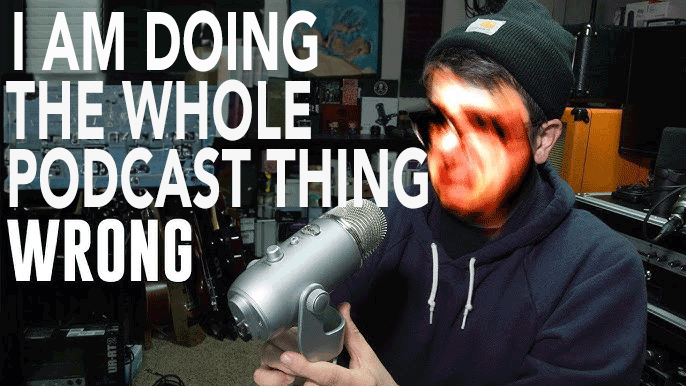
Ha ha, trying to be so clever. I harken back long ago to a conference panel at EDUCAUSE where one of the anonymous feedback messages I never forgot was:
Alan Levine thinks he is funny but he is not
I digress.
Or de-gress.
I can roll out my experience doing podcasts since the early 2000s when really it was part of my early wonder/fascination with the Power of RSS. See me try to be clever with an early workshop at Maricopa called Podcasting, Schmodcasting. I remember recording on tiny mp3 recorders, recording audio in Second Life, Skype, many years of wave form editing in Audacity, then tools like Zencastr, also hacking together publishing platforms in MovableType, in Podcast Generator, many rounds in WordPress. I have done them for my work, for clients when I did web dev. and for no real good reason except fun like the Puerto Rico Connection.
I quite love the informal conversation mode and even more, I do geek out on the audio editing. I can spot the wave form of my own Umms at 100 yards.
Still, I do not want to proclaim expertise and I am very confident I have much to improve. So here I am talking about what I have been at since 2021 for OEGlobal with the OEG Voices show running on a WordPress site I self manage (hosted by my organization) running the free version of the PowerPress plugin.
State of Editing
And indeed a game changer for me has been taking on the use of Descript for my audio editing, and I love it for how it makes the editing tied directly to the transcript (yet I am poking in often to greet those waveforms).
Yes, that’s a tool flavored/imbued with AI, but I do not use any of its generative features -well I do include in my writeup one clearly identified AI generated summary as a nod or a thumb tweak, but not for the bulk of my posts, those are all written by typo-prone me.
But a lot of folks count on the AI tools to make the task faster. My pal and geographic neighbor Dean Shareski is way more efficient than me with his podcasting.
Before using Descript a one-hour podcast recording would take me about three hours to edit, produce and publish. Descript helps remove filler words and creates clips and descriptions that now reduce the three hours to one.
https://ideasandthoughts.org/2024/10/
I was definitely doing it wrong a year ago, in fact I was doing to much fine editing to make things sound “smooth”.and in many cases making some editing mistakes that would dislodge the timing of entire track (note, use the blade tool in Descript to remove both sides of unwanted sound, avoid edits that slide things up and down in time).
So a big improvement where Descript offers a “remove filler words” for me that has worked well is not to have them deleted, but use the option to remove them from the transcript. Leave the human “umms” and “ohhs” in the sound (unless it very much detracted from the point), but take out of the transcript to make it more readable.
I might be closer to Dean time level. A few things that add are that I like to make custom images for each episode, and I also spend a lot of time looking up link references. And let’s talk about how the magical automatic transcript mangles place and people names (especially for non-English names and places), and all the variations it manages to transcript when people say OER (my favorite is “oh we are”).
But I find something magical or just insightful about that second pass in close re-listening more closely while editing the script, stopping to look up those web links or terms/place/projects mentioned.
Time to Hearing Guest’s Voice
I have listened to some podcasts (not naming names) where there is so much in the beginning, the ads (one show started with a pair I was not even sure I was listening to the right thing, and then they were repeated three more times), plus the host asking for folks to follow/subscribe/patreon, or the announcements of their new book or show dates. I clocked a few that were maybe 6 minutes in before it got to the guest.
TTGV is my acronym for how much Time To Guest’s Voice.
I got that to zero (well sort of) really inspired by Tech Won’t Save Us hosted by Paris Marx. That show opens with a quote from the quest as a highlight, so the very first things you here is something to entice you to stay listening.
This resulted in me…
Trashing My Oh So Clever Intro
I was always inspired by the opening to the original podcast of Serial that featured the multivoice ad from Mailchimp. So when I started the OEG Voices show, I wrote a simple script, and asked my colleagues and eventually guests and anyone else I could nag to send an audio recording.
And heck I even built a simple HTML web site where you could not only generate a mix but for me, generated a command line script I could use to cobble together into a single audio.

Loved doing it and fiddling withe mix tool (even made a generic forkable version), but after hearing the guest quote as opener from Tech Wont Save Us, I dropped this completely.
Moving the Intro Out of The Studio and Maybe a Third Voice
While I said I do not read intros, I do write them as a rough guide for me starting and ending the show. I have been looking at that and thinking that its time my guests do not need to sit there while I blab. I am considering do them in post. I do not want them to sound canned, but after editing I can probably do a better job of setting up and closing the show after the recording.
Still pondering this before my next recording this month.
But again, from listening to show, I noticed in the Communities of Practice podcast by the incredibly listenable and human on the ears Brenna Clark Gray (“Doozer” follow the link) that she sometimes interjects with what feels like a parenthetical or maybe a way to emphasize a key section. I heard it once or twice and is definitely a post recording move to break in and say something to signify the importance of what happens next.
I am not sure I really want to do that, but its just a simmering thought.
I’m a One Dog Show
Many podcast shows have staff– producers, editors, publicists. Or for some, it is their vocation, so they are then needing to find ways to cover expenses, or rent, or food. That’s where one ends up needing ads and paid supporters.
And I am not here to criticize those choices. I am fortunate that I have over my years managed to wangle podcasting into part of my regular job, its something I do in that role or slightly off to the side. It’s in many ways a luxury to have that, but it does free me from having to infuse things like ads, and sponsors. On the other hand, the recording, editing, publishing land on me to do it all– but I think I like it that way.
I do not claim to have a professionally edited and produced show, it’s a bit of a amateur level production- the level I prefer to be at.
Never The Same Theme Song
General wisdom is a show should have a recognizable theme song. Heck it would not be Terry Greene’s Gettin’ Air without the rocking sound of Gettin’ Air by Chixdiggit. It’s the brand, right?
I went off track here too. Given that my subject is Open Educators, I choose a different song each episode from the Free Music Archive (FMA) because those tracks are Creative Commons Licensed and the product of independent musicians. Yes, there is some extra time to search and pick a song, but to me part of that is thinking about the guest and the topic. That is not efficient, but I am not budging yet on doing it.
And in fact I got us setup with the FMA to build a playlist of all the tracks I have used for the show (59 so far), If I had infinite time, I dreamed of doing a parallel podcast one each song and why I chose it. I do not envision this ever happening, but one can dream.
I Am Not Important
I wonder too if I should be doing some analysis as to what percentage of the conversation time is me. I do notice in a number of podcasts, that hosts do something like that Conference Guy Who Stands Up at Q&A But Spouts More Than a Question.
Well maybe that is not severe. But I recognize that I can get caught up in conversations where I feel a tendency to interject my own experiences or ideas.
It stuck out for my once in a podcast show I cant recall but Chris Gilliard was a “guest”. Chris is one of the most amazing, powerful, and delightful voices to hear. But the host was so revved up on giving his thoughts that he was almost monopolizing the air. I tuned in to hear Chris. I remember pounding the dashboard of my truck (I mostly listen to podcasts while driving) screaming “LET CHRIS SPEAK! LET CHRIS SPEAK!”
There are shows where the host is so good that I don’t mind to them talking a lot- thinking of Mark Hurst who does the fabulous Techtonic podcast. He’s a radio person and has that ability to be very listenable.
But if my podcasts are about the voices of the guests I am trying to pay more attention to making sure Alan is not yakking too much.
This is where again I reach back to the memories of Kathy Sierra who was blogging long ago on presentations, but this applies in so many ways. In Presentation Skills Considered Harmful she emphasized crafting a presentation as a user experience for the audience.
When you design for a user experience, you quit focusing on your skills and start focusing on their skills. What experience can you help them have? Can you give them a more powerful perspective? Can you give them a new idea with immediate implementation steps they can’t wait to work on? Can you give them a clear way to finally explain something to others that they’ve been feeling but could not articulate? Can you give them a new tip or trick that has such a high-payoff it feels like a superpower? Can you give them knowledge and insight into a tough topic, so they can have more interesting, high-resolution conversations in the hallway?
And now we’re truly at the heart of what matters most in a presentation. Look at the previous paragraph of experiences you can help them have. What’s the common thread? It’s not really about the user experience they have during your presentation. Like your presentation, their experience of it is also just the enabler for something bigger. Because what matters most is NOT the UX but the POST-UX UX. What happens after and as a result of the user experience? The best software and product designers know this. The best game designers know this. The best authors know this. The best filmmakers know this. What happens after what happens happens?
When they walk away from the user experience, then what? Are they different? Are they a little smarter? Are they a little more energized? Are they a little more capable? Are they a little more likely to talk to others about it?
https://web.archive.org/web/20150217030423/http://seriouspony.com/blog/2013/10/4/presentation-skills-considered-harmful
Indeed for a podcast I very much want to set up something to create a sense for a listener of “What happens after what happens happens?”
I Must Be Doing This “Right” Because…
I though spam seeking links in blogs or pre-fab content was bad enough, but over the last months I get a non stop stream of email from agents suggesting guests and pitching podcast analytics services offering the equivalent of podcast SEO. Here’s a fun one:
Hey there Laura,spam email
I wanted to introduce you to ***** ****, who I believe would be a great fit as a guest on OEGlobal Voices.
***** is a former educator who who co-founded **** with one goal in mind: help schools better understand and support every student. **** was built by educators to support educators. One of the ways they’re doing that is by analyzing attendance patterns and connecting them to academic performance. It’s giving teachers and administrators early warning signs so they can intervene before students fall too far behind.I think the combination of *****'s educator background and his work with **** would position him nicely for an interview.
Let me know what you think about booking **** ****? Appreciate your consideration!
Best regards,
****** *********
I was charmed at the “Dear Laura” greeting until I figured out that was the name of one of my most recent guests. Not to mention that ***** really has no connection to Open Education.
Yeah success is getting spammed.
I have no assurance I am doing podcast wrong, right, or even “goodly”, I am just trying, and continually tinkering.
And its damn fun.
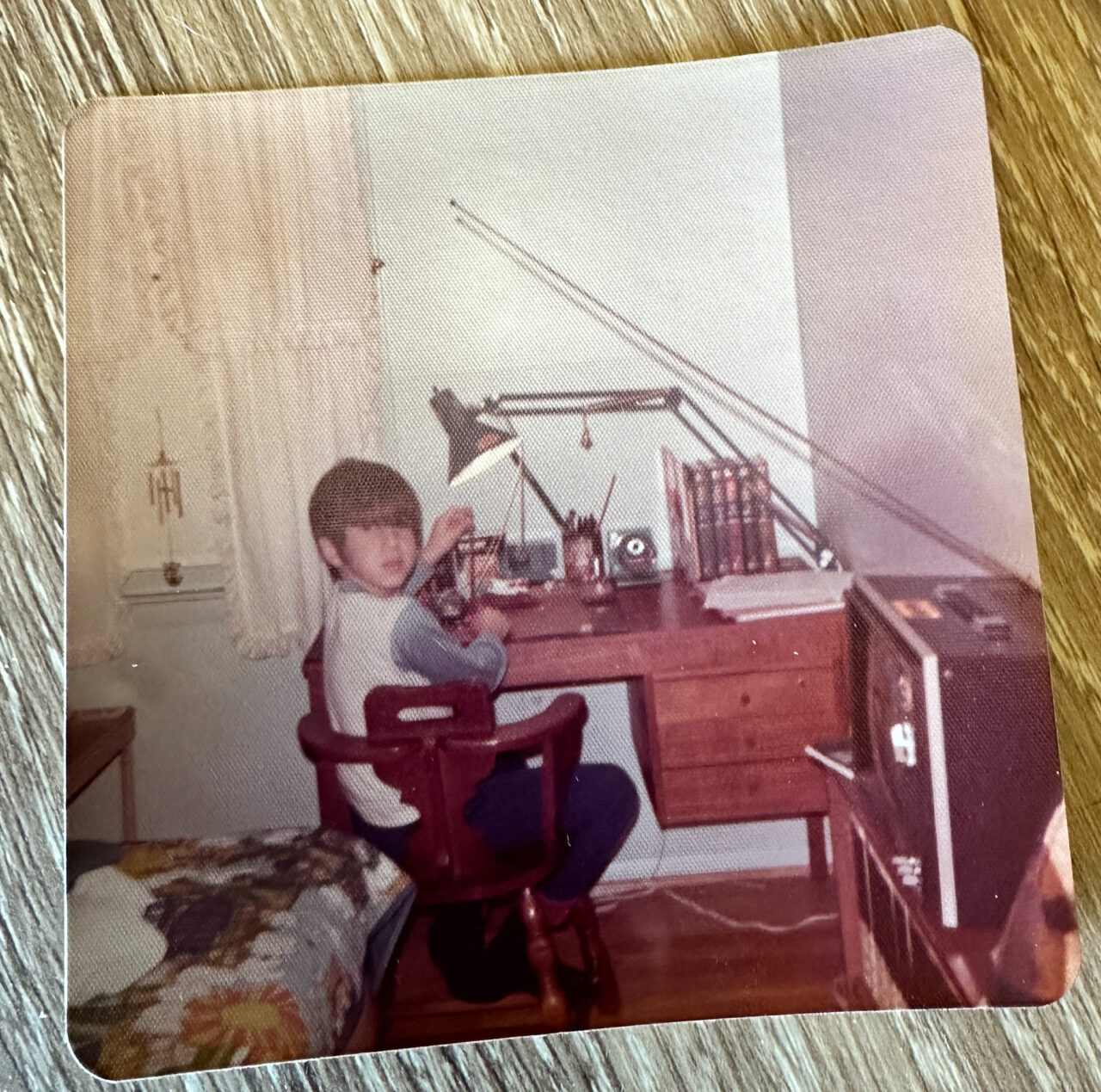
Featured Image: Me tinkering back in maybe 1971. Me Tinkering flickr photo by cogdogblog shared into the public domain using Creative Commons Public Domain Dedication (CC0)
 Share this barking on social media