
I’m here for the first check mark for my effort of counter Tsundoku or reducing that pile on unfinished books. This is hardly a book report or detailed analysis, really I could just say, I’m done” and move on to the next.
As an eager web fan boy, I put my order in for Tim Berner-Lee’s book This is for Everyone. Given the web has been the arc of my career, and ow much I enjoy back stories and “the making of” style of writing, I had high hopes to learn more into how the web came to be, and the thinkings of the man who made it happen.
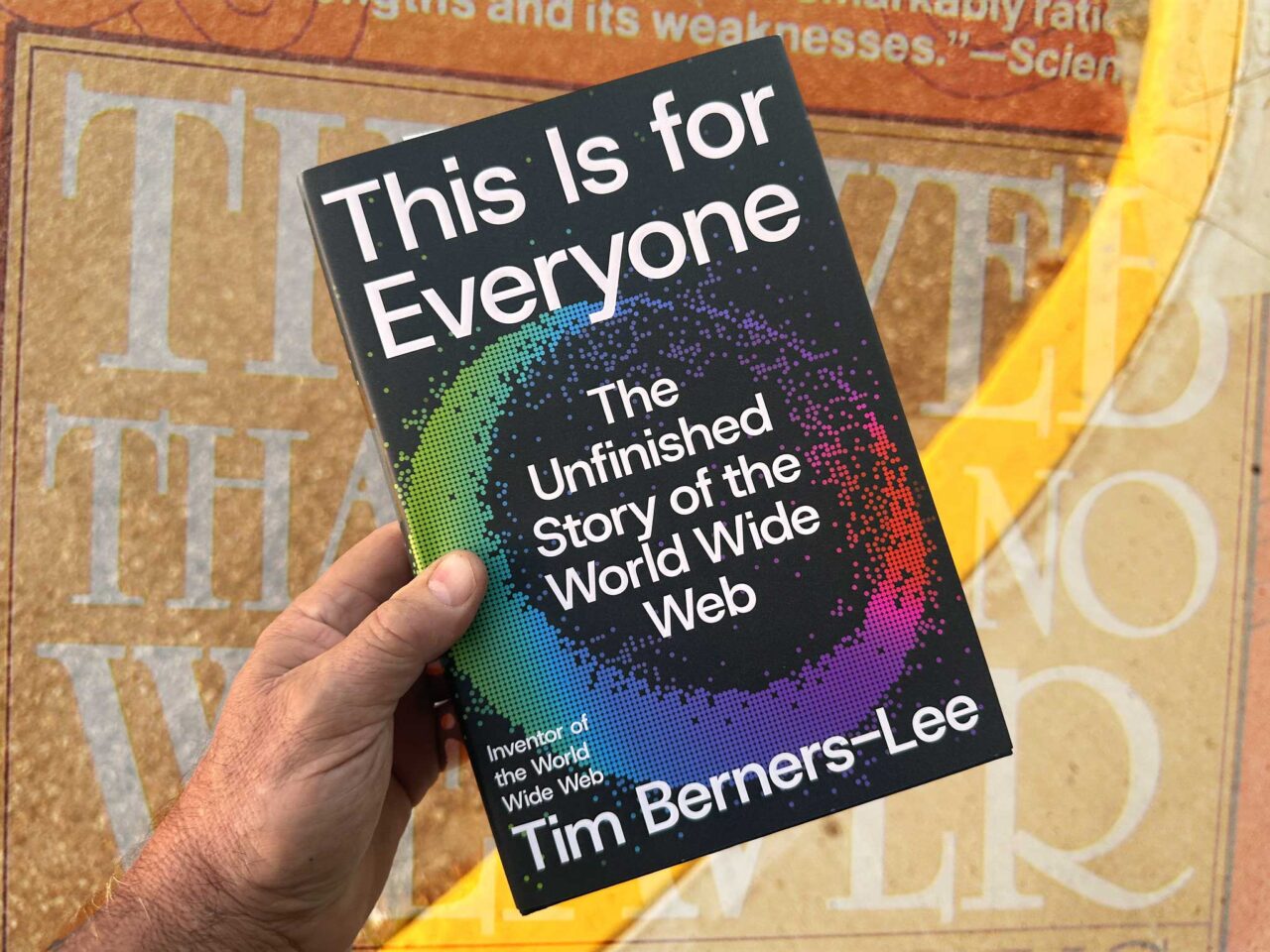
That photo of the book in my hand was outside the Indigo store in Regina where I picked it up September 24, 2025, and four days later I was in.

Who the *#&#$ am I to be a critic, especially of a knighted hero? I should stop now. But I got to the last page feeling a little less lifted but also just feeling a bit less filled on the story. This I phrase my post with the promise that called to me in the early 1990s and I can still hear its echos, that the Web IS for Everyone, yet in 2026, it has a taste of WAS.
It’s not inevitable. Right?
I got some important facts and some insights, the influence of TBL’s parents, the CERN environment, the sheer power of the humble hyperlinks, the reach and growth of the web over time, but I found many parts of the history written more in a string of events in the neutral tone of a Wikipedia article (the story of the rise of Yahoo, Google, the infighting of the “browser wars”).
One part that stayed with me was TBL’s description of how distributed the research at CERN was, with different projects all using custom document systems. But a key description I read was how he found there the place to get answers from CERn folks was… a place tey gathered for coffee.
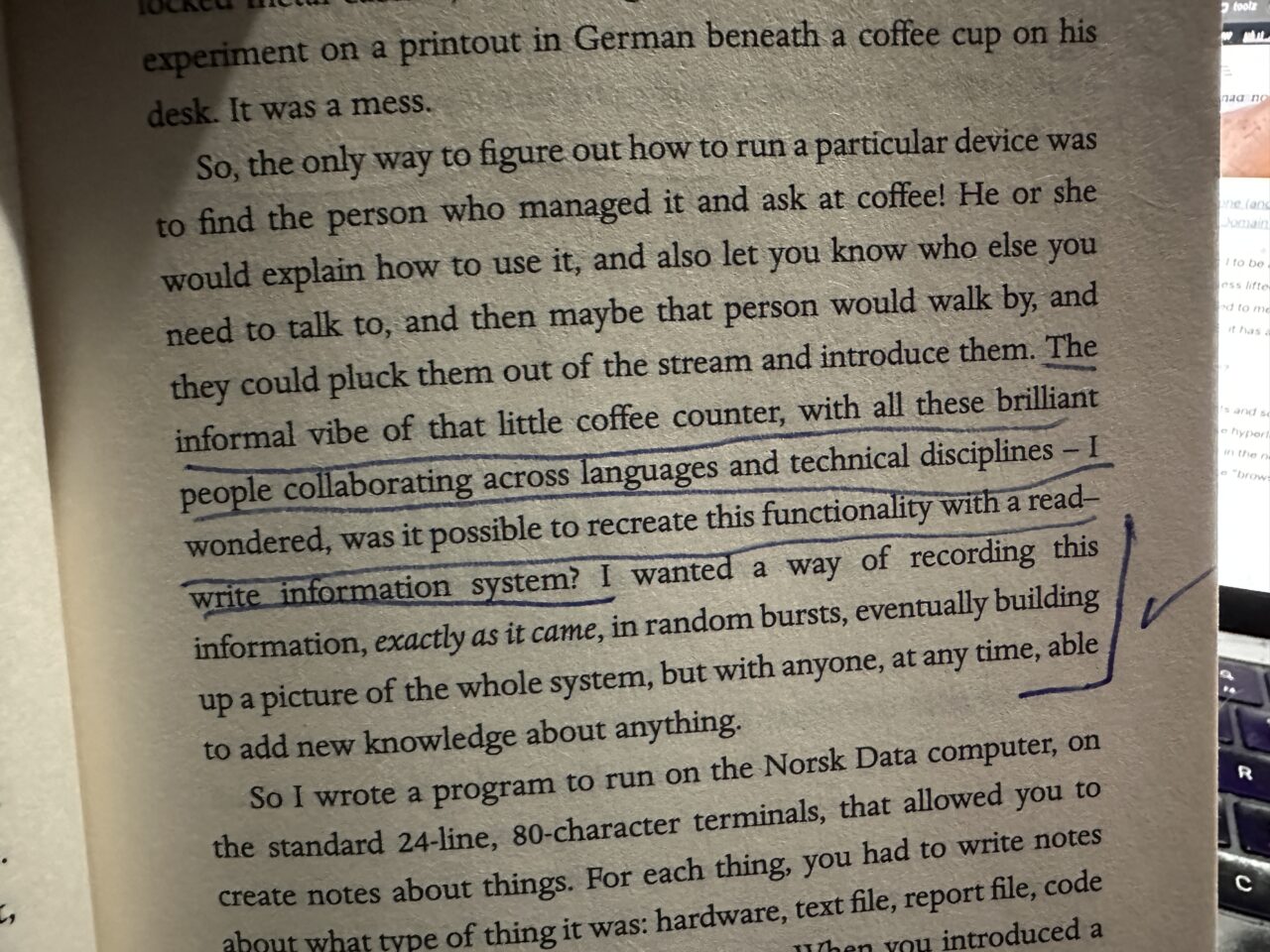
I think TBL does elevate this as maybe a metaphor or aspect of the web he designed, there is a social or at least a human connection element at play here. For some reason, this is something that really stands out in my reading.
The author writes the history summary of hypertext, acknowledging of course Vannevar Bush’s As We May Think, Ted Nelson and Xanadu, Doug Engelbart and the Mother of All Demos, Bill Atkinson’s creation of HyperCard for Apple, and I guess it is interest when he follows with an admission that it is a “potted history”:
So there is your potted history of hypertext – except at the time I was almost totally unaware of these developments! When I was conceptualizing the web as an information-wrangling tool, I had never heard of Ted Nelson nor Douglas Engelbart, and I had never used HyperCard.
TBL shares that he got “connected” to hypertext via a colleague who shared with him Transactions on Computer Systems 1998 issue titled “Hypertext on Hypertext”- rather ground breaking that it was distributed with a floppy disk of executable demos if hypertext.
With some digging I found this issue in the ACM archives and with more digging a short demo of the interactive part of Hypertext on Hypertext. See more stuff from this issue for the very curious in Hypertext Research: The Development of HyperTIES (Ben Shneiderman and Catherine Plaisant)
I had really high hopes to read about a story I latched on a while ago, how as a boy, young TBL discovered in his parent’s library, a Victorian book of practical information called Enquire Within Upon Everything (Project Gutenberg link). I found a quote of a quote that I believe came from his earlier book Weaving the Web (likely more of the story I expected here) where the original web weaver wrote:
With its title of suggestive magic, the book served as a portal to a world of information, everything from how to remove clothing stains to tips on investing money.
Tim Berners-Lee
Yes, but the inspirational bit I hoped to hear more of was how Enquire Within Upon Everything was organized- from the Editor’s Preface
Like a house, every paragraph in “Enquire Within” has its number,—and the Index is the Directory which will explain what Facts, Hints, and Instructions inhabit that number.
For, if it be not a misnomer, we are prompted to say that “Enquire Within” is peopled with hundreds of ladies and gentlemen, who have approved of the plan of the work, and contributed something to its store of useful information. There they are, waiting to be questioned, and ready to reply. Within each page some one lives to answer for the correctness of the information imparted, just as certainly as where, in the window of a dwelling, you see a paper directing you to “Enquire Within,” some one is there to answer you.
….
Well! there they live—always at home. Knock at their doors—Enquire Within. No Fees to Pay!!
https://www.gutenberg.org/files/10766/10766-h/10766-h.htm#section2
This was significant when I read this in 2014 or so. The book was essentially a nexus of information you find via the old school style of hyperlink, “to learn more go to page 446” But on re-reading this now, the phrasing that the knowledge sections were like homes with addresses that were managed/maintained by individuals.
TBL mentions it in his first chapter, amongst the descriptions of his parents who were both academics immersed in the first age of computers, colleagues of Alan Turing. The mention of this book that I thought was pivotal is one sparse sentence:
Also on the shelves, as would later prove relevant, was a fussy Victorian manual of practical household tasks, entitled Enquire Within Upon Everything
Later in the description of his first effort to connect disparate information at CERN just that he named the program Enquire Within “short for Enquire within Upon Everything, that book in my parents’ bookcase.”
So here I am reading this book, and how much TBL talks about the powerful concept of hyperlinks to connect disparate information, yet… there are almost no links even as URLs in the book. I do not find one until page 345, and really not necessarily anything more important than the rest of the text (plus the URL is one I would never expect a human to enter in the browser).
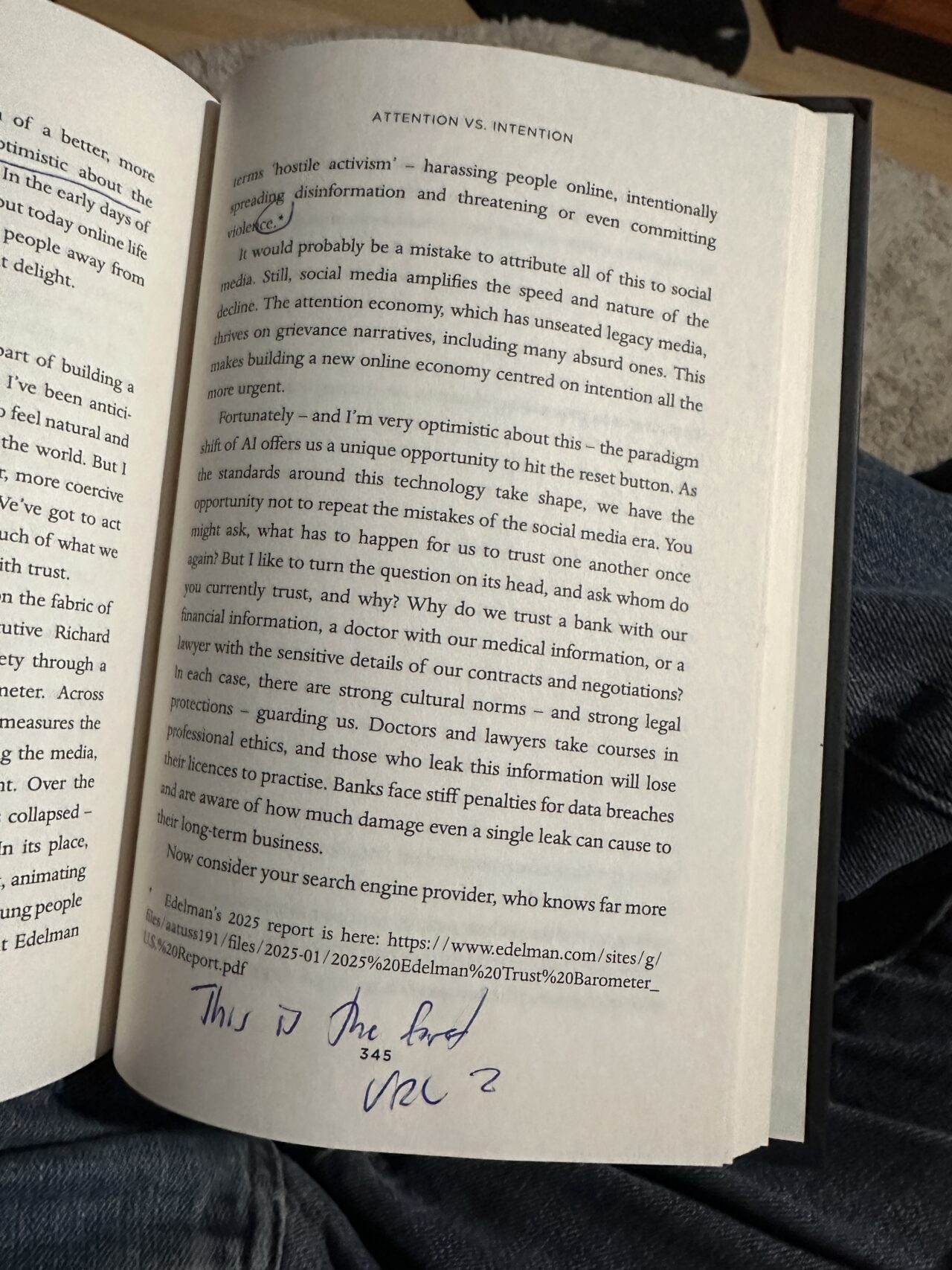
Somewhere in the book TBL describes his long series of writings on the w3c.org web site as Design Issues for the Web I believe suggesting it his writings for 35 years in the same place, maybe the first blog. Oh and I am wrong above, here o page 273 is a URL https://www.w3.org/DesignIssues/ I had never come across this body of writing before.
So perhaps it is my own personal over expansion of that old Enquire Within Upin Everything, that maybe set up up to expect a book about the web to be a bit more like the web. It’s no different from a lot of reading now, where writing with hyperlinks seems a dying art, why should I not expect anything other than Just looking Stuff Up as I read. I thought maybe as an appendix there might be some key links, but alas no.
Maybe that’s more on the lap of the publisher.
And really what the focus of the book is really un the subtitle, the “unfinished story” of the web. I am absolutely in awe of the tiring travel, speaking, organizing TBL has devoted his life for. He has more faith than I right now on how AI is going to play that web out, he’s hopeful for more open and web caring systems that do not seem to be the one dominating right now. I smiled a bit as his idea of AI being a friendly assistant who helps us with mundane tasks, and indeed TBL calls his “Charlie” (another dude like Claude?).
It’s good to see in the closing pages a strong support for the fediverse and Mastodon. That’s quite something for a TBL endorsement.
He’s also hoping a lot more folks will take up Solid, the idea of us maintaining and controlling or data in safe “pods”. It sounds ideal, and TBL is hopeful the early adopters can lift it like the first of us (that was me) you sat down and created stuff with HTML. The comparison seems a larger leap to me. But I ought to do more and take a peek.
I will say throughout This is for Everyone that TBL expresses his dream of open access to the web he spawned and one that empowers individuals, not corporations. That it still has the spirit of that CERN coffee room (at a global scale) and even as the book of wonders I construed Enquire Within to be.
I had known for a while that something was wrong with the web.
What was intended to be a tool for creativity and collaboration had become divisive, polarizing and toxic. I had often talked publicly of the two Cs of the web: creativity and collaboration. After 2016, I began to talk of a third C: compassion. I was greatly concerned that the human element of the web was beginning to disappear. In its place we had large, faceless systems which spied on and manipulated the user.
opening to Chapter 13, Design Issues, of This is For Everyone
And it has always felt to me, from my first hypertext click in 1992 that This Was for Everyone. Let’s see about seeing it live longer as an IS. For us, and for what has been an amazing journey from the tunnels of particle collider to here.
Featured Image: 2025/365/267 This is For Me! flickr photo by cogdogblog shared into the public domain using Creative Commons Public Domain Dedication (CC0) superimposed atop Which Web Might This Be? flickr photo by cogdogblog shared into the public domain using Creative Commons Public Domain Dedication (CC0)
 Share this barking on social media
@barking really interesting and personal and, even if self-deprecating, honest .. also, thank you for saving me the time of wading into it .. i have considered it a couple of times, and now i feel secure with you having done the lifting for me 🙂 .. keep writing reviews!
Remote Reply
Original Comment URL
Your Profile
Why do I need to enter my profile?
This site is part of the ⁂ open social web, a network of interconnected social platforms (like Mastodon, Pixelfed, Friendica, and others). Unlike centralized social media, your account lives on a platform of your choice, and you can interact with people across different platforms.
By entering your profile, we can send you to your account where you can complete this action.
Hi Pete! Is “interesting and personal and, even if self-deprecating” me or the book?!! Maybe dont expect alot from my opinion I barely finish books.
Great read! I really enjoyed the perspective you shared here.
It’s always refreshing to find content that is both informative and well-written.
Thanks for sharing! Feel free to check out my thoughts over at
sukslan.blogspot.com as well. Keep it up!