
This year marks my 55th year living with Type 1 diabetes (I can think of at least one interested reader on this topic). It’s always something to address every several times a day, I am lucky to have gotten this far, always offering thanks to Drs Banting and Best.
The “technology” of diabetes care when I was diagnosed in 1970 included daily injections of insulin extracted from slaughtered pigs and cows plus testing of sugar in urine with Clinitest tablets (just learning though search that this method was developed by Jonas Kamlet in the early 1940s).
Pump 1 Medtronic MiniMed (2006)
For most of my adult life I got away with, beyond remembering my insulin shots and always carrying candy, almost barely acting diabetic, until in my mid 30s when an optometrist spotted signs of diabetic retinopathy a wake up call to me to at least start using a blood sugar glucose monitor. Still, it was not until 2006 that I stepped into wearing an insulin pump, a Medtronic Mini-Med.

My timing was lucky to get the pump in winter of 2006, fully covered under the medical insurance for my job at the Maricopa Community Colleges. When I replaced it in 2015, being self employed but lucky to have the ACA coverage, I still had to pay $900 as my share. So there were technically 2 pumps in this era. Who’s counting?
The combinations of an insulin pump for regular delivery and being able to get precise blood sugars with blood testing was definitely an improvement. I relied much on physical activity like bike riding. The measure of care is the A1c test which gives an overall three month average of sugar levels. I managed mid 7s which is okay. My nemesis is my food control, I love food, not sweets, but just good amounts of regular food.
I fared better the years I took up running half marathons, getting A1Cs into the 6s, but as the blog url says, I Hate Running. Another notch of improvement in 2016 was adopting Felix, and starting a regular routine of dog walks, the biggest data point being dropping 2 inches in jeans waist size.
Pump 2: OmniPod (2019)
That tubing from the pump in my pocket to insertion spots in my abdomen were an ongoing issue when it got snagged by draw pulls or brnaches when hiking, often ripping the infusion set off. So after moving to Canada in 2018 and being eligible for Canadian health when I got permanent residency status, I was able to go “tubeless” with the Omnipod, which felt freer for a long time.

Along with this i started using a continuous glucose monitor (CGM), the FreeStyle Libre which includes wearing another sensor patch– but rather then getting spot checks on my sugar levels, it gathers data all the time, and easily monitored via a mobile phone app. It also can warn me of extreme highs or lows, especially the night time ones that can be confusing.
Yes, there’s much to be said as the cost of the OmniPod was completely covered by provincial health care (supplies are covered at 20% co-pay)
While free of the snagging of tubes, I did manage often to lose a pod not paying attaention to walking through doorways or vigorous towelling off. I was surprised to find out if called in, OmniPod would replace even the ones I managed to knock off myself. The other downside was that the storage capacity in a pod was only 200units of insulin, which on its own was maybe 2 days max. I tried to stretch my taking my bolus doses (what is needed at meal time) by syringe, and left it to the pump for all the background doses.
Beyond the covering of the pump costs, health care coverage in Saskatchewan also includes quarterly doctor visits and regular support from diabetes educators. My A1cs were still fair, in the low 7s.
Still with all this I saw regular spikes hight and low drops, sometimes where I ovetreated lows with too much sugar or over-treating highs with too much insulin, aka the Diabetes Rollercoaster. Even if I maintain average represented by a decent A1c this was often in the balance of highs and lows.
Pump 3: The Tandem t:slim (2025)
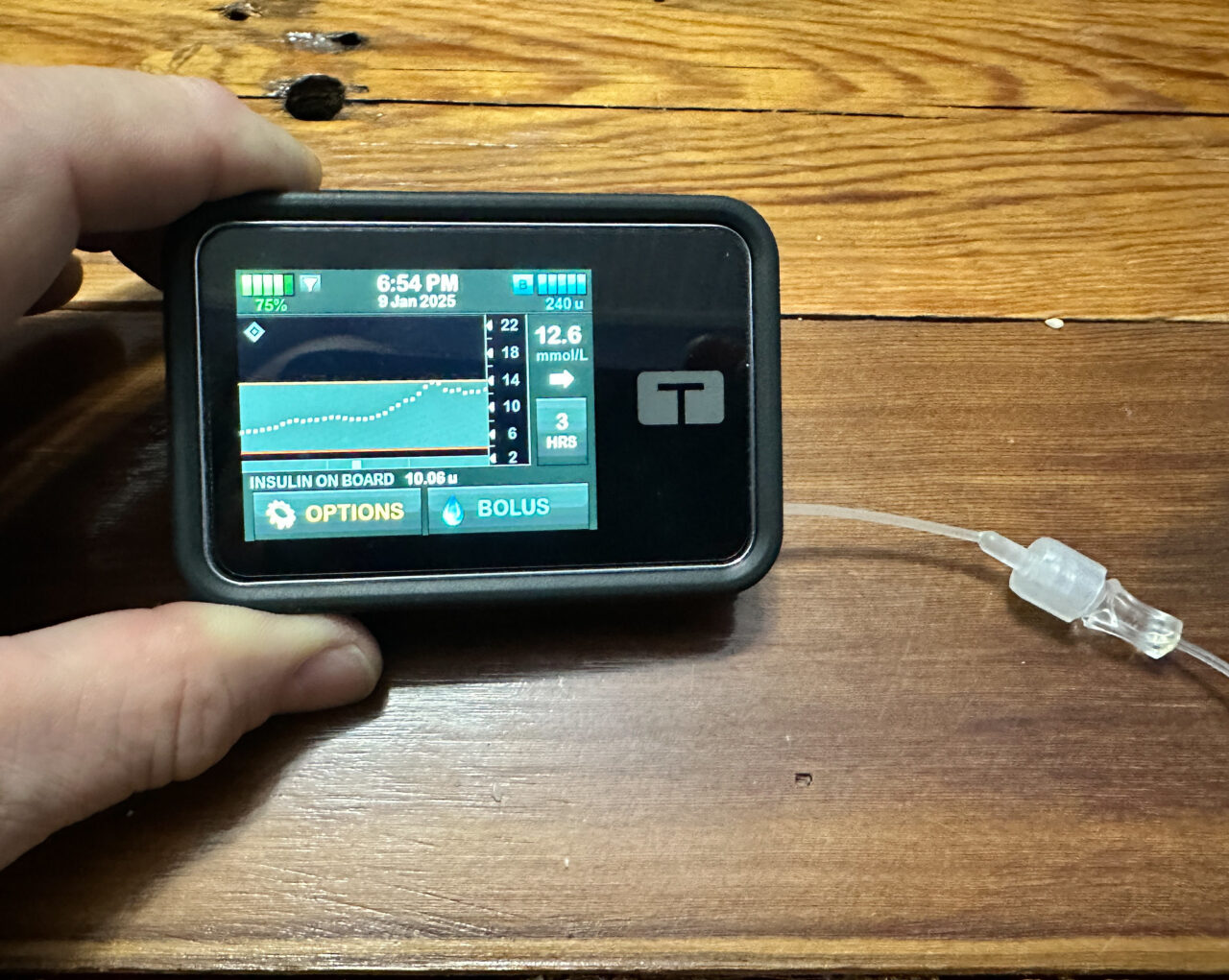
Towards the end of last December I got notice that my Omnipod was nearing its end of warranty, but also I was eligible to get a new pump. After a meeting with my team of diabetes educators it was suggested to go to a “closed loop” of a Tandem t:slim insulin pump that keeps in communication with a Dexcom G7 glucose sensor– this means the pump could adjust small amounts according to the sugar levels it detected.
Also, the storage capacity is 300 units, the same as my first Medtronic. It did mean returning to a tube again.
After submitting the paperwork, we lined up a January 7, 2025 for our Tandem representative and my educator team to meet to review the pump system. I was on my third pump system since 2006.

I have to admit some disdain for all the packaging that the supplies come with, there is a small rubble after a change of the reservoir and infusion set. Because of my thrifty mindset, I have been extending the supply one change by manually refilling the supply after the first empty.

Another thing with the Tandem is Clicking Lots of Blue Check Buttons. With many interactions there are steps that need confirmation clicks, and more clicks, and more. It’s understandable to make sure dosages and changes are correct. I have had a few times I did not do the final click and missed a dose, but that’s my fault not the pump’s.

And I had lost the photo that would make this clear, but for filling the pump, getting the syringe lined up with that small white pouch at the top of the reservoir could be big challenge for those with eye sight challenges.
The other improvement this year was getting better calculations of the carbohydrates in my good, which is what goes into the pumps calculations for meal time bolus doses of insulin. I’ve long known the concept of carb counting for diabetes control, and I have gotten several iterations of how tos, sheets to look up, even apps to find the amounts of carb in food. But the problem was me, I always tired to measuring or the process, and I usually stayed with the practice maybe two weeks.
The thing that changed it for me was an app… called RxFood my educator told me about. It’s been a game changer for me, and indeed, I am very positive about a technology that is labeled as using AI. For any meal, I upload a photo of my plate and add as many keywords to describe whats on the plate. It is able to interpret the portion size, and even has identified elements when not listed, and it calculates a carbohydrate estimate for what’s on the plate.
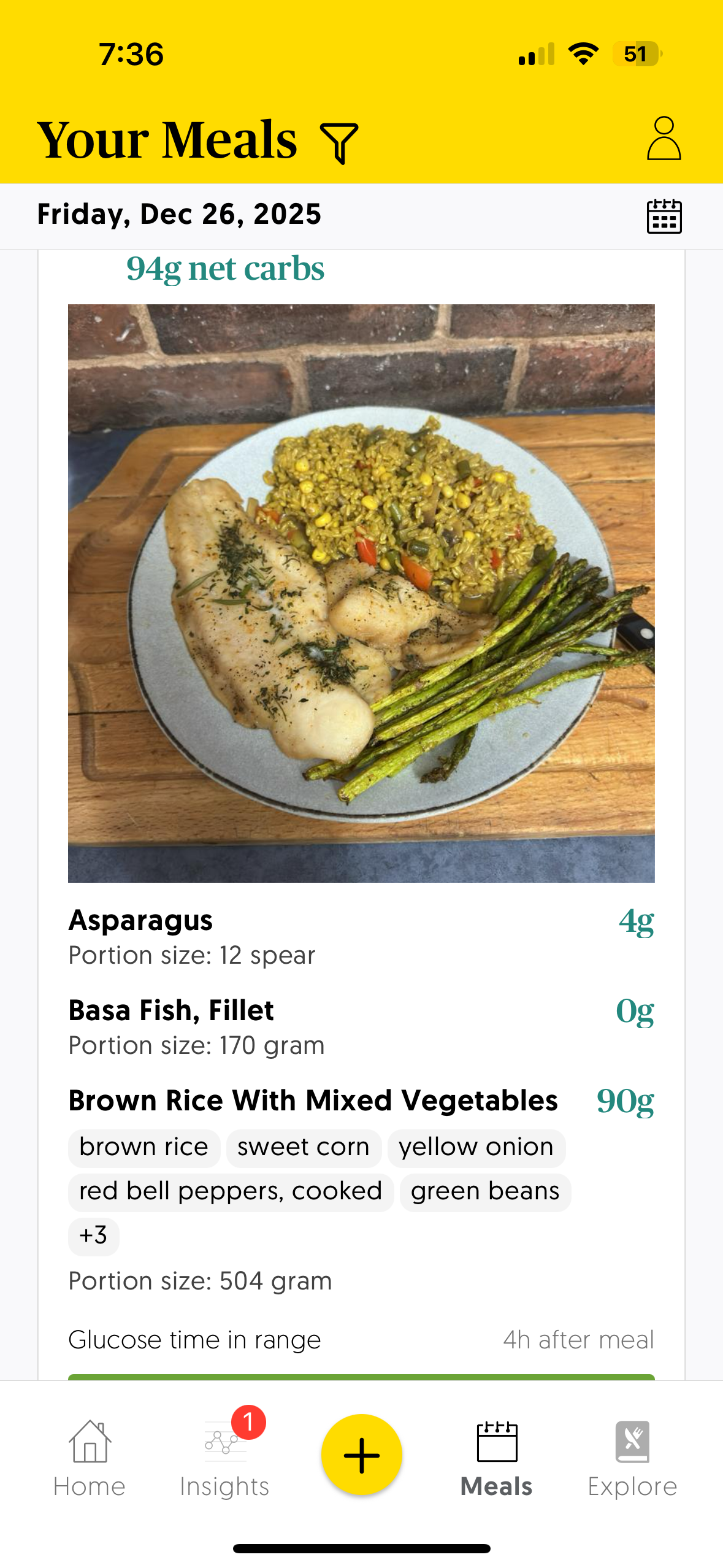
It also communicates with the Dexcom sensor, to show what’s at the bottom, for how the sugar levels registered for 4 hours after a meal. The whole idea is to avoid post meal peaks (or drops).
For some reason, this approach has made a huge difference and helped me eat more appropriate amounts. I think getting everything on a plate reduces my tendency for seconds. And over the past year, not only are my A1Cs dropping, my last test was 6.7 I have not been below 7 in many years. More importantly,. the data from my sensor tracks my “time in range”, the percentage of time my sugar levels are in a healthy range have improved from 50-60% when I was on the Omnipod to 70-80%,
Sometime last Spring, I was very upbeat about the RX Food app and sent the company a positive message about my experience. I was surprised when a few weeks later a rep from the company reached out asking to meet their team in a zoom call to share my experience using the app (apparently it is relatively new). But its quite rewarding for a software developer/provider to be that keenly interested.
Not only that they later asked if I would not mind talking to a reported doing a story about RxFood, so I got my 15 microseconds of fame in a Global and Mail story published in July An AI app is helping diabetics count carbs with photos of their food – and major health care insurers are buying in (see paywall free version).
Alan Levine struggled for years to track what he ate. Even though he knew it would help him manage his Type 1 diabetes, he found food journaling and carbohydrate counting tedious. “I just wouldn’t do it that much, and I’d try to guess” how much insulin to take, he said in an interview.
Then in February a diabetes educator with the Saskatchewan Health Authority in Moose Jaw, near his home, suggested a new approach: photographing his food.
Using an artificial-intelligence-powered app called RxFood, the 62-year-old simply had to snap pictures of his food. The app would quickly generate an estimate of its carb, calorie, protein and fat levels. After three days, it produced a detailed report on his diet and offered daily tips to improve it.
https://www.theglobeandmail.com/business/article-rxfood-app-food-counting-diabetes-journaling-walmart-greenshield/
With calls every 2 weeks to my diabetes educator, we have tweaked all the settings on the pump to now, 55 years later, doing near ideal (I hope) diabetes management. It’s never guaranteed, and so many things can throw the good routine off the cart (late meals, too much exercise, too many snacky potato chips), but this new system Pump 3 and the Canadian Health care, have me doing better than ever for my health.
Featured Image: Insulin Pump Thiird Gen flickr photo by cogdogblog shared into the public domain using Creative Commons Public Domain Dedication (CC0)
 Share this barking on social media
What a journey you’ve had. I still remember that day you went to the doctor when you were 7 and ended up in the hospital. I’m always interested in learning about technology that solves problems, especially useful AI applications. That food analysis app is very cool!
I think it’s amazing you pulled an a1c of 6.x just with management. Bravo! Sometimes things align and the technology just works.
Thank you for sharing this journey with us! I learned a lot about what it’s like living with diabetes. I’m so glad the new system is working well, and yay for Canadian healthcare! ?
Diabetes and Drones, two out of the many numerous connections we have. I always appreciate you sharing your diabetes technology story and I’ll check out the RxFood site to hopefully spur on even better eating in 2026! It’s amazing what a good healthcare system can do.