
Hmmm, what to write about? Maybe, me!
No, I am mulling about Geology, my semi-accidental path into it as a near-career, the tectonic shift into educational technology, and all the intertwingly stuff I think of as I write.
Who can resist cool rocks?

My work path weaving from computers to geology back to computers could never have been scripted, it all happened through a lucky series of connected events. And I find that there is a graceful intertwining of these fields.
For a long time in my edtech career at the Maricopa Community Colleges, I kept a tagline on my email footer that read “was geologist now technologist.” I lost count of the number of times someone would see that maybe in an listserv or a message I sent, and send me a note with a “me too” story.
I got jostled into thinking about Geology from an unexpected source.
Recent Triggering Event
Not quite seismic or at all, but the idea to write (and to scrounging for my old saved copy of a 1973 National Geographic) was reading Erin Kissane’s epic use of a historical seisimic event as a tectonic metaphor for the whatever word you want to use for the destruction of the Web We Thought It was.
Stop reading me and read deep Landslide- a Ghost Story or at least bookmark it to read, really read. It starts with a story to grip you (well me) of high magnitude 1964 earthquake in Alaska who’s destruction was magnified by circumstances of a town build on loose soil, that was made more unstable by oversaturated soil, all of it hit by mega force of tectonic plate crashing.
Okay I am trying to talk ore about this article, but for me it was like a personal subsurface resurgence of my own forays into Geology. More than that, I am a sucker for good use of metaphor1, and especially ones that draw from the field I study.
Blame a Magazine
I was never a kid that grew up collecting rocks or minerals, and really was not that much of the out doorsy type (my first overnight camping trip was in high school, and that was a debacle). So Geology was not a thing I thought about.
I aced high school classes and was definitely bound for higher education, a dream of my parents. There was no computers in our house but a class in programming was fun – we learned to code FORTRAN, coloring in punch cards with a marker, and taking a bus once a week to the one school in the system that had an IBM 1130 mainframe. My sister had started in Computer Science at University of Maryland Baltimote County before it was even a department and she got a job she held for a 30+ career at Social Security.
Since I liked doing the computer stuff and it was n obvious path to a Good Job, it was a logical major when I enrolled 1983 at the University of Delaware. There was one problem – a year into classes likely basic theory and maybe if I recall programming in Lisp… I hated it. This mounted even more when my Dad arranged a visit for me to a friend’s business that was centered on automation and programming. I recall this sinking feeling as I looked across a large open room of mostly men hunched over machines, no windows.
Maybe I had a minor panic. Or an awakening.
I sheepishly made a visit to the advising office. After explaining my situation, the person I spoke to gave my a suggesting I must have internally rolled my eyes. out. They told me to sit down in the office and flip through the college book of majors. If I found something interesting, they suggested taking one class as a test.
“Really?” I might have thought, “this is your best advice?”
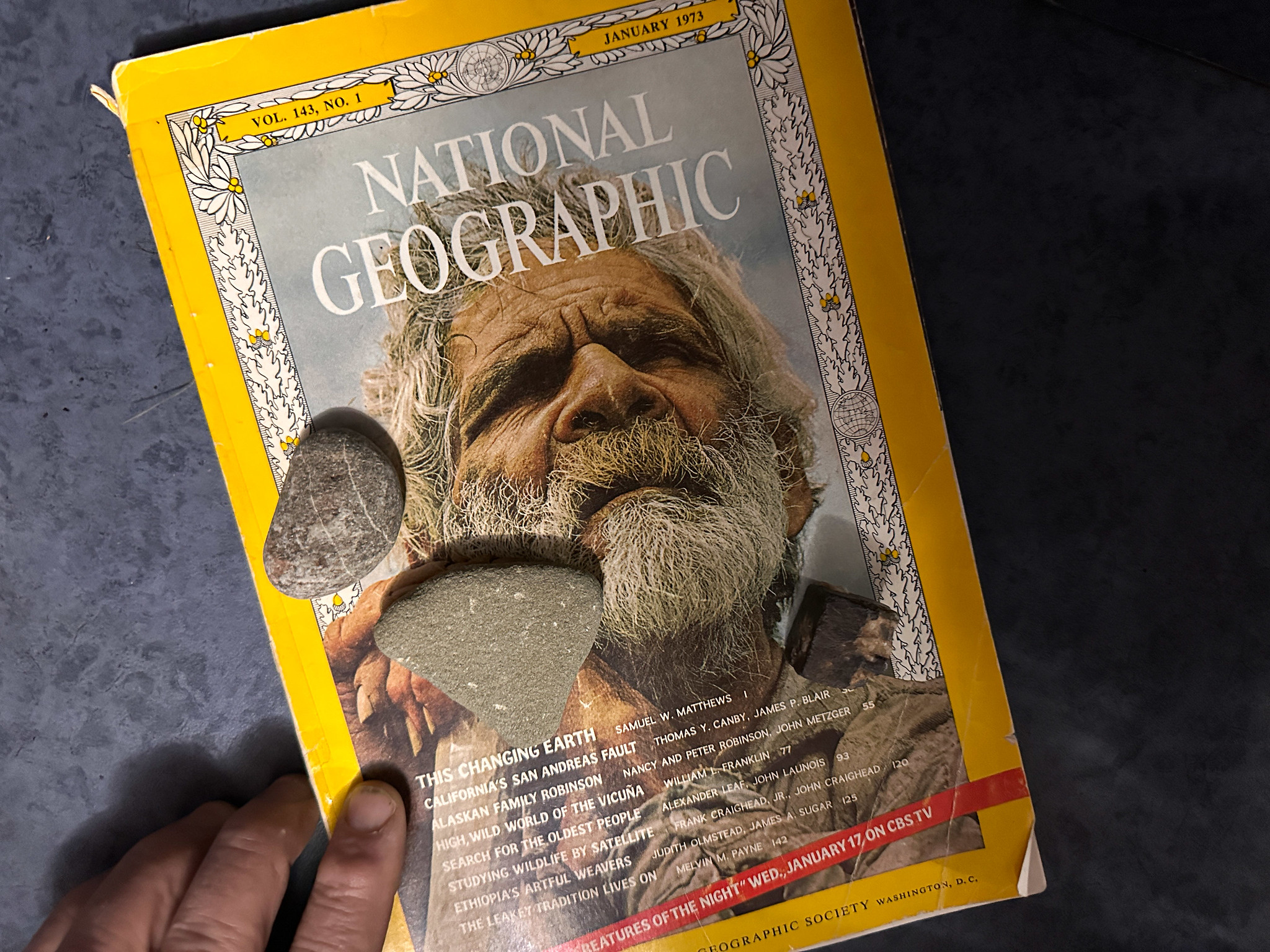
But I followed rules, so I started at the beginning, mostly focussing on the science and math subjects. “Biology”? Nah “Chemistry” Ugh. Tghen I got to the “G’s” and stopped. Something jumped out at the description of Geology. And to this day I cannot explain how my young adult mind formed this connection as it zipped back to a memory of reading a 1973 issue of National Geographic, where the lead article This Changing Earth was the story how the relatively recent acceptance of plate tectonics as theory completely turned the field inside out.
I remember having that conversation with my Dad on a weekend he came to give me a ride home to visit. I had to brace myself to explain to the man who was underwriting my college education that I wanted to switch from Computer Science where there was a high certainty of landing in a Good Paying Job to Geology where you did not really even talk about what jobs there would be. And I cannot remember what played out or if he even tried to change my mind (I doubt it) but he gave his blessing.
My parents always let me go where I wanted to go.
I have kept this issue with me wherever I went.

Just for fun, you can get a taste for the vintage of the magazine in the opening advertisement.
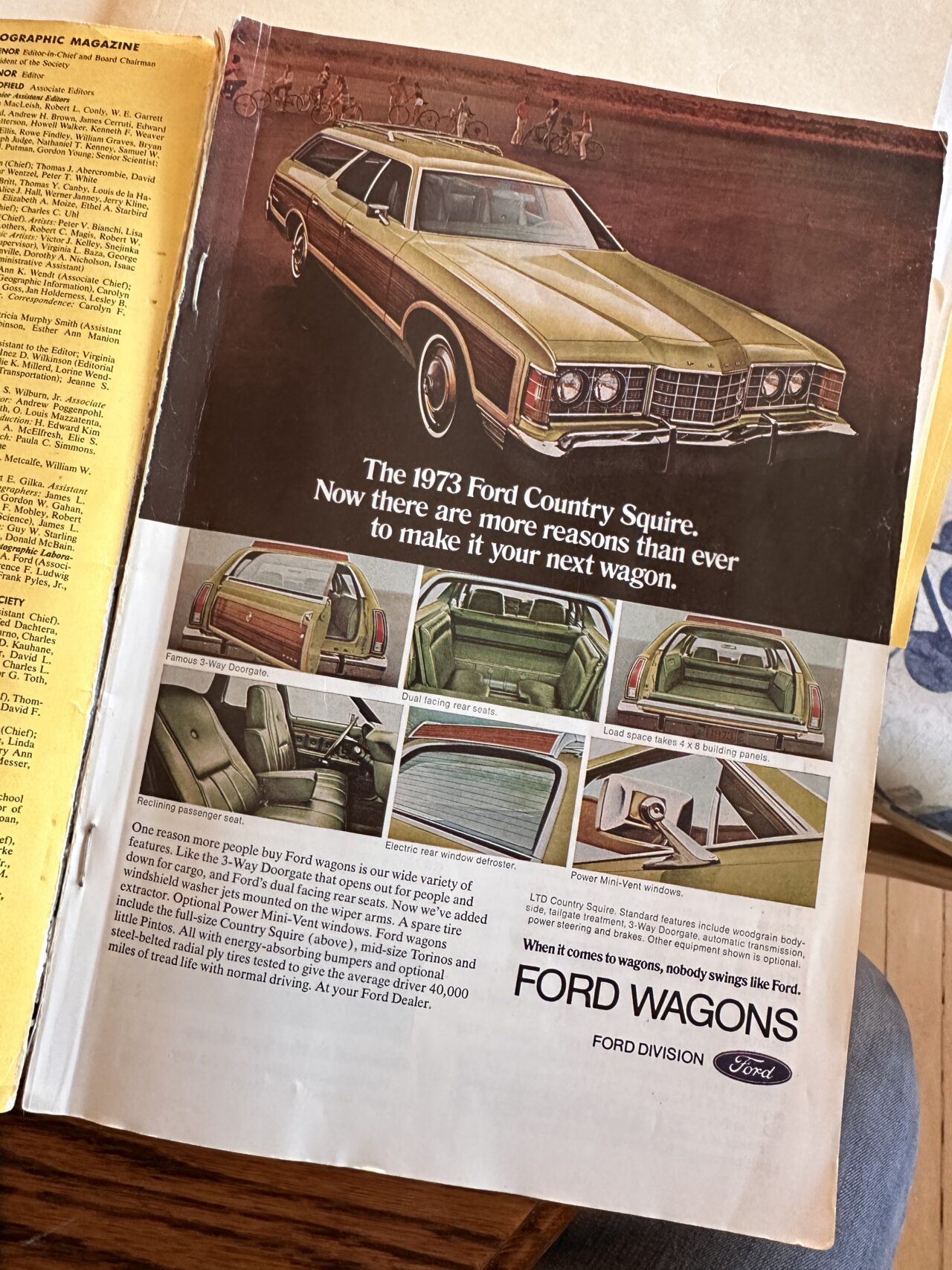
So in 1982 I took an Introduction to Physical Geology class with professor John Wehmiller2 — I love that class so much I read the full textbook (not required) and then changed my major. I went on to graduate school in Geology at Arizona State University.
They saw I had this bit of undergrad experience and gave me a TA assignment of running a brand new lab or Mac Plus computers the department set up in 1988. I helped other students write and maybe look up stuff (we had a 300 baud dialup modem), and I even put my FORTRAN to use writing a gravity simulator program. I ended up doing using other visualization software, used early NCSA pre-Mosaic software like Telnet and vaguely remember one called NCSA Image.
I can tell at ASU that my sarcasm and desire to remix was there, pretty much my humor has not evolved all that much. I took it on myself to publish and distribute printed copies of department news modeled after tabloids, I called mine the Weakly World News meant to tell fun “fake” stories about the Geology Department, and a few real things.
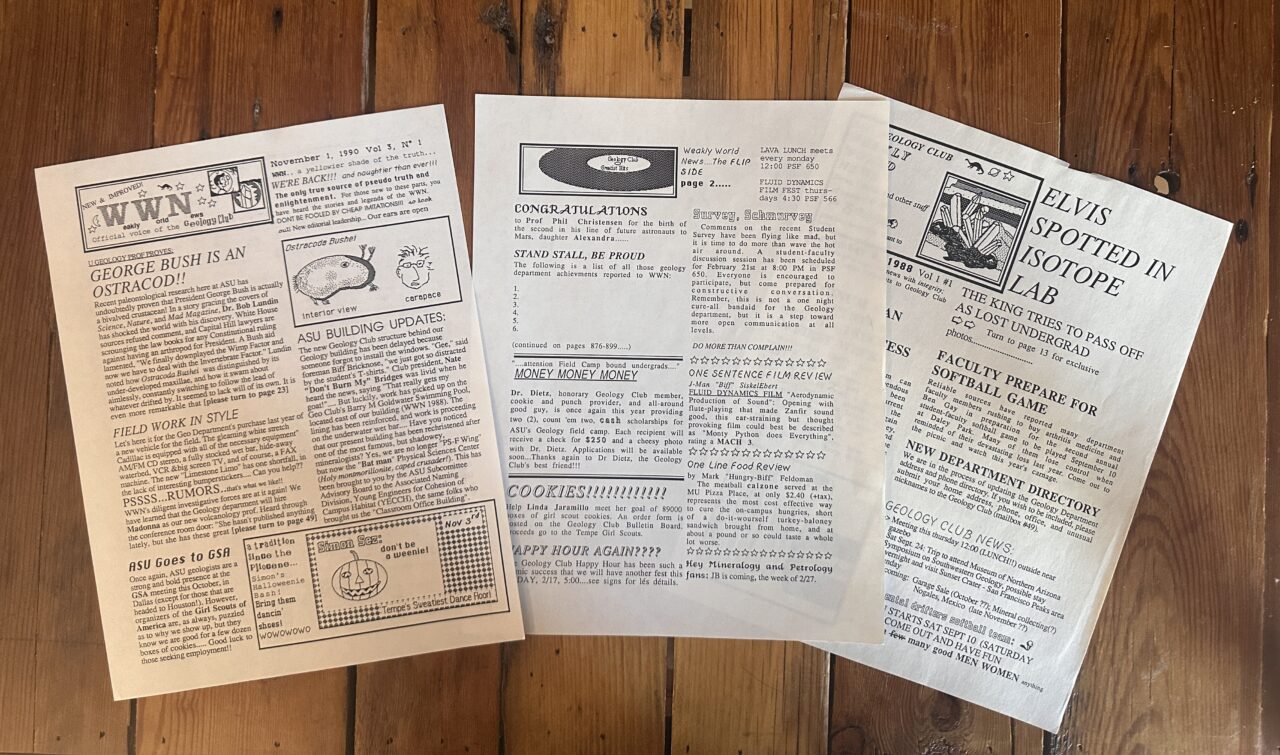
I have no idea if anyone really even wanted these but I kept at it for 3 years.
Those years as a geology grad student at ASU almost feels like a paleo geological era, but I did not realize until later what a free and expansive time it was for me as a young person, especially the opportunities to go out in the field. I remember my grad school roommate Jamie once quipping (he quipped a lot!) that “Geology grad school is kind of getting paid to go camping… you don’t get paid much, but still.”
How I ended up bailing after 1/2 a PhD and almost equally as unlikely ending up in ed tech is another story blogged somewhere (most of what I write now has likely been blipped out here before).
The Dietz Connection
In my bursts of nostalgia a few weeks ago I busted out that National Geographic article and re-read it. I remain rather amazed that what was fixed as known scientific opinion- the earth was a solid static thing, and was flipped over the span of decades, the early proponent that the contents moved, Alfred Wegener was ridiculed.
And my memory is fuzzy if I had made the connection in the article when I read it, and likely not because the connection is not listed, is the mention and photo of geologist Robert S. Dietz, who studied the geology under the ocean and is known for coining the term “sea-floor spreading” (following the ideas of Harry Ness) to account for discoveries that the newest ocean floor was produced near the volcanic plate like boundaries and that the sea floor rock got older the farther away you were from that seam.
Dietz is among the many key geologists who are credited with the research that affirmed the theory of plate tectonics.

Of course I know Dr. Dietz, he was an emeritus professor at ASU when I was a grad student there. His interests were not stuck on the bottom of the sea, he also research impact structures on the moon and I have read somewhere was the first to conjecture that Barringer Crater in Arizona was created by… a meteor (later renamed to Meteor Crater).
My memories aer fuzzy, I did find a note in my Weakly World News acknowledging Dr Dietz’z support of our student Geology Club (read through the bad sarcasm). He did pay for the cookies and juice served at the Wednesday Colloquiums the department held as public events.
Money Money Money
Geology Club Weakly World News, maybe January 1989??
Dr. Dietz, honorary Geology Club member, cookie and punch provider, and all-around good guy, is once again providing two (2), count ;em two, cash scholarships for ASU’s Geology field camp. Each recipient will receive a check for $250 and a cheesy photo with Dr. Dietz. Applications will be available soon. Thanks again to Dr. Dietz, the Geology Club’s best friend!
I have no clue of Dr Dietz appreciated my humor at all but I do remember him as being very outgoing and good for a laugh. Towards my later years Dietz was known for taking on debates with Creationists.
This quote came up when I was looking for references, and says a lot about Robert S. Dietz
In 1985 I became active emeritus. I never gave any thought to retiring to the quiet life. Being a professor in a research-oriented university strikes me as the best of all possible worlds even as an emeritus without compensation. I find that people my age are too old for me. Working with college students helps one to remain young, at least in mind. An end to age discrimination is one of the new rights that has enhanced the quality of life.
https://ffrf.org/fttoday/november-1994/articles-november-1994/marine-geologist-robert-s-dietz/
Dietz passed away in 1995 and the Geological Society of America published a full tribute and Memorial to him but again the opening quote says much about this man:
Robert S. Dietz used to say that when his time came to leave this Earth, he wanted to be struck by a meteorite and then become fossilized.
https://rock.geosociety.org/net/documents/gsa/memorials/v29/dietz.pdf
I am rather fortunate to even have this path crossing with a giant in the field, and it all flows back to that issue of National Geographic I will treasure even more each time I read it.
Geology and Me
I certainly relish those years in Geology. I got to be a TA in overnight trips to the Grand Canyon. I got to visit Mt Saint Helens with leading volcanologists, did a Geology class field trip rafting ther Grand Canyon, got to go to a research conference in Germany, did long term projects at the US Geologic Survey in Flagstaff and at Los Alamos laboratory.
But I did now I was not one of those geology types that have that keen field sense. People who could read a big outcrop liek a book or readily identify odd minerals. I could be good at research and publishing but it never felt like it was in my bones.
Don’t get me wrong, I love looking at rocks and being out in canyons and mountains and plains and badlands. I made the right choice that day I lost my research passion in a New Mexico canyon. But lessons and people from those years in Geology stayed with me. I could outline a long list of them, but the blog post is already longer than the length of Valles Marineris.
The one I will always lean on is the folk wisdom teaching style of Doc Thompson, who taught me Field Geology and Petrology at the University of Delaware. Right in the middle of talkign to us about a certain group of rock types, he just stopped and said something like:
You know, Geology is fill of classifications. And in terms of classifying things, some people are lumpers and some people are splitters.
Allan M. Thompson
That has come to mind so often in my tech work when I come across metadata or taxonomies. I got so much of being in the presence of great teachers and humans like Doc Thompson.
But indeed, an appreciation of Deep Time helps with putting my sarcastic puny life and blog mutterings in perspective. And the vivid description of the powerful forces shaking up the networked world so elagantly laid out by Erin Kissane just resonates that much more deeply with my Geological bones.
Got rocks, anyone? And look at me, in 2026 I am footnoteblogging3.
1Just today relishing in D’Arcy Norman’s use of “punctuated equilibrium” which got my brain rekindling the brilliant writings of Stephen J Gould.
2I reconnected with John 19 years later on a road trip visit back to Newark, DE – that post tells this same story but as well the sadder story of John’s musician son.
3 With a nod to the blogger with the best footnotes.
Featured Image: The Magazine That Launched Almost Everything flickr photo by cogdogblog shared into the public domain using Creative Commons Public Domain Dedication (CC0)
 Share this barking on social media
It’s funny how many of us have stories like this when joining what might one day be known as the “Golden Era?” of edtech. That is very self-serving, but still it is better than managing vendor relationships, the new edtech reality for all too many souls who need and deserve more. Anyway, I like these deep dives into who you are, they are one of the reasons this blog has a soul. I don’t understand why people haven’t figured that out, we want to read about the person—people interest us. Your experience that brought you to where you are is everything, and I think that it’s easy to forget that when we get labelled as one thing or another because that’s how we make a living. I am purely a technologist by mistake, I was supposed to be a professor, but that field was becoming more and more a nightmare given the adjunctification of HE that meant fewer jobs, more teaching, less research, and ridiculous competition. Falling into edtech was just dumb luck, but it was also liberating. I’m sure more then a few faculty at UMW were like how does this motley crew of printer fixers have more freedom and possibilities than PhDs who dedicated their life for a 4/4 teaching load? With a diminished sense of tenure protections, more committee work than your chair-bound ass can handle, and static salaries—the slow death of professionalism in higher ed has been a reality of our generation. Part of it saddens me because I am a true believer, but also that expansive time between professions, those expansion points you mention when you are still learning and exploring that the real magic lives. what’s more, the ability to fuse knowledge from one field into another is the ultimate joy.
At UMW and then Reclaim I fell into these canyons and found myself surrounded by all sorts of amazing people—it’s them that provide an antidote to the ongoing, relentless narratives of doom and gloom that become more and more like water on the forehead as they drip from the faucet of social media unendingly. Alone, it’s enough to break your spirit—especially when there is more than enough material evidence to support the claims—but with the stories of others and the reminder we go here through a network of people and ideas that have sustained that sense of curiosity is an important reminder. That’s what this post was for me, thank you..
And a big thank you right back, the Reverend has spoken, and your timing is impeccable. I need a few more of those canyon bottom (nice use of metaphor) voices.
And who is to say there are not people jumping in now that could be having their own Golden era? I’d like to think so.
What a long strange trip its been! I remember when you switched to geology but never knew why. I still have some rocks you gave me!
Hang on to those rocks, little big sister, they almost live forever.