
Again and again I find the most interesting things that turn up in my various web pokings is not what is served up on a platter as an answer like search or now spewed into prosaic all knowing “intelligence” by generative machines.
It’s what I find accidentally, often when i am looking for one thing completely unrelated. There has to be a clever word in a non English language for this phenomena. If you ask the machines, they suggest Serendipity, which is not quite what I am after. Maybe closer is apophenia “the tendency to perceive meaningful connections between unrelated things.” But its some combo of both.
But phooey on definitions. This is it in action.
It starts with reading a new “post” (in quotes) by Lance Eaton “…screw around with it. See what it does. And we have to do that, fearlessly” an interview he did with Corrie Bergeron (I dug around to see any current blog, profile links, alas I just get a LinkedIn profile, through which I do find a most cleaver association description with SCA).
It’s funny because I know I have crossed comment, blog, social media, video session moments with Corrie. I can’t recollect a conversation or meeting in person- which I say knowing full well he might reply and say “We met at NMC in ….”.
In his interest, Lance is asking about Generative AI and Corrie refers back to PLATO- I can remember some of my first computer experiences at University of Delaware where I had a part time job as a PLATO tutor:
Back at PLATO in the ’90s, we did something called Math Problem Solving, which kind of simulated AI in DOS, with a coach based on a state engine. It looked at the state of the simulation and provided coaching to the student as they went through it, based on the state of the various objects in the system. It worked pretty well.
https://aiedusimplified.substack.com/p/screw-around-with-it-see-what-it
Okay, that is a possible jump off memory path, but the real journey begins down page, with their recalling of the early excitement era when there was a magical platform that rhymes with Bitter, when Corrie says:
So there’s this presenter named David Warlick, this science teacher from Georgia I think, and he says something profound. He says, “We are the first generation in history who knows that we have to prepare the next generation for a future that we know we can’t imagine.”
https://aiedusimplified.substack.com/p/screw-around-with-it-see-what-it
OMG! David Warlick! Of course I remember David, he was a pivotal influence in the early blog/ed tech years, when so many of the ideas flowed back and forth from K-12 to higher educators and back.
Mostly I remember a week or more spent in Shanghai where I was among a group of edtech bloggers who got invited this Learning2.008 conference in Shanghai (hah an old ning site). Organized by Jeff Utecht part of this amazing network I fell into of teachers at international schools, also where I get to meet for first time Jabiz Raisdana. Both these names of folks I’ve not crossed with in like a decade.
What an insanely fortunate opportunity to be invited to a conference because I blabbed on a blog! There I was in this new to me city with a blog mob of David Jakes, David Warlick, Clarence Fisher, and Brian Crosby, plus getting to meet Ewan McIntosh.

All of us connected by globs, teaching, and a joy of exploring tech. In Shanghai, we North Americans stuck out, especially Jakes, a big guy, drew stares and was always a target for street sellers. I remember he bought on the street an arm full of fake rolex watches he tool back to his staff.

I later visited David a few times in Chicago, he once took me to one of the best places every to get a steak.
And Clarence Fisher, the teacher and for a while at the same time, of Snow River Manitoba. We once connected his students by internet radio to another class of Heather Durnin’s in Ontario. Brian Crosby invited me to skype into his elementary school class in Reno, Nevado, and on a later trip I got to visit the same students in person. Ewan McIntosh was and still is a Big Deal, but a humble and funny guy, heck I had dinner with him a year or more ago on a visit across Canada, at a dinner with Alec Couros and Dean Shareski.
But we all were in awe of David Warlick, he was like an elder statesman or better, a Gandalf of Edtech. That featured image is David presenting at that Learning 2.008 conference, look closely at the background to see “ning” and “wetpaint” and “delicious”.
Of course, being 2008, a preconferencr activty was held yes… in Second Life, here is David in SL form:

So thinking about David, the reach to find him is web search. Lance linked to David Warlick’s Wikipedia page, which of course also comes up in search, and sadly too meaning there is a Grokopedia link which I will never ever link to. It’s getting sad when looking for links to people, finding a blog or a web site they self manage is more rarer than ever. David’s last Instagram photo of a deer was September 2022.
Alas I finally find a link to a post by Chris Lehman David Warlick A Thank You that brings the hard truth:
For folks who do not know, David has been battling cancer for the past seven years, and about three weeks ago, he posted an update that makes it sound like life’s getting a bit harder of late. It strikes me that all of us who have been influenced by him have a moment to make sure he knows the profound impact he’s had on us. I’ll start.
https://practicaltheory.org/blog/2024/02/18/david-warlick-a-thank-you/
Oh damn, and that was close to two years ago. I am not ready for this phase of life, but what can one do?
I find warm comments from more folks I know, like David Truss (have not web seen a few years) remembering David’s K12 Online Conference keynote in 2006 (I was there!) and what I did not know that David named his blog Pair-a-Dimes for Your Thoughts (last post 2022) after David’s blog “2¢ Worth”
Now I am tracking down David’s blog which I do remember, finding a link http://2cents.davidwarlick.com/ that redirects now to a localhost address of http://127.0.0.1/ with the sadly ironic message “It works, well, eh?!”
Always, always the Internet Archive Wayback Machine is the salvation. Now I am deep in memory land with his blog post from June 2012 on Where is the Future of Education?: A Pre-ISTE Blog Entry
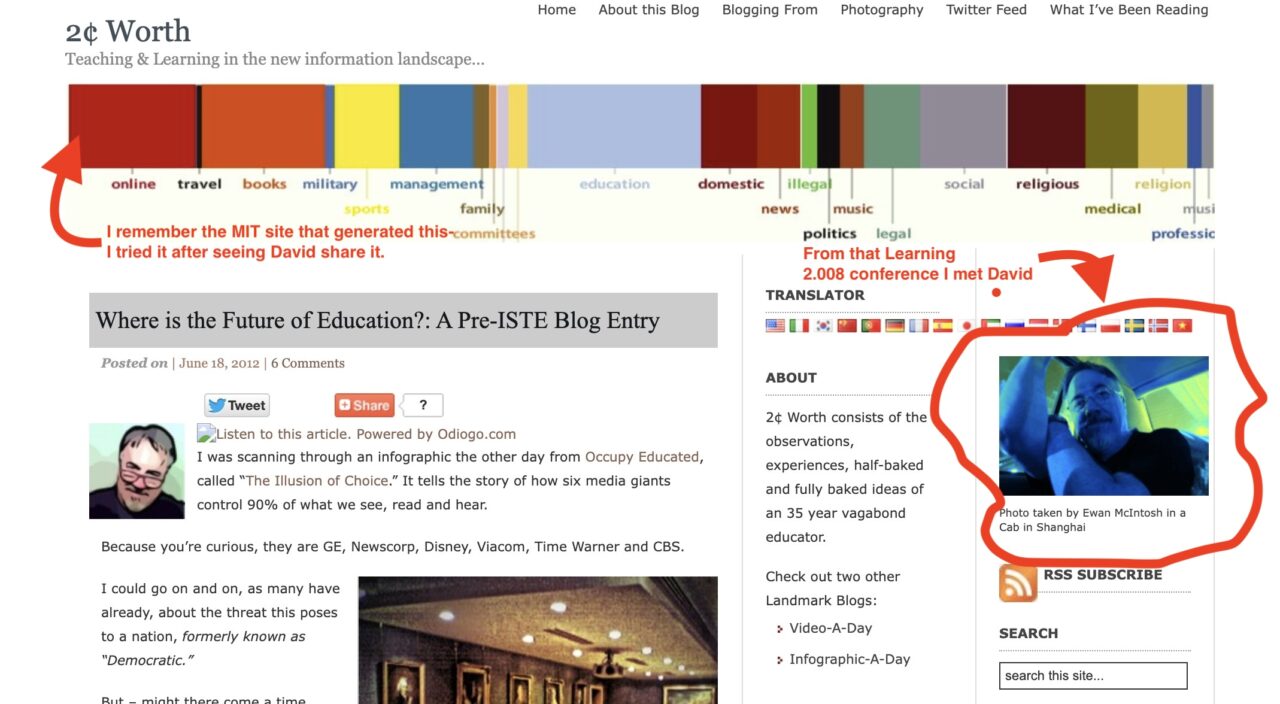
But look at what David was laying out 14 years ago:
I was scanning through an infographic the other day from Occupy Educated, called “The Illusion of Choice.” It tells the story of how six media giants control 90% of what we see, read and hear.
Because you’re curious, they are GE, Newscorp, Disney, Viacom, Time Warner and CBS.
I could go on and on, as many have already, about the threat this poses to a nation, formerly known as “Democratic.”
But – might there come a time, when we see at the bottom of this infographic how 90% of our schools are controlled by, say, three corporations, three boards of directors instead of local boards of education.
https://web.archive.org/web/20120623215749/http://davidwarlick.com/2cents/?p=3614
Those media giants are now subsumed by the new oligarchs in a nation “naively once known as Democratic”
This is but a small example of why David was a large influence on so many folks. Yet I am looking at the details of his 2012 blog. The photo of him and Ewan in a cab was at that Learning 2.008 conference! And that header image is also familiar (well revived). When I first rummaged today in my flickr images for photos of David, one was not of him, but this very similar image mentioning David

Read my captions for more depth than just a photo:
Thanks to a nifty find by David Warlick I love this MIT project that generates a sort of DNA of your digital presence on the Net (although it picks up a bunch of other Alan Levines out there).
Get yours at
personas.media.mit.edu/
Personas was (no more) a MIT exhibit/project subtitled “How does the Internet See You?”
Personas is a component of the Metropath(ologies) exhibit, recently on display at the MIT Museum by the Sociable Media Group from the MIT Media Lab (Please contact us if you want to show it next!). It uses sophisticated natural language processing and the Internet to create a data portrait of one’s aggregated online identity. In short, Personas shows you how the Internet sees you.
Enter your name, and Personas scours the web for information and attempts to characterize the person – to fit them to a predetermined set of categories that an algorithmic process created from a massive corpus of data. The computational process is visualized with each stage of the analysis, finally resulting in the presentation of a seemingly authoritative personal profile.
In a world where fortunes are sought through data-mining vast information repositories, the computer is our indispensable but far from infallible assistant. Personas demonstrates the computer’s uncanny insights and its inadvertent errors, such as the mischaracterizations caused by the inability to separate data from multiple owners of the same name. It is meant for the viewer to reflect on our current and future world, where digital histories are as important if not more important than oral histories, and computational methods of condensing our digital traces are opaque and socially ignorant.
https://web.archive.org/web/20100105114944/http://personas.media.mit.edu/
Those emphasis marks were mine- but soak that vision again — “where computational methods of condensing our digital traces are opaque and socially ignorant.”
Shivery timbers!
I am counting on Wikipedia’s accuracy of David’s page only bearing a birth year and that where ever he is that his spirit is a strong and vibrant as I remember it.
All my path exploring and ferreting out, is somewhere more in the realm of oral histories because what digital personas throw back today are missing all of the nuance that lived experiences and connections still pulse.

To our Shanghai crew, both Davids, Brian, and Clarence, remembering that dinner at a restaurant where no staff spoke English and he ordered by excessive pointing at menus, just can’t beat that experience. I only have a photo of noodles, but my memories have more.
Featured Image: David Warlick flickr photo by cogdogblog shared into the public domain using Creative Commons Public Domain Dedication (CC0)

 Share this barking on social media
@barking
Are you not happy with that wonderful English word "serendipity", the art of finding valuable things you were not looking for?
Remote Reply
Original Comment URL
Your Profile
Why do I need to enter my profile?
This site is part of the ⁂ open social web, a network of interconnected social platforms (like Mastodon, Pixelfed, Friendica, and others). Unlike centralized social media, your account lives on a platform of your choice, and you can interact with people across different platforms.
By entering your profile, we can send you to your account where you can complete this action.
Oh I love serendipity and use it more than frequently 171 posts worth plus a subset I like to call web serendipity.
I was after a word that fit for the times when my energy is on lookign for one particular thing, and I end up finding something else that sparks my interest so much I put the first search aside. But ignore me, it definitely fits as serendipity.
I love this rabbit hole that was spurred by Corrie & me’s conversation! Thanks for reading and for sharing!
David Warlick influenced us all in so many ways. I am grateful to have known him then and I remain so now. May all find peace.
Miguel Guhlin
https://mguhlin.org