
Another of the quarter baked drafts that have been bounding around the noggin that now has a reason to see some light. Or maybe it is an excuse to give my pal Todd Conaway a Plain Old Telephone Call so we can rehash a long going topic.
As I edit this long/unfinished draft, I can see my grand plan for communicating my ideas disintegrating into the usual tangents of distraction bordering on incoherence. So in an attempt to summarize:
- “Building Community” conjures something different than “community building”
- To me, misplaced focus on tools/platforms
- I find myself failing to get participation / responses in many places, and naturally self blame
- Challenges in efforts of OEGlobal community space or maybe it is not as bad as I think
- Backyards and planned communities (a story distraction/flawed metaphor)
- Pulling together a conversation
- Keeping On
What Do You Mean “Building”?
When I hear the phrase that is pretty much in the shape of my job title at Open Education Global — “building community” my back of the neck hairs bristle up. “Building” conjures up tools and a focus on platforms, and endless debates of which platform is “best” (the answer is either none of them or all of them).
You either choose one or perhaps try to make it happen within the context of “where people are already”, that would be the Social Silos, you know their names. Personally I am feeling:

My stomach turns that educators seem to have landed in “everyone is in LinkedIn”. But I do have to ask myself if my personal issues get in the way.
But back to platforms, and I know how much people really like Discord. I find it okay, it’s in design no different from the other Slack-al-likes with channels and topics and emojis and like buttons. I dislike its promoting of all the add on gunk, and in the last year the data breaches and now rumors of access coming at the price of giving your face away, makes me grumble.
Yet I will go there for the Reclaim Hosting Blogging community or MyFest. I can swallow my annoyance if the interaction is rich. And dynamic. And fun.
As someone using the icon on the girl the boy is distracted by, I fell right into Discord Alternatives Ranked. I am a draw for a well created (not generated) meme:
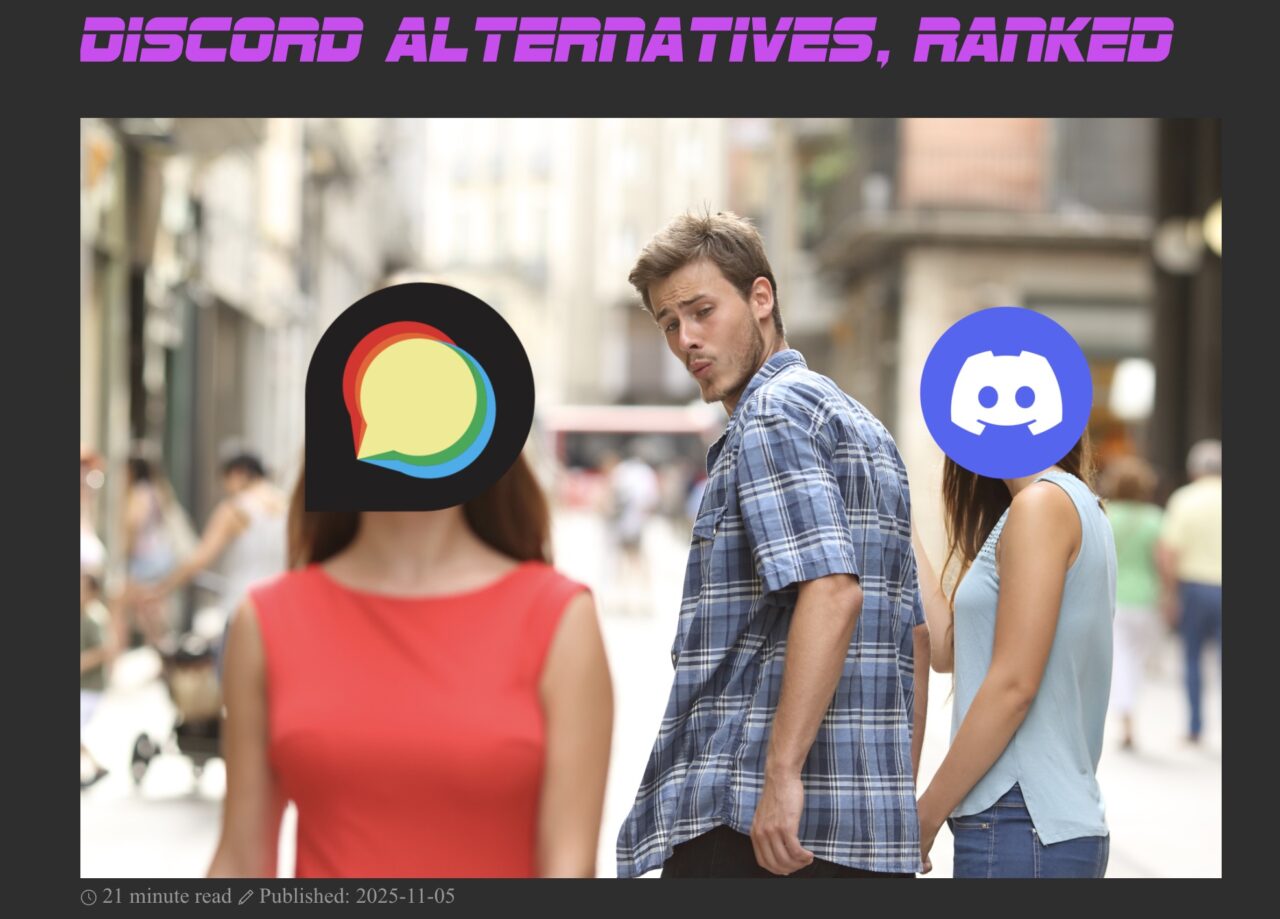
If we just get a platform and promote it in ______, and thus landing in the cornfields of FoD syndrome, eventually wondering, Hey where is everyone? Why won’t they come here?
I have used nearly all those platforms, and the difference has nothing to do with the features, but who is there, and what is happening. If the discussion is interesting or engaging, the platform fades. I hate bringing the platform to the front.
I remember really dynamic community happening in BBSes and the original email listservs. I got to experience it through the late 1990s with groups in Australia (anyone around from the Flexible Learning Framework?), and getting to be part of astounding projects with Nancy White like Project Community and later the UDG Agora. And the list goes on.
Firing Social Blanks
But in my efforts over the last?? years?? more?? I am finding that my online efforts are… like shooting blanks, or duds. It used to be relatively easy to rally responses to contribute resources or to remix a silly gif or to participate in a collaborative song. The stuff that made DS106 a living breathing spread out community-less community, or CLMOOC or Rhizo14 or Name Your Favorite Dead Hashtag? Even the DS106 Daily Create, still going non stop since 2012, has a regular participating group of about… 4. All my usual tricks, prompts (the human kind), calls for responses seem to be dying on the vine.
My first self effacing reaction is to self blame. I cherish the SPLOT things I blabbed about incessantly? Those WordPress child themes spawned in 2014-2015 still work. For the most part they were aimed at making sites that the public or some nebulous community could contribute content without logins or requiring personal information.
With my disgust over the fawning embrace of GenAI, especially the generators of lame imagery, I was hopeful my pitch at a collection site of Sadly Robotic Metaphors of AI might get a few contributions.
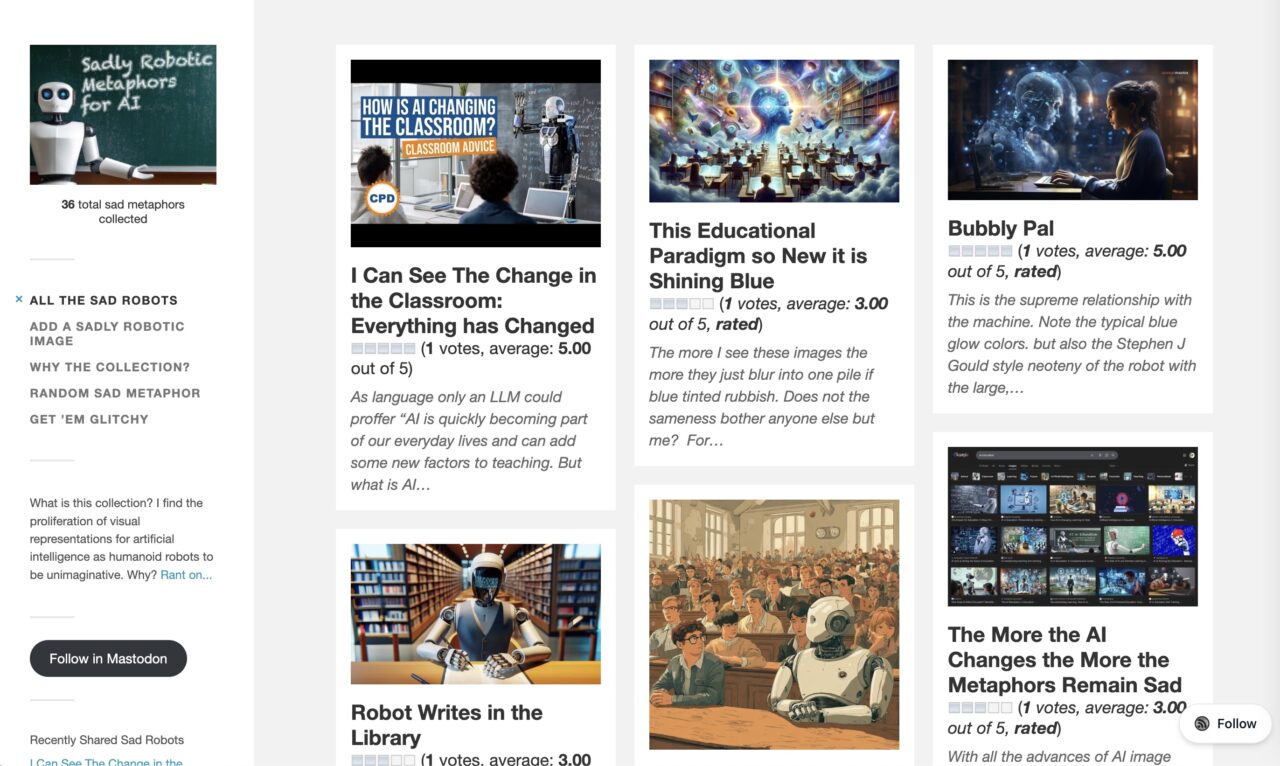
Alas all but 1 are from me. Maybe I’m the Last Person on Earth Disgusted By the Sameness of AI Imagery.
I guess I need to pump this more in LinkedIn.
Hah.
Rattling the OEG Connect Cages
One of my first “community _______ing” efforts when I joined OEGlobal in 2020 (what timing, like a week before lockdown) was to launch OEG Connect a community space we run using Discourse. It got a lift boost that first year since we did that conference “pivot” to online for OEGlobal 2020, based in that space.
I have tossed a lot of social spaghetti on the wall to generate participation, and also made somewhat of a sprawling mess with all the efforts to organize it. The way discourse works when it works is its driven and sustained mostly by user activity, not neat file/folder structures. And I also have dabbled with a number of add-ons (like WordPress it is quite extendible). Let’s see, what have I tried as approaches?
- Organizing activities as asynchronous professional development
- Offering areas for Spanish speaking and French speaking colleagues
- Mini focus events, the Three Days of Focus non series
- Weekly Discussions that start as polls or my 2026 efforts as Monday Connect topics
- Sharing recipes (literally)
- Invited posts from board members
- Asks to share views of where people are, e.g. Views from Where I Sit or What Do you See 25 Steps from your front door
- Auto publishing from WordPress sites for discussions, e.g. for OEG Voices podcast
- Places to share resources and places to share events
Hmmm, when I look back maybe these have been more active than I am griping about.
OEG Connect is fully public to read and we provide account creation for anyone who wishes to join. There us a steady pace of signups and coming from many parts of the world you do not always think about, we are closing in on 2000 users, as of January 2026, representing 83 countries:
| Afghanistan, Algeria, Angola, Argentina, Australia, Azerbaijan, Bahrain, Bangladesh, Belgium, Benin, Brazil, Cameroon, Canada, Chile, China, Colombia, Costa Rica, Cuba, Dominica, Egypt, Ethiopia, Fiji, France, Georgia, Germany, Ghana, Hong Kong, India, Indonesia, Iraq, Ireland, Italy, Japan, Jordan, Kenya, Kyrgyzstan, Libya, Lithuania, Luxembourg, Madagascar, Malaysia, Malta, Mexico, Moldova, Republic of, Morocco, Nepal, Netherlands, New Zealand, Niger, Nigeria, North Macedonia, Oman, Pakistan, Peru, Philippines, Poland, Portugal, Qatar, Romania, Rwanda, Saint Vincent and the Grenadines, Saudi Arabia, Sierra Leone, Singapore, Slovakia, South Africa, Spain, Sri Lanka, Sudan, Sweden, Switzerland, Taiwan, Thailand, Tunisia, Turkey, Uganda, Ukraine, United Arab Emirates, United Kingdom, United States, Uruguay, Viet Nam, Yemen |
This feels rather… global, right? I am not quite sure why people keep signing up nor what they really seek, almost none do an introduction (I do a monthly welcome to all new users, but only a handful respond).
And I have been unable to get my own colleagues to participate. I have heard reasons of “not up to the academic discourse” or “nothing happens when I post” or “we need a regular series of topics”. Very few of the users bother to fill out their profiles.
So pretty much this community site becomes almost another blogging place for me, as I am regularly popping stuff in there. A successful gizmo is that I track interesting web sites in Pinboard I tag oegconnect and through a Zapier integration they post automatically to the OE Sharing Zone.
And when I do whinge a bit in the space, I end up hearing how valuable they find reading it.That’s all fine, but I really want it to be driven more people than me.
I rather feel like I am flailing away or maybe just making so much noise, people turn off the notifications.
Back Yards and Master Planned Communities
I’m sure my friend Todd has heard me spout this story too many times. Once more, my friend.
In the neighborhood I grew up in Northwest Baltimore. our suburban homes all had open back yards. Me and the other kids would play and do stuff running from one yard to the next. The Cohens put in a big swingset and a basketball hoop anyone could use. Yes, the Lawsons had a fence around their in ground ppol, but that was a safety thing, their yard beyond the pool was part of the commons of kid.
This was maybe just my isolated experience, but this kind of shared space is what I think of as a neighborhood.
I was rather taken back in 1987 when I picked up and moved to Phoenix for grad school to find the housing norm there was every yard fence in the back. There was no running from yard to yard, just cinder blok walls, maybe connected by an alley where the trash trucks came. I was just taken by how different it was, but yet there were plenty of local parks, green spaces. But norm for homes was walled yards.
I was hardly the only person to ask, see this KJZZ (I miss this public radio station) Q&AZ: Why do most metro Phoenix homes have big block fences?
But what really got me puzzled was the popularity in Phoenix of “Master Planned Communities” – as large areas enclosed by a big block wall, with a front gate monitored by guards, where the houses were all cookie cutter designed from required designs and paint colors.
Everything about this billed as a “community” ran countered to what I felt was the idea of community not being a designed place, but where and why people gather together? I saw MPCs as artificial and forced.
Now this metaphor is stretched thin, but to me defining a community by its place or platform or structure is really counter to the real kind of communty I experience online from Web 2 era on into the Twitter Collapse, that there was places project people gathered, but then you’d see people from different hashtags in communication. It was community in and out.
So to. me community is informally the alliances and connections we make across walls, not within.
But that’s just my solo opinion
A Conversation Coming
But I have talked to lots of folks who prop of community sites at least in the open education spaces I mostly work in, and hear similar frustrations of gaining traction or involvement.
So I have been inspired to convene a panel of others to commiserate in a live streamed discussion for Open Education Week (details TBA ASAP as I juggle the poll results). I asked 9 colleagues and they all said “yes” to a session without agenda,, the format I have loved so much doing as OEWeek Live. I am thinking of asking them in advance to share their “state of their community” or to even pen a post or ideas in hopefully a more coherent structure than I am offering.
To be honest, it is the small interactions within spaces or even open ones (my main focus these days in Mastodon, I am missing out on the big parties elsewhere). I crave direct replies, and cajoling people into responses. I see it so important to welcome people or recognize them individually even to to comment them on their cat photos. My gut says that we are so awash in Big Media and All The Streams that often the human scale connections are washed away.
Or I am just full of blather, washed up, and nearing irrelevance with my firm grip of #ds1064Life.
Put the building tools aside and let’s talk, ok?
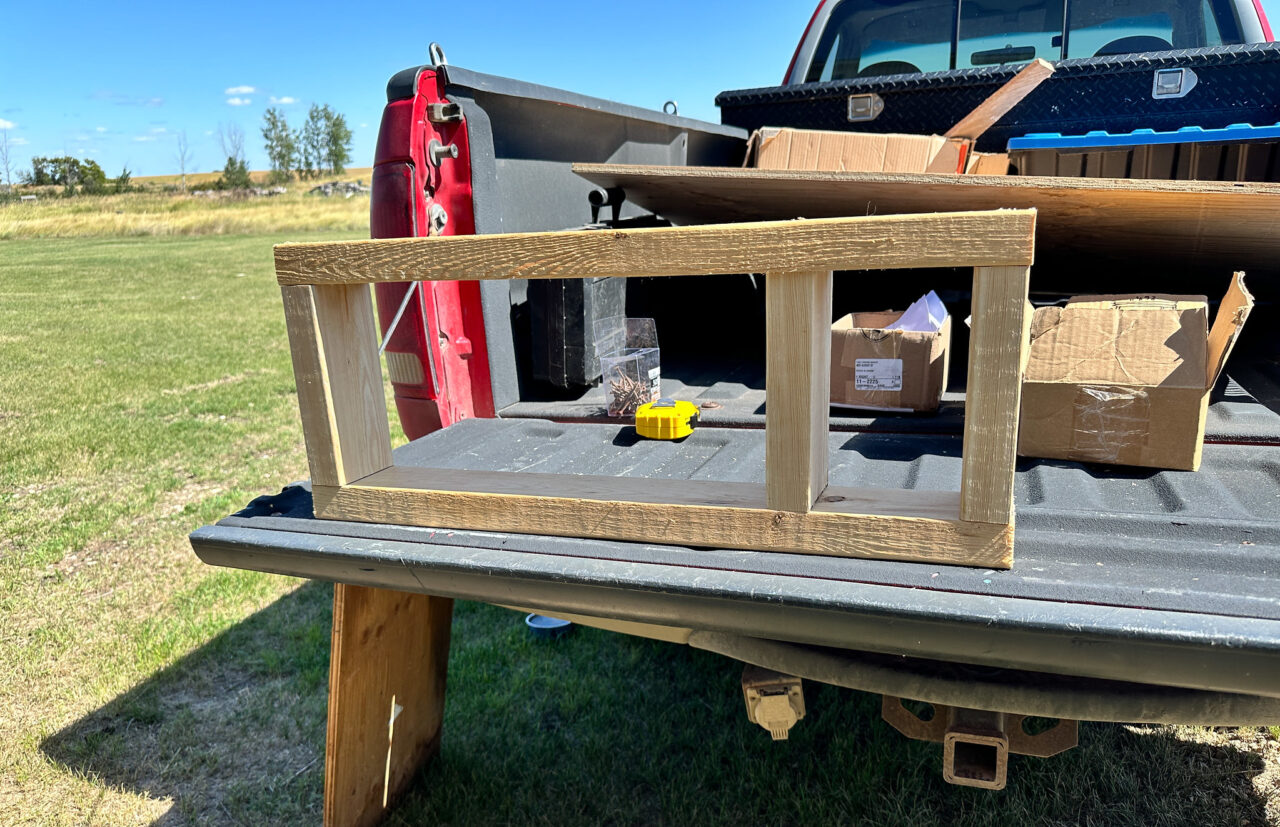
Featured Image: Project Cat Maze flickr photo by cogdogblog shared into the public domain using Creative Commons Public Domain Dedication (CC0) This was one of those “building” projects with zero plan, just cutting lumber and screwing them together with a loose idea in mind.


I blame frictionless consumption and fragmented attention we are all swimming in now .. makes the kind of slow, reciprocal, “we’re in this together” work of community-building much harder to see and sustain in public.?
Federation gives me some hope here – re-centering small, human-scale spaces and shared governance instead of platform-driven metrics. At the same time, most people are still on centralized, commercial platforms, so we’re on the steep slope of technical and cultural adoption; a lot of the work now is just helping people experience and grasp what a federated, community-first space can feel like.
This is well frames and wisely spoken, Grant! I will make use of your human generated (I hope) words.
You’re reminding me that I wanted to do something with David Byrne’s list of necessary ingredients to make a scene and Brandon Walsh’s riff on it specific to building a DH scene. As I look at it now, I note how few of these are really “tool” (or “space”) issues, and how many are policy/practice issues. Because you’re exactly right – the architects are doing the prep work, while the actual community building is done by the participants.
I totally get what you’re feeling. I’ve been online since the 1980s ‘building community’ the whole time. What do I have for my efforts? A response rate to my posts that averages around ‘zero’. I had one successful community once – the 2200 people who joined that first MOOC. Never really replicated that success. My most recent MOOCs had far fewer people in them.
The old definition of community is based on proximity
– it would be based on neighbourhoods or regions
– so online, ‘building community’ usually means pulling everybody into the same place
– this almost never works – it’s like getting people to pick up stakes and move to a new city
You can ‘create community’ this way if you can capture people where they already are. That’s why professors are so successful at building community – they have a built-in captive community consisting of students at their institution (I always envied Jim Groom this advantage of his). Similarly if you have people using a given product (like Reclaim, or Microsoft, or D2L, whatever). And similarly if you can carve out a ‘community’ on a popular platform like LinkedIn or Reddit.
A lot of the institutional mandates that say ‘build community’ contain the built-in expectation that you’re going to recreate LinkedIn or Reddit in the image of the institution. The promise of these community-building tools is that if you have Just the Right Tool (read: Discord, Matrix, Zulip, whatever) people will flock to your new community. None of this is going to happen. Unless you have something else over and above the community (let’s call it a ‘community object’) that creates a built-in audience, you’re not going to create a community from scratch.
You have to have something really compelling to build a community this way, which is why they depend so much on marketing and optimize for engagement with rage-bait and such. If you don’t have access to mass marketing (and unless you have something over and above your ‘community’ to draw people to) efforts to ‘build community’ this way will be unsuccessful.
I gave up on this long ago. I just could bring myself to self-promote in a way that would get a whole bunch of people to cluster around me (or any of my products or services).
The new definition (according to me) definition of community is based on similarity
– birds of a feather (in theory) flock together
– people are in different places, so they never see each other, even though they have similar interests
– so online, ‘building community’ means connecting people to each other when they have similar interests
It’s like building a peer-to-peer network (on top of existing technology). The connection is, people get to know each other. They probably never comment on your own site and maybe never even email you. But they find each other and something flows out of that.
There’s no centre to such a community. No proximity. Peer-to-peer connections require that the two peers have some tool in common, but it doesn’t matter which tool. They can connect on LinkedIn, Mastodon, by email, whatever.
There’s virtually no recognition for building this sort of community (people mostly believe, not altogether in error, that they built it themselves). If you ask, they might say “I saw it on so-and-so’s website first”. But maybe not.
The real measure (if it can be measured at all) is the propagation of the ideas, not the concentration of (a mass of) people. The ‘community builder’ spots ideas and passes them along to people who might be interested in those ideas. Not in the sense of ‘ideas worth spreading’ – that’s a mass-media approach – but in the sense of ‘ideas-worth-forwarding’. I see person A wrote something cool about X, I send a post of the form ‘A said X’ to person B, the result is a connection ‘A-B’ and the propagation of Y from A to B.
Sure, I’ll add value to these ideas as they pass by. I want them to arrive at B in a different form than they were sent from A, combined with other ideas, other people, and contributions from my own perspective. So A and B have something to talk about (even it’s only to complain that I have completely misrepresented X).
So if there’s a purpose (beyond cataloguing for posterity) my own reactions to what I see of the world as it passes by, it’s to build the community in this way. It’s not the path to fame and fortune, but such paths almost never make the community better. This does.
At least, that’s how I’m seeing it today, after decades of failure to do it any other way.
ring…..ring……ring….
@barking https://youtu.be/r5fFlI7MFeM?si=Wz1rwV49Vjw1yfUS
Remote Reply
Original Comment URL
Your Profile
Why do I need to enter my profile?
This site is part of the ⁂ open social web, a network of interconnected social platforms (like Mastodon, Pixelfed, Friendica, and others). Unlike centralized social media, your account lives on a platform of your choice, and you can interact with people across different platforms.
By entering your profile, we can send you to your account where you can complete this action.
We love your 1960s vibe. Grow your hair long, man!
@barking I like that you used the word "Bubkis" for post title. Not sure what decade that is from 🙂
Remote Reply
Original Comment URL
Your Profile
Why do I need to enter my profile?
This site is part of the ⁂ open social web, a network of interconnected social platforms (like Mastodon, Pixelfed, Friendica, and others). Unlike centralized social media, your account lives on a platform of your choice, and you can interact with people across different platforms.
By entering your profile, we can send you to your account where you can complete this action.
@toddconaway @barking From my Yiddish speaking Mom
Remote Reply
Original Comment URL
Your Profile
Why do I need to enter my profile?
This site is part of the ⁂ open social web, a network of interconnected social platforms (like Mastodon, Pixelfed, Friendica, and others). Unlike centralized social media, your account lives on a platform of your choice, and you can interact with people across different platforms.
By entering your profile, we can send you to your account where you can complete this action.
@cogdog ?? @barking
@cogdog ?? @barking
@barking I need to get a better handle on how to see comments/replies on your posts. I subscribe to your posts via RSS but suspect I miss some of the community you’re fostering there without knowing when/if new comments get posted after I’ve dropped by. Still, you are someone to emulate when it comes to these authentic opportunities for connection and I’m so appreciative of your gifts.
Remote Reply
Original Comment URL
Your Profile
Why do I need to enter my profile?
This site is part of the ⁂ open social web, a network of interconnected social platforms (like Mastodon, Pixelfed, Friendica, and others). Unlike centralized social media, your account lives on a platform of your choice, and you can interact with people across different platforms.
By entering your profile, we can send you to your account where you can complete this action.
@bonni208 @barking I need a handle too, but thanks for actually making comments!
RSS is your pal. All WordPress blogs automatically have a feed for all site comments
https://cogdogblog.com/comments/feed/
I used to monitor this across students blogs when I taught classes in the Devonian era.
Or you can get a feed for comments on one post
https://cogdogblog.com/2026/02/on-building-community/feed/
That all comes free with WordPress!
Remote Reply
Original Comment URL
Your Profile
Why do I need to enter my profile?
This site is part of the ⁂ open social web, a network of interconnected social platforms (like Mastodon, Pixelfed, Friendica, and others). Unlike centralized social media, your account lives on a platform of your choice, and you can interact with people across different platforms.
By entering your profile, we can send you to your account where you can complete this action.
I’m all set on subscribing to comments/feed via Inoreader. Wahoo… Thanks for the reminder of the magic of wordpress, Alan.