
I didn’t intend today to be poking around in the Internet Archive Wayback Machine nor duct taping together a bookmarklet tool. But that’s where the afternoon took me as I am trying to get over a nasty cold. Cutting first to the end, try this out.
If you know where to put them (the bookmarks bar usually below your browser’s url display), drag the link below to your bookmarks. Next, in a new window, go to any site you visit regularly or perhaps the article you just recently red. Something a few clicks back in the browser history
Ideally when clicked it should take you to the first record in the Internet Archive for the domain of the page in view. Why does the world need this? I dunno, I’m resting here on the couch.
Long Live the 500 Year Old Web
I got to reading a nice little write up at Long Live the Web and frankly a sweet celebration of the web, flying in the face of its ongoing dumpster fire toxic bin of poop that it can feel like. I certainly champion its words, but it was down a bit towards the end my eyebrow was raised:
Håkon Wium Lie often says that the web will last 500 years and has used Gutenberg’s printing press as a point of reference. And that CSS written today may still be readable in 500 years. These are bold predictions for such a young technology, but I too think it’s possible.
https://longlivetheweb.org/
That link for 500 years is in the middle of a 2018 presentation mostly about CSS – go there first and right arrow to the next slide(s) for what looks like early CERN photos. I’d like to believe there is a bulletin board next to the first web server reading World Wide Web, you click we do the rest!.
Sure you can eye roll at 500 years, but I did some math to see one of my earliest web pages, from 1994, still available on the web has 468 orbits to go.
Well yes, I have archived that tiny folder of HTML file and some GIF images from its oroginal server location to my own, and at some point I pointed some URLs that were live then to the internet archive.
But I got thinking, maybe there is an easier way to find the first appearance of a URL in the machine other than running to through the search.
Monkeying With URLs
I have long lost a reference, but I always recall a talk Jon Udell did in the late 200s when Gardner Campbell had him out to Virginia Tech. It was something about thinking of URLs as not just jumps to web sites but looking at ones returned from search and other database systems as tools to manipulate (by “reading” the parameter name and value stuff that are stuck on the end of them). It’s something I do so reflexively I don’t even think about it,
But related, is what I shared in that post I sure you read about how you could do a trick with any URL for a web based recipe to rinse it of all its non recipe cruft simply by prefixing the URL with https://cooked.wiki/
I had memories that you could do that was well for using the Internet archive, like if you take any random URL you happen to be viewing, maybe it is https://cogdogblog.com and if you prefix it with https://web.archive.org/web/*/ its a shortcut to find all of that links records in the archive – try it https://web.archive.org/web/*/https://cogdogblog.com. That’s just a quick wat to do a web archive search for a URL.
Going Directly to the First In Archive
I thought there was an existing the answer, so here I try to let Google Brilliant AI help, and as it often does, its wrong. Badly.
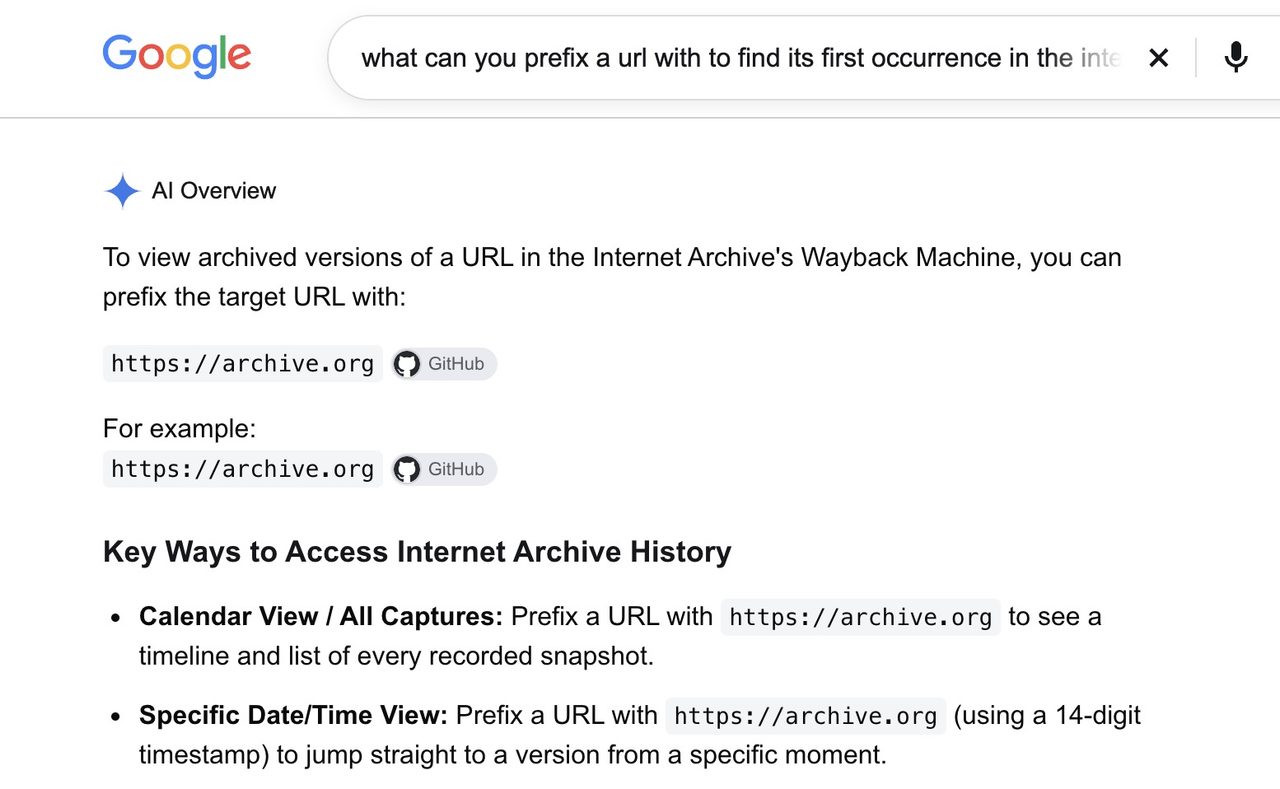
So I know from previous links I had already done, the University of Berkley early web concept of the web as a “subway” that was once at. http://www.ucmp.berkeley.edu/subway/subway.html has many versions in the wayback machine like https://web.archive.org/web/19990427190551/http://www.ucmp.berkeley.edu/subway/subway.html
Note that strong of numbers in the middle 19990427190551, that one may think is the random kind of database IDs you find in URLs, but I have a sense that its actually a date and time stamp. You might guess that its April 27, 1999 at some time (hey that’s my birthday). So you might guess you could get to early versions by say changing the first digit to 1997 (it seems to land on the closest day, June 6 1997.
So now in a wild guess mode, I wonder… what if you just put a 0 in place of all the digits or https://web.archive.org/web/0/http://www.ucmp.berkeley.edu/subway/subway.html
Boom there it is! The first in the archive for that URL. Try it now, go to any URL in your browser, and insert in front of it https://web.archive.org/web/0/ that should automatically transport you to that web sites first record in the archive.
Neat? Does it have any use? Maybe.
Bookmarklet It Baby
I have a huge love and regular use for browser bookmarklets, just a line of JavaScript as a web address that can do something from a page in view. I use one of my fleet almost every day, be it my Flickr CC Attribution Helper or the one I use to search my blog for a selected piece of text or ….
I actually had one that does the trick of speed searching (the * trick in the URL) that prefixes the current tab/window URL with the stuff to bring its record up in the wayback machine
javascript:location.href='http://web.archive.org/web/*/'+window.location.hrefAnd I could have just gotten what I was after changing the * to a 0. But I thought more useful than finding a specific URL was the first record of the domain hosting a site, which I was able to do in the bookmarklet above with:
javascript:location.href='http://web.archive.org/web/0/'+window.location.origin;Noting thing window.location.href for this post give you this post URL while window.location.origin returns https://cogdogblog.com/
Here’s some fun ones, let’s see the waybsck debut for
- Some crazy web search thing
- I’d Like to Watch Videos but it requires Flash
- Who would ever want to resd news on the web?
- Let’s give away courses for free
- Get movies sent to you on CDs in the mail
So What?
I dont know, but when I start mucking arond with URLs and make them do something unexpected and possibly useful, then its time well spent. I leave it for the 1 non AI bot reader to tell me what yo replace the 0 with to get the most recently archived page for any URL.
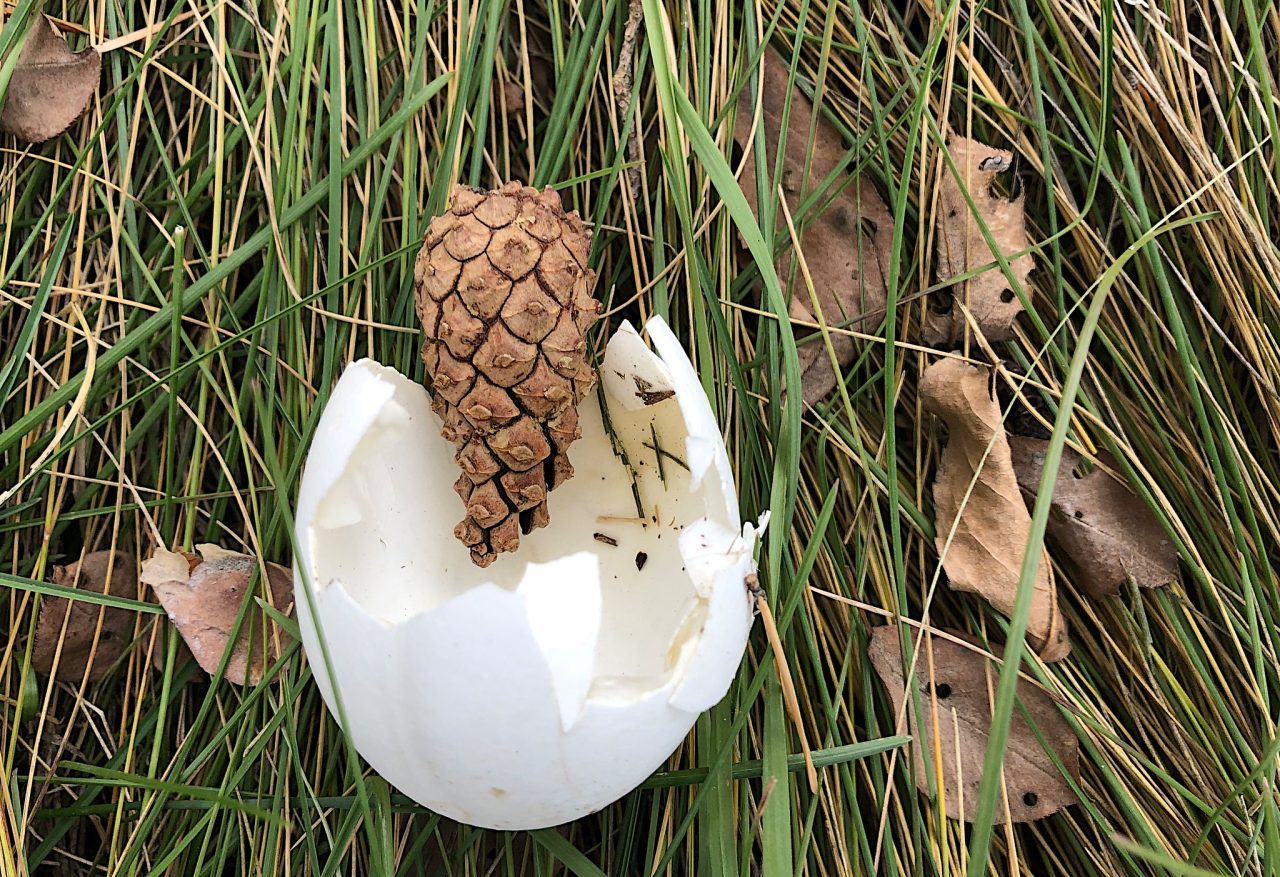
Featured Image: (and yes what follows comes from a bookmarklet) 2021/365/298 Which Came First? flickr photo by cogdogblog shared into the public domain using Creative Commons Public Domain Dedication (CC0)
 Share this barking on social media