
… are the ones you dig yourself. After more years than I prefer to calculate, little matches the joy and super charge energy of a session of web rabbit holing, of hopping from one link to another, and finding something at the other end I might never have thought existed.
That’s what the web, with all its current baggage and slopification still makes possible- through the humble hyperlink, open a door to an infinite number of stopping points. The fatigue of wondering about social media going somewhere is the expectation, desire that the scrolling through a stream, be it chronological or algorithm, will deliver to you something interesting. It’s passive.
The same for the insatiable appetite to type in a box and magic gigahedron eject an answer for you — strips the sheer delight of finding it yourself.
There is a time and use for these things, but it ain’t my whole webchilada (today is some kind of portmanteu day). But I have this we joy in trying to occasionally map out what seems to be statistically improbable paths. As I go via link to link, anyone of those stop and click points could have easily gone somewhere else (maybe better, maybe not). The odds of ending up on Romina’s story feel less than infinitessimal.
Dialling the web history back a few days, this is one hole.
The Links to Romina’s Story
So yes, it starts in scroll space, my Mastodon feed. What makes the social media valuable to finding worthy connections to people I do not know. I sift the streams. So I saw a boost or a comment from @paulwalk
One of the best places to start a curioisty path is someone’s profile. If it’s a “real” web service, its one with links you can click (coughigram). There’s decision and prioritizing over what link you put there (discounting the linktree idea), but typically it says what’s important to a person. Duh. (as does links in email, another good click jump point for me).
So yeah, I note Paul does consulting from the UK in open access research. I hop on the link train for what’s labeled his business Antleaf Consulting (great logo). I jump to work to see what kinds of stuff they do, anyone of the projects has some elements of interest, but given my work at OEGlobal, the first one for International Repositories Directory (IRD) looks interesting –
“COAR commissioned Antleaf to develop a directory of open-access repositories across the world.”
That seems a bookmarkablecsharable resource, a directory of open-access repositories. There’s a side trip to note (and bookmark) that COAR is the Coalition for Open Access Repositories. This is seeding my brain, heck maybe it is training, with stuff I might recall later. But onto the page about this IRD, which shows data for what it indexes, and interestingly, the count of repositories per continent:
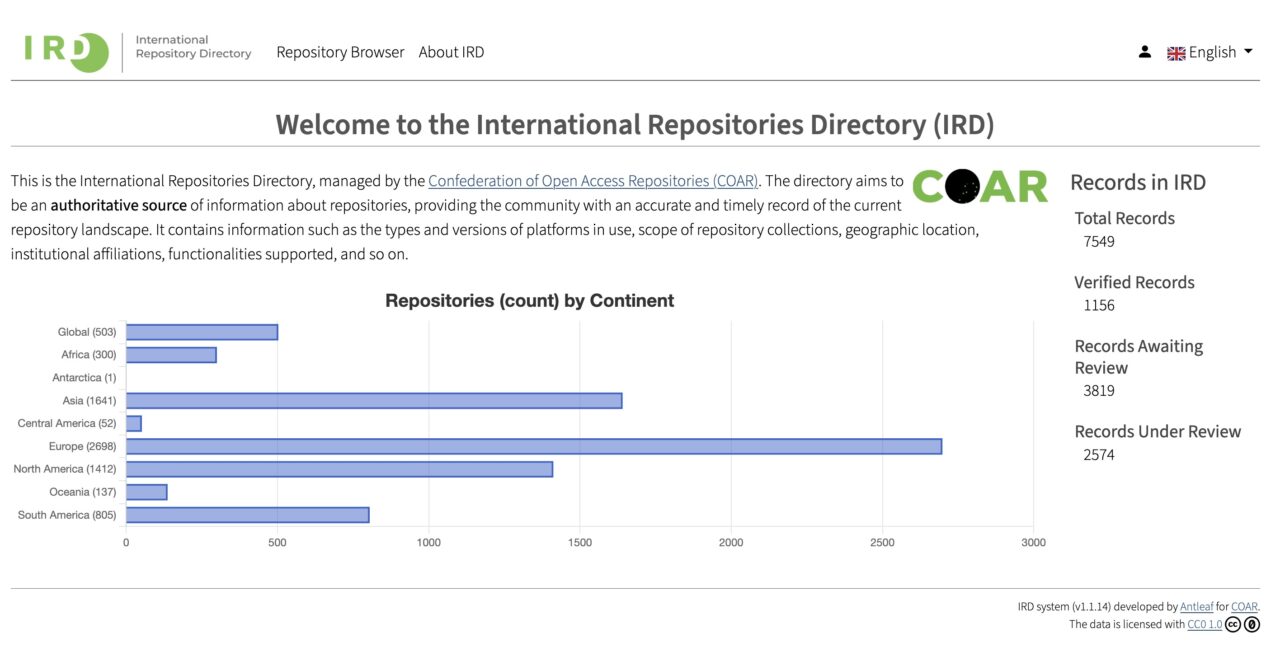
Look how Europe leads the pack! It did not register yet the curiosity about the contintent with just 1 repository.
It was not right away obvious how to get in, but I tried the Repository Browser link and voila! I’m into a clean search interface. This could have been enough for me to stop and just pinboard the link, call it a web day.
But I am looking at the filters for country, and there again I see Antarctica with an indicator of 1 record. I just had to wonder, what open-access repository was down there? Some kind of science research one, most likely.
There it is, the entry for RUresearch Data Portal, probably something about penguins or ice core data, right? Not much info, it has not been renewed.
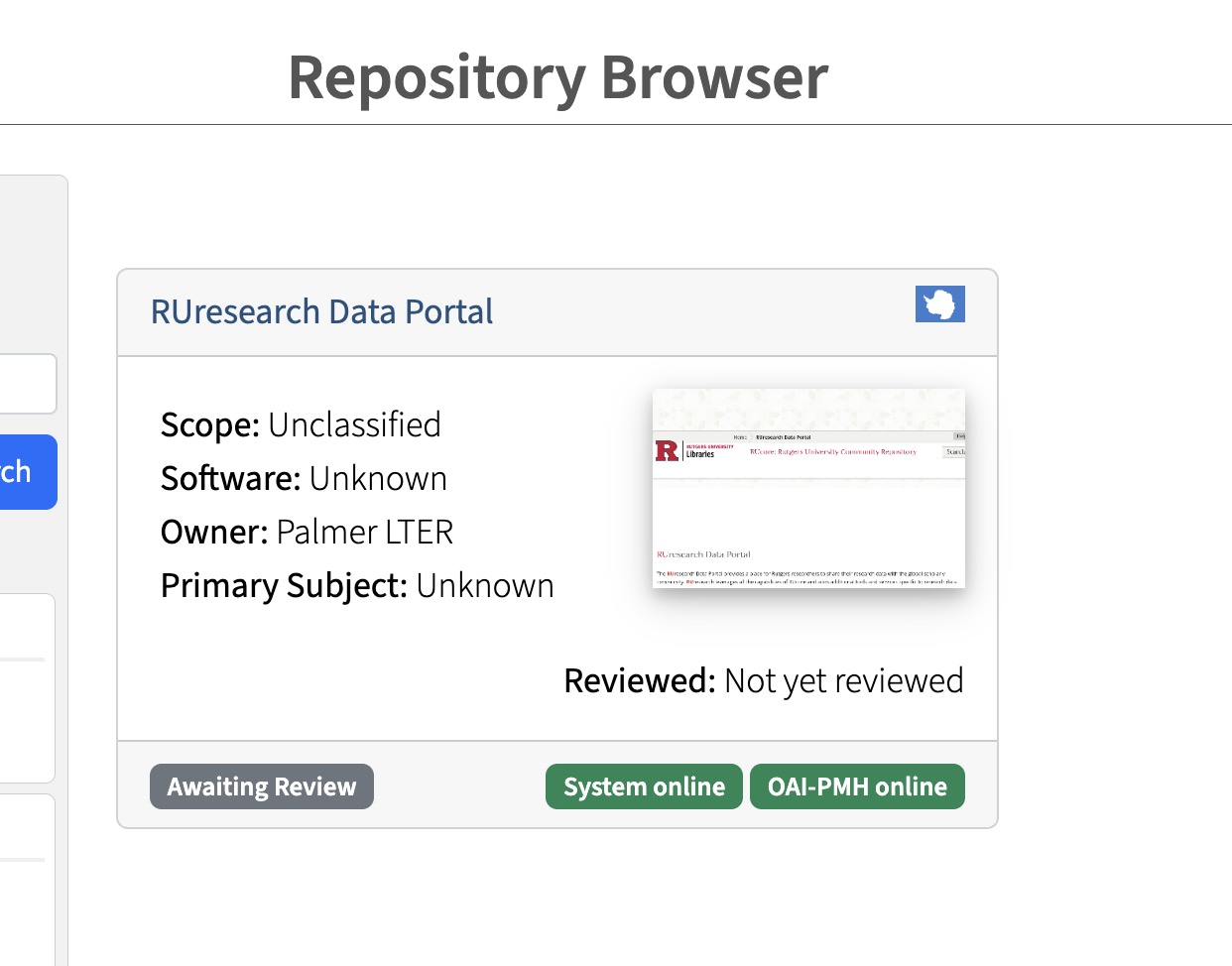
Again, this could have been the end of the link road, enough done? But I follow the title link and I’m drilling down into more metadata for RUResearch Data Portal, its owned by “Palmer Long Term Ecological Research” but the URL… https://rucore.libraries.rutgers.edu/research/ is a repo of research data at the Rutgers University library.
Hold the phone, that’s New Jersey, right? I’m on their site, reading info like:
“The RUresearch Data Portal provides a place for Rutgers researchers to share their research data with the global scholarly community. RUresearch leverages all the capabilities of RUcore and adds additional tools and services specific to research data.”
https://rucore.libraries.rutgers.edu/research/
Lots of RUs! Again, close window seems logical, but I glance at the sidebar on the lower right under a heading “Highlighted RUresearch Collections” is a link for Video Mosaic Collaborative — hey that sparks some interest.
Click.
Now the interest is rising, no longer caring about Antarctica:
The Video Mosaic Collaborative (VMC) is an interactive collaboration portal designed to enable teachers, teacher educators and researchers to analyze and utilize the real classroom videos shot over a span of 20+ years to make new discoveries in math education and transform mathematics research, teaching and learning.
https://rucore.libraries.rutgers.edu/vmc/
Research on 20 years of classroom videos? I am back on the click again train for the link labeled `https://videomosaic.org`
Oops.
One problem. The actual hyperlink has a typo in it, it points to `https://.videomosaic.org` (extra period in front of video, ooops). And this is where a crawler would stop right? Dead link, dead end.
Alas, I at the url bar can undo the typo to get to https://videomosaic.org
And wow, the project’s subtitle is “Watching students grow with math”
The Robert B. Davis Institute for Learning Collection of 300+ videos (100+ hours) consists of observational videos of students learning mathematical concepts. The videos were captured through a series of research projects studying the same student sample, from first grade through high school, 1992 to the present. The collection consists of video clips edited to highlight evidence of student reasoning and effective teaching practices as well as raw footage suitable for education and child development research. Additional video from 1,350 hours of raw footage continue to be added to this unique and growing collection. 30+ dissertations, 50+ articles and two books, with two additional books in production have resulted from research using this collection. Teaching principles modeled in the studies promote independent thinking and reasoning by students.
https://videomosaic.org
They tracked in video how students learned math over a span from grade to 12 (and beyond). Woah. From one of the front links I am now into their case study of Romina, a student they recorded videos of her mathematical reasoning from 1st grade 1992 through the end of high school and later as she went to work as a consultant and ultimately a final video in 2006 as an MBA graduate.
These are among 300 videos for this project, a part of larger corpus of research at Rutgers University, and itself one of 7000+ repositories of open-access research published globally.
Getting here from a Mastodon user profile seems magical. And it makes even more clear how vast this web is, and how impossible it is to know it all or even in part.
Hole 2: From #Small Web to Netizen Ideas
This path is shorter, and again, spawned by almost luck. I have in my RSS reader a feed for the #Smallweb tag in Mastodon. I glance at it irregularly, but it was almost the same day as hole 1 that I went down again spotting this item as it was in my reader:
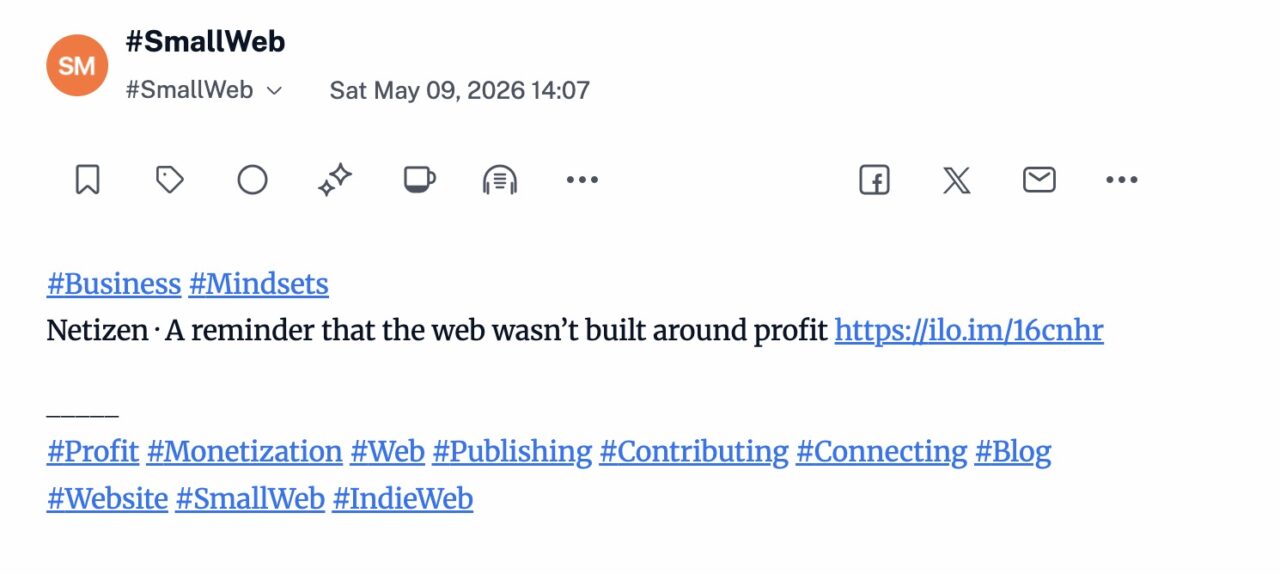
Nothing about it I can recall jumping out, and the first hashtags might be a move on warning, but the phrase on the web not being built for profit and the word Netizen sparked something (the URL seems to be a shortener, so no clue).
What a great delight to find that this was a post by Derek Sivers titled indeed Netizen – read it, it’s very short. But he talks about finding his way to the internet in 1993 (about the same time I did) and how it was a space where people were just more than eager to share and help.
Slowly the culture around me changed, so now it seems I need to explain my strange behavior — why I don’t monetize everything like everyone else. I’m just a product of my place and time. 1993 shaped how I think of the internet, and I’m keepin’ on in that original spirit.
Like picking up trash where you walk, even if the rest of the world is full of litter. You keep doing what you can to make things better.
https://sive.rs/netizen
Derek offers the 3 things he commits to in this vein – he answer emails from everyone who emails him (10,000 oer year, guess who is adding to his total; running NowNowNow.com an aggregation of individual web sites with “now” pages (I’ve seen this somewhere), and the most doable one I will pledge to– keep sharing everything he can on his site.
The thing I know him for is a video someone (I am thinking maybe Darren Kuropatwa, where are ya buddy?) shared with me long long ago when I was doing those not antiquated presentations/keynotes on sharing, that so full gets to a main reason educators don’t share- they downplay their own work. Here from 2011 and still feels right today
In fact I just used it a few months ago in a small contribution I made to an article in the CHallnges of Sharing feature- From Judgement to Sharing: Rethinking Teaching Practices in the Era of Open Education.
It’s that good.
Be more Netizen, eh?
That was just two link paths down the web rabbit hole and back. I still love using intution to follow links (which more often than not hits dead ends).
Holes of interest still for me.
Featured Image: Holes of Interest flickr photo by cogdogblog shared under a Creative Commons (BY 2.0) license
 Share this barking on social media
Rabbit holes are the best holes of interest for sure! I went on so many this past week, related to digital gardens. I’m also geeking out so bad with Obsidian and a way of organizing our digital stuff called Johnny Decimal. Though of course I had to make it my own and distinct in some way. So my version is called Bonni Decimal. ??
What a fantastic character name! I can just read in your words the excitement of discovery. May your decimals have high degrees of precision.
@barking I like the idea of behaving that way because that’s how you learned to behave, and have no intention of changing.
Remote Reply
Original Comment URL
Your Profile
Why do I need to enter my profile?
This site is part of the ⁂ open social web, a network of interconnected social platforms (like Mastodon, Pixelfed, Friendica, and others). Unlike centralized social media, your account lives on a platform of your choice, and you can interact with people across different platforms.
By entering your profile, we can send you to your account where you can complete this action.
I’ve started going down nineteenth century rabbit holes in things like the Briitish Newspaper Archive, and the Internet Archive (Notes & Queries is a particular favourite).
One rabbit hole is the correpsondence debate, where over a period of weeks two or more people argue over something or other, sometimes across different periodicals, often with other people chipping in from the sidelines, again in other publications. Tracking down the web of communications, particular where the OCR is flakey, is a bit like a puzzle (eg one one communication refers to something published you havenlt yet found, a bit like citation chasing).
Another rabbit hole is where one story turns into another. This simple “fact check” of a stroy about a duel in a pub I go to an open mic in turned out to have both precedent and and antecedent bits to the tale once I started looking… https://island-storynotes.montystoryteller.org/wheatsheaf_duel.html
I love how your path just started from noticing an object on the wall. It seems like we could fall down those holes an endless number of times (and maybe never eat or bathe again), but if you never take a tumble…
Such a long tale just from one man calling the other a coward! That act cannot stand. You did a masterful trace there.
Just the other day our daughter? A history PhD student shared an archival telegrsm of a land surveyor reporting back to HQ his dismissal of a worker who disagreed with a measurement and “ told me to go to the place of eternal punishment with the curse of the Creator”. Sounds like regular social media.
Great as always to hear from you Tony!