
Amongst the many blog post drafts still bouncing around upstairs is one about being the last person ever to vibe code anything but of more interest is writing about what is my major project at the moment over at Open Education Global, the Open Education Awards for Excellence.
Aince I end up doing what one might call blogging over at OEGlobal, I wanted to just mention a post I spit out last week that has some overlap, a summary of the responses nominators made in 2025 when I added a field for declaring their use of GenAI in compiling a nomination. Read the whole shebang, it’s pretty much a blog post hanging as “news” (I have no luck convincing my colleagues to write posts that are not just ANNOUNCEMENTS).
First of all, I read / scan all nominations as the come in over a span of weeks. One part is that I have to add a few tags/classifiers on the back end, but also it gets me a good sense of the pool this year. So I already had a sense last year that much use of GenAI was for people whose first language is not English (the G in our organization’s name!) as well as fitting to the form field character limit, but also to help draft/frame replies to match the criteria.
It was in the mindset of experimenting that I decided to swallow my LLM loathing (actually I use them often for organizing unstructured data) and load the responses into NotebookLLM. I did not add an identifying information, I only used as data the response to the open ended question on GenAI transparency and also included a column for the country of the nominator.
I will not repeat the outcomes (read the post), but it did a fairly good categorization that was along the lines to my own, and also did a decent job to pull some relevant quotes. Also, because the question was just one question “Describe your use if any of GenAI in writing your nomination” I aimed to have to pull from responses some sense of what LLMs were used.
The assistance for non-English speakers is pretty obviously important and something I would never want to limit– although we encourage nominators to write in any language (we get a few in Spanish and French) as we can translate and send to multi-lingual reviewers, it is pretty clear that most feel like they should write in English.
On Groundtruthing
There is an aspect of the whole GenAI game I do not see discussed (though I hardly see all most discussion) but that is having a familiarity with the data one is analyzing. Without being close to understanding what’s being dumped from the truck into the magic machine, the only way you can judge the outputs is how readable or pretty they are.
This leads me back to my formative academic years studying the subject that has nothing to do with my current work- Geology. So much of the education and process was “experience in the field”- you can understand all the concepts and block diagrams and mineral thin sections, but without what was always called “ground truthing” you are getting into something close tio statistical or speculative conclusions.
For decades before I started and into my study years, for mapping and field work, we relied much on areal photography of landforms their relationships. When we trudged out to a real place on the earth, along with the maps and compasses and rockhammers and notebooks and granola bars in our backpacks, we’d take those photos out in the field tio see if what we saw from the air matched what was really there.
In my Masters research it went to another level in that I was using data from Landsat satellites to see what its data (some outside the human visible range) could tells us about large areas of volcanic landforms.
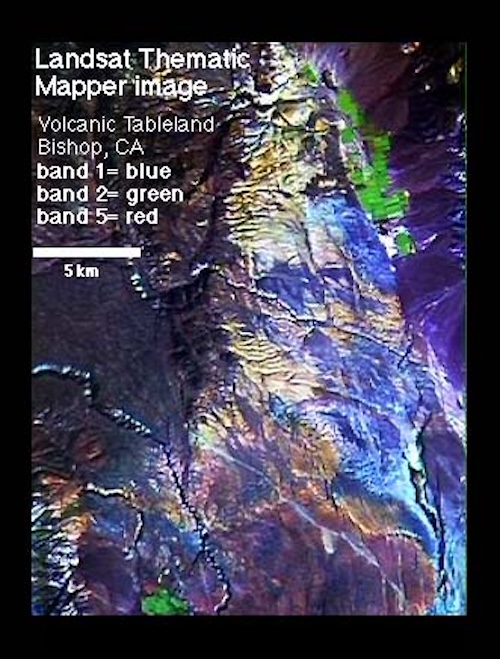
The satellites merely collecting the energy radiated back to their sensors from light bouncing off the ground. The work included analyzing and experimenting with representations the data recorded then on magnetic tapes, with then the field work or ground truthing to see what was revealed “out there” taking samples back for inspecting under microscopes and labs to measure their spectral reflectivity.
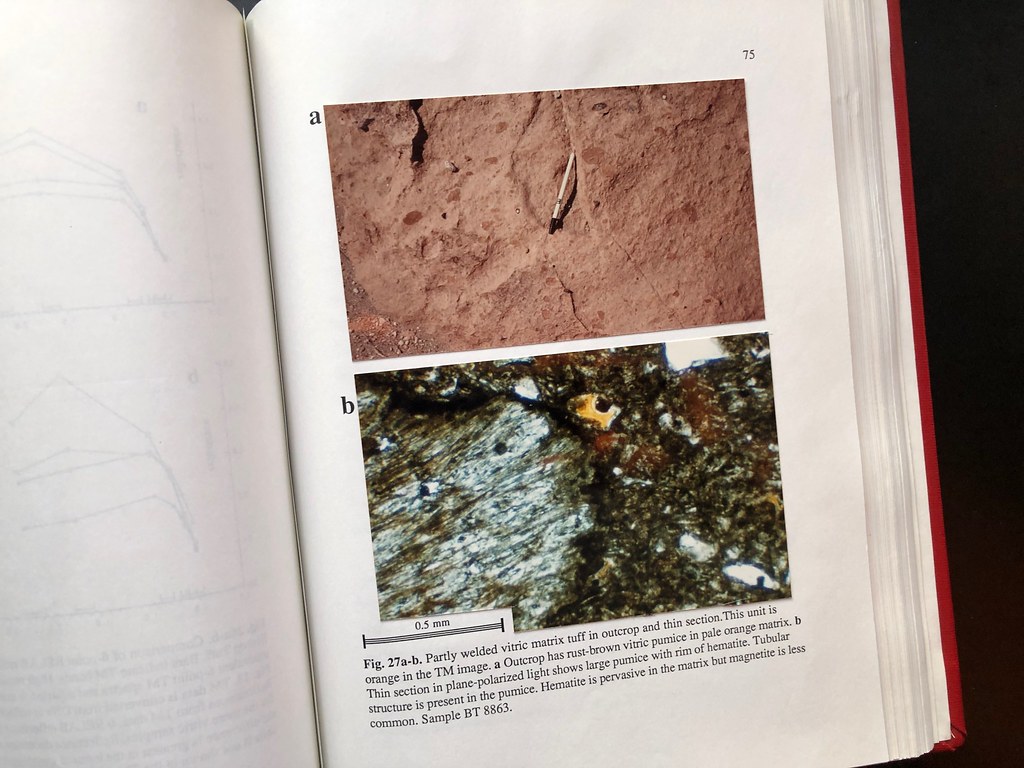
Old School Pasted Images flickr photo by cogdogblog shared into the public domain using Creative Commons Public Domain Dedication (CC0)
I see what we are rushing to do with LLMs and GenAI is to do a lot of fancy summarization, generation of stuff measured way way up in space. But if you have never walked up and down the hills, canyons, cracked open rocks to examine in details, took samples back to the lab, measured sections and mapped with notes, how to you know what to make of the pretty pictures the data could show.
I diverge a bit too much with my Geology field work nostalgia days (actually they could be extremely frustrating, another story).
If I am plopping something into an LLM to analyze, summarize, something-ize I will always have done some sort of first cut myself or at least have an understanding what data went on.
GenAI for the 2026 OEAwards
Again, I wrote more details already, but I did make some refinements in the questions for the 2026 Open Education Awards (open for another 26 hours!). The first was making the first question be a simple yes/no, did you use GenAI at all for writing your nomination (making this a clear data point not inferring form responses).
At this moment the “yes” rate is a notch above 60%. If this was the response, then the next question asks the nominator to explicitly share what tools they used and for what purpose.
From reading this year’s responses, the use cases/reasons are fairly similar, but what comes through more is how usual this seems (my inferring) for people who use GenAI, that it reads like part of their normal workflow. Also the tech last year was mostly ChatGPT, this year I am seeing more Claude and Copilot mentioned.
There will be a followup analysis.
Humans will Be Humans
With a bit of sad irony I spotted this pattern once in 2025 and twice so far in 2026. A nominator indicates that they did not use GenAI, but the at the top of the description or rationale entries is a bit of the reframing response from the machines, like “I have condensed the description for you to copy to the nomination form” or “Here is the text you can copy to the reasons for nominating response, reduced to match the word limit.”
I almost do not know what to do with someone who states a negative as on a question of transparency but leaves the tell-tale dirty fingerprints of LLM responses in what they copy paste.
It is most human of them.
Featured Image: I adamantly refuse to have any image for my writing to be spawned by GenAI., For the love of humanity, make use of the oodles of open licensed images to which you can credit real breathing people as well as go first to Better Images of AI if you need an image to represent GenAI that is not another Robot or blue glowing brain. For this post Better Images of AI graphic Distant Writing by Fabrizio Matarese Licenced CC-BY 4.0

 Share this barking on social media