
There’s more to memory than just recall versus forgetting. I came across this brilliant read “To grow, we must forget… but now AI remembers everything” and it downs like the broligarchy thinks they just need to toss into the algorithms is a machine that never forgets?
Forgetting is a feature of human memory
“Infinite memory” runs against the very grain of what it means to be human. Cognitive science and evolutionary biology tell us that forgetting isn’t a design flaw, but a survival advantage. Our brains are not built to store everything. They’re built to let go: to blur the past, to misremember just enough to move forward.Our brains don’t archive data. They encode approximations. Memory is probabilistic, reconstructive, and inherently lossy. We misremember not because we’re broken, but because it makes us adaptable. Memory compresses and abstracts experience into usable shortcuts, heuristics that help us act fast, not recall perfectly.
They argue almost we are designed to forget.
Yet lost in this to me is not whether we remember everything or not, but that joy of recall, or one of those forgotten memories that swirls to the top of our awareness, without visible cause. Or how it triggers connections to what is statistically so far its off the edge of the chart.
There is joy in that serendipity, the kind of joy the AI machinery wishes to roll over and obliterate.
So follow along on an imperfect tale of recall and connections that connect the non connected.
Let’s Start With a Mention of Fractals
My OEGlobal colleagues are rolling out a staff book club discussion of adrienne maree brown’s Emergent Strategy which I am learning rolls out the theme of fractals. In the Slack start of our discussion, a colleague writes:
In everyday language, especially in Emergent Strategy, fractal refers to the idea that:
“How we are at the small scale is how we are at the large scale.”
If you want organizations, communities, or movements to be compassionate, equitable, and connected, those qualities need to show up in the small day-to-day interactions, too.
So: small patterns = big impact.
I can get behind that. As a math geek in school, as a a former gard student in geology where fractal patterns flow – somewhere I have on the shelf by copy of D’Arcy Wentworth Thompson’s On Growth and Form. I’ve evoked fractals in the glory days of DS106
and also an argument against the pursuit of scale.
So let’s see this week fractals just bubble up in the active area of my grey matter, or maybe just was dialed into the antennae of my information scouring.
The Grand Connection
As far from this as it could be, the next connection was a one word message from my good friend I knew originally from Arizona, Todd. One word “water” well and a link.
The “story” in the link is how the hotels on the very busy South Rim of the Grand Canyon had to close due to a lack of water, citing forest fires on the North Rim that destroyed, well not only the lodge and visitors center but also the infrastructure of the water system.
Now for a bird, the distance between these points is maybe 10 miles, by road it is 200 plus, and by foot, walking the trails it is maybe 22 miles. But this is a story of Geology. All those pretty layers of rock fprmations you see in the vistas, that look flat, are actually tilted a bit south. What’s the big deal? Well all the snow that falls in winter, that melts into the ground, hits those layers, and flows away, south. There is no water supply on the south Rim. There is much on the North Rim because of that flow from land to the north.
Thats where the engineers came in and built the Transcanyon Waterline a hydraulic system of pumps on the North RIm that let water flow down pipes to the bottom, an pumps there push it up to the thirsty tourists and washrooms on the South Rim.
That plumbing system runs underneath the main hiking trails that connect the rims. I’d seen this in 2013 when my friend Uwe and I did the classic Rim to Rim hike, a 24 hour trek overnight from North to South.
And here is where the pictures come in. For some reason I thought I had photos of the water line, or maybe the pump system in my flickr, so I did a search of my photos on grand canyon and memories fly open on the scrolling results. The closes I came was the water line cap I had spotted that had an ironic name on it. I suppose its an access point where they can check the flow or test the water. The Rich Water.

But it was in that scroll that I spotted an unlikely image, why is an article with a title of The Sierpinski Triangle doing in this search results?
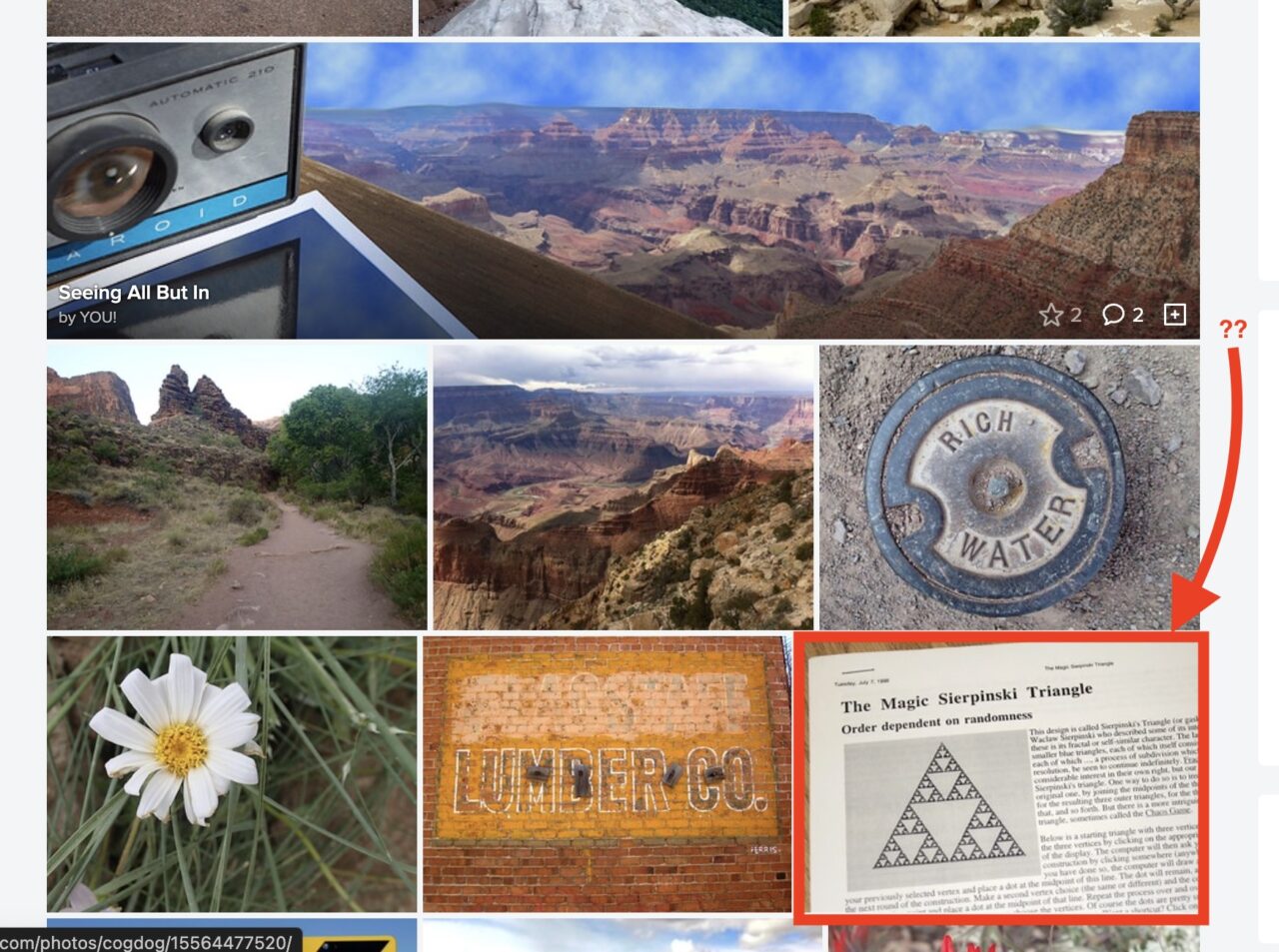
The Magic Sierpinski Triangle
So the next unlikely stop. An article dated July 7, 1998 on The Magic Sierpinski Triangle with a tag ine “order dependent on randomness”:

I was unable to search for a publication source, but the memory flows kick in again. But we can Wikipedia it for all the skinny.
[The Sierpinski Triamngle] is a fractal with the overall shape of an equilateral triangle, subdivided recursively into smaller equilateral triangles. Originally constructed as a curve, this is one of the basic examples of self-similar sets—that is, it is a mathematically generated pattern reproducible at any magnification or reduction. It is named after the Polish mathematician Wac?aw Sierpi?ski but appeared as a decorative pattern many centuries before the work of Sierpi?ski.
https://en.wikipedia.org/wiki/Sierpi%C5%84ski_triangle
Woah we circle back to fractals? And its simple yet complex. The recipe is easy. You start with an equilateral triangle, and subdivide it by 4 more inner triangles, take away the middle one, and then repeat.
Forever.
.png)
The Wikipedia article then opens up all the weird avenues like the Serpinski Gasket, the Towers of Hanoi, 3D pyramids, and more.
The Gift of a Mentor
That article was given to me I’m sure in my first year or two of being a baby educational technologist at the Maricopa Community Colleges. It came from math teacher Betty Field who taught at Paradise Valley Community College, but her legacy goes back to those innovative time in the 1980s when the Maricopa system made huge advanced moves in networking the entire district and seeing the potential of both computing technology for system operations but more, micro computers as they were called for learning (this is all another post or 20 of Maricopa history).
Betty Field was deeply part of this history of educational technology at Maricopa, and was a close advisor to Naomi Story, director of the Maricopa Center for Learning & Instruction (MCLI). It was Naomi who hired me in 1992, a mullet headed Geology grad school drop out who had a few computer chops, for a position in MCLI as “Programmer Analyst/Instructional Systems”.
I was so naive for the interview (which I was floored that I got), I had envisioned I would be talking to one person. I walked in a little conference room to maybe 6 staff and faculty from the district… oh it was a hiring committee. Betty was there! In my career, she was always a mentor, to me and others. I remember meetings when she would draw on her long experience with words of “just some words from Mother Betty.”
I am on guess level wavelengths here, but I am sure Betty shared that Siepinksi Triangle article with me for the mathematics of fractals, but there was another Grand Connection.
Those Hiking Math Teachers
I learned these stories later because I became close friends with Betty and her husband Roger, bonding over a love of the Arizona wilderness and hiking it. They came to Arizona from Colorado, both hired in their first teaching jobs at Northern Arizona University. I remember Betty’s story of how much they loved hiking in so ,many places accessible from Flagstaff, she said that first year they were backpacking “50 of 52 weekends”.
But in that math department she got to know very well fellow mathematician Harvey Butchart a legend more for his obsession with discovering unknown (often dangerous) hiking routes into the Grand Canyon.
Butchart kept a detailed log of his explorations, which would eventually reach more than 1,000 pages.[5][4] He recorded 1,024 days spent in the Canyon, and over 12,000 miles (19,000 km) walked. He climbed 83 summits within the Canyon, and scaled the walls at 164 places, claiming 25 first ascents. He was credited with discovering over 100 rim-to-river routes within the Canyon.
https://en.wikipedia.org/wiki/Harvey_Butchart
Now here is where my mind is really stretching at the neural seems. I recall Betty sharing Butchart’s use of a mathematical approach to his canyon wayfinding, maybe as general as Google AI’s suggestion “Butchart treated the canyon as a complex problem, methodically working through uncharted areas, much like solving equations.”
But I remember a germ of a conversation where Betty described Butchart’s notion of the fractal aspects of the canyon or maybe that the forms and shapes he saw in his hikes were repeated on levels from the grand down to the rocks under his feet.
I just carried this idea that there was a relationship of fractals and the Grand Canyon. And all of that surfaced this week as well with that Sierpinski triangle.
Shockwaving the Triangle
In those days my technology development was heavy into multimedia development with Macromedia Director and mixing with my earlier interest in the web, putting media into the web with Macromedia’s Shockwave. Okay I will brag, through a lucky coincidence and a wild shot email, I got to be on the beta test for Shockwave, when it was called “Fried Green Director”, even woth .fgd file extensions.
From that article Betty gave me, I made a Director animation version of the Sierpinski Triangle, that I hung in my collection I called the “No Java Shop” (this was in reference to the tech hype at the time was Java and I loathed the hype intensively).
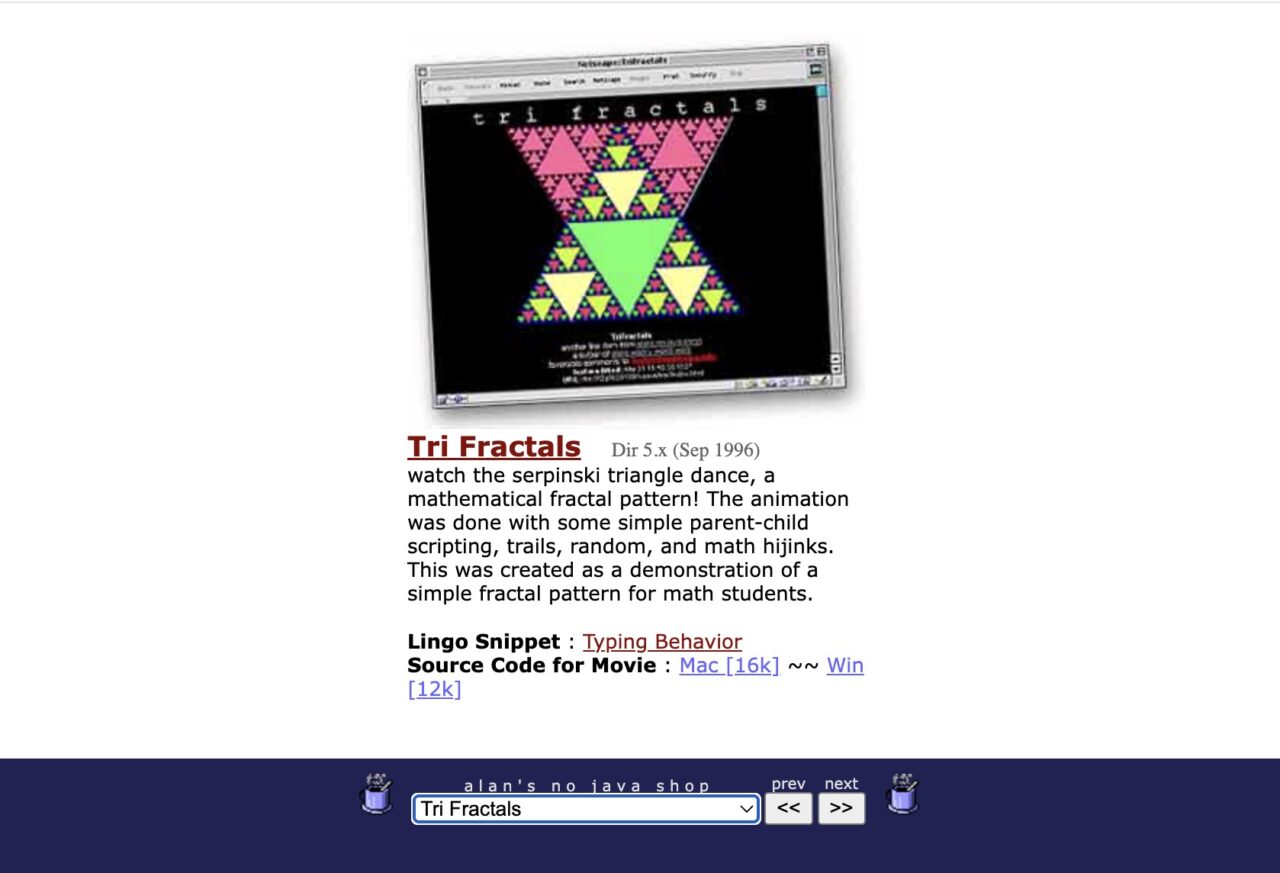
Of course it does not work know because Shockwave is a dead tech –just on a whim I searched yesterday and found an open project and a Chrome extension offering emulation of Director content, none working for me yet.
I might have to break out the working 2002 iBook to see if I can get a running version.
But the animation is not important.
It was this wild path of largely unrelated topics for the vast majority of the world – fractals, the grand canyon, a math teacher, and a Sierpinski Triangle that thread together in me, through my own stories, experiences, and people.
So I do not care how much of the worlds water and electricity you through at making machines “think like humans” to me it will always be just a simulation thereof. Machines cannot know this rush of serendipity and joy in reliving memories.
Life, memory, love… does not compute.


@barking we’ll, I was down the rabbit hole too. Only I was playing golf with some real cards.
Remote Reply
Original Comment URL
Your Profile
Why do I need to enter my profile?
This site is part of the ⁂ open social web, a network of interconnected social platforms (like Mastodon, Pixelfed, Friendica, and others). Unlike centralized social media, your account lives on a platform of your choice, and you can interact with people across different platforms.
By entering your profile, we can send you to your account where you can complete this action.
Hi Alan,
This makes me think about several things.
Your “memory story” posts are from a different & much more human place I imagine. I always enjoy following the twists & turns.
The AI and memory links was fascination and the solutions interesting. I’ve noticed that AIs give answers I a not looking for when they make mistakes about the domains I am working in.
Lately I am starting to think that my own rather poor memory is linked to my inability to visualise (Aphantasia, I suspect). I wonder if that is why I find blogging, and the ‘on this day’ plug-in so interesting.
I’ve occasionally thought about those quantifiable self type of site. I don’t think I’ve got the consistency and dedication needed, even if I decided that would be a useful approach.
“rush of serendipity and joy in reliving memories” goes into the quote book!