
If anything, my career long use of dog metaphors summon, I hope, both the attributes of loyalty, but also the refusal to relent pulling at something. So… it’s been 16 years since I took a dive into the myth of humans processing visual information 60000 times faster than text.
And I never let up in scrounging deeper down the information holes indeed that looks to average one per year. But still, the trail has been cold since 2015 when (with help) I was able to surface the first source was an ad insert in a June 28, 1982 Businessweek article (when they came in these devices called “magazines”) written by one Philip Cooper.
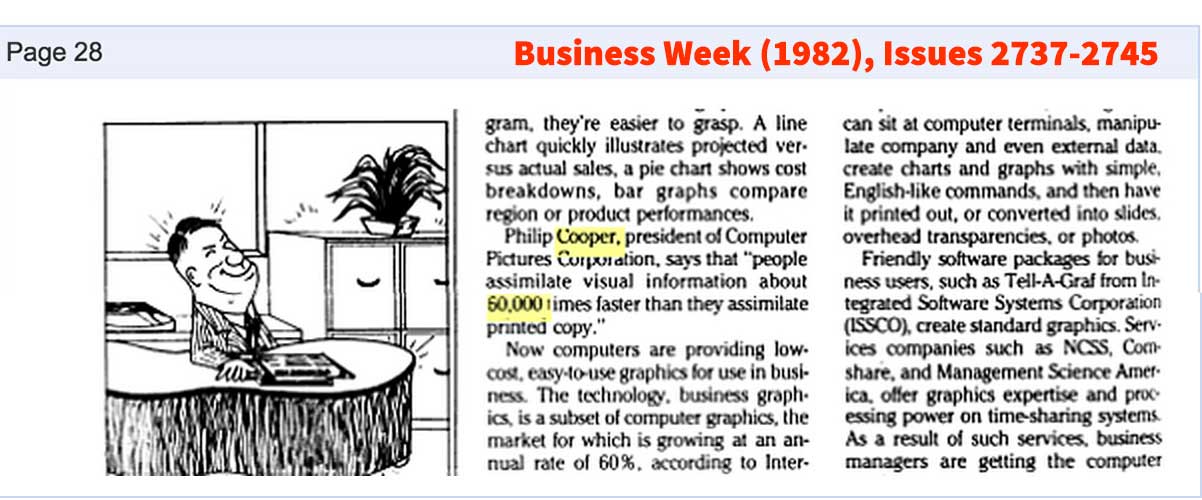
The waves rippled recently when I got an email from Mark Santos who runs Mark Studio where they published an extensive piece Video Thumbnail and CTR Statistics (look at my I had to look up what CTR stands for) and in it included in a section of myths a heading for “The brain processes an image in 13 milliseconds” and “visuals are processed 60,000 times faster than text” that summarizes it again, kindly crediting my obsession:
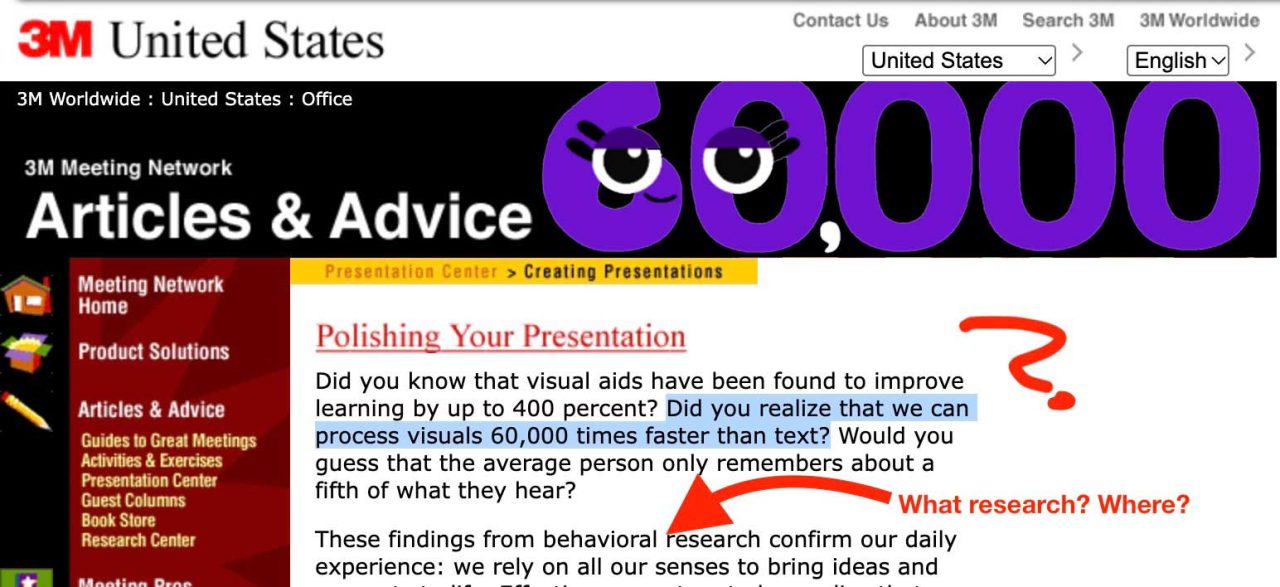
The 60,000 figure has no study behind it that we could find. Its earliest known appearance is an advertisement, not research: a Special Advertising Section in the June 28, 1982 issue of Business Week, “Computer Services: Management’s Answer to Data Overload”, quotes Philip Cooper, president of Computer Pictures Corporation, as saying “people assimilate visual information about 60,000 times faster than they assimilate printed copy”, with no source. Alan Levine, who blogs as CogDog and has chased the line since 2012, reported the find after a reader spotted it and a librarian confirmed the issue; Levine wrote to Cooper in 2015 and got only an out-of-office reply (CogDogBlog, March 2015). Later repeats include a 1998 presentation by a 3M product specialist (CogDogBlog, April 2014) and a 3M Meeting Network presentation tip sheet captured in January 1999, which credits unnamed “behavioral research”. The only 3M-funded study we traced, a 1986 University of Minnesota study, found presentations with visual aids were 43% more persuasive; it measured persuasion, not speed (University of Minnesota / 3M), and its lead author, Douglas Vogel, told Levine his research “had nothing to do with visual processing speed”. HubSpot still states it as fact: “research has determined that the human brain processes visuals 60,000 times faster than text” (HubSpot, 2023).
Thanks Mark! https://www.markstudios.com/research/video-thumbnail-and-ctr-statistics#origin-13-ms
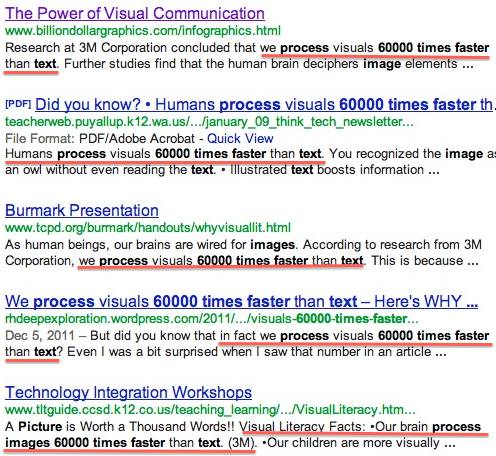
It’s worth noting that since I started barking about this, the google search results for image processed 60000 times faster text has drastically changed. In 2012 it was just repetition of the claim in many published sources to in 2026 more of the top links (not all) are its debunking.
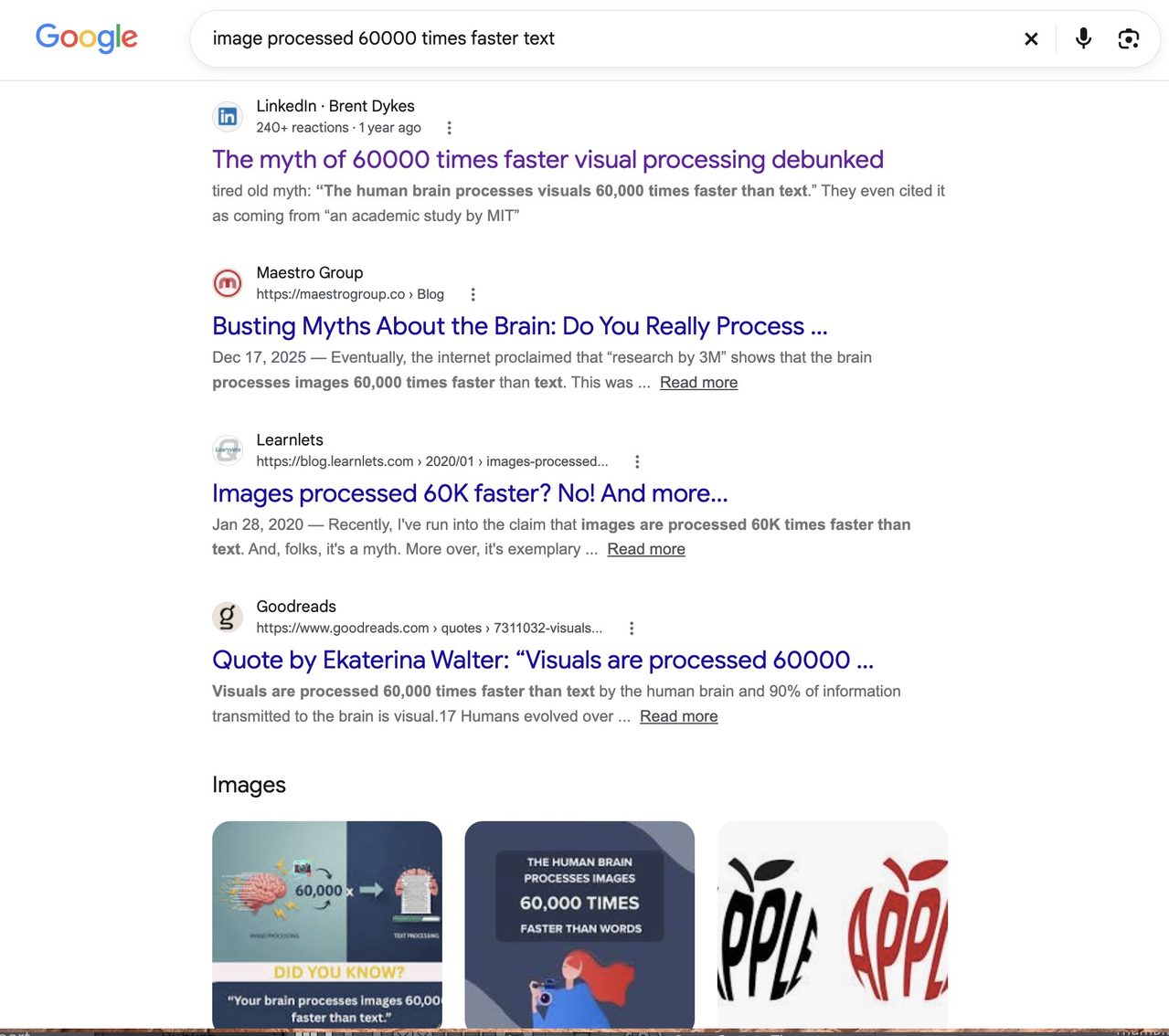
I have to take a humble brag that most of those debunking articles give me some credit in name and even sometimes with a link. But that’s not what I care about. It really is like a zombie refusing to die.
Yet, there is a person out there that can resolve this all for once, the author of that Business Week insert, one Philip Cooper. Previously I had tracked him down as a faculty at the MIT Sloan Management School, I sent emails and even once left a voicemail.
And let’s give Phil some prescience credit- his 1984 MS Thesis at MIT was about some pie in the sky technology– Artificial intelligence : a heuristic search for commercial and management science applications. It goes deep in over 200 pages, starting with:
The issues behind Artificial Intelligence are not simple. To understand the the framework we will be discussing commercial products in, it is necessary to have a good understanding of the history and relevant issues of the disciplines from which Al emerged. We can’t do more commercially than we can do theoretically.
https://dspace.mit.edu/entities/publication/c69b3e57-af82-411e-85cd-229b18c9369b
and ending with
Intelligent computers present us a new challenge. They have the capacity and promise to reshape our society, jobs, leisure time, and limitations. The time may come when the Office of Human Resources (formerly the Personnel Department) will have to be called the Office of Cognitive Employees. Perhaps managers will interview machines as well as people. Perhaps the managers will be machines. So we may as well start doing unto machines as we would have them do unto us.
Satis verborum. Enough of words, no more need be said.
https://dspace.mit.edu/entities/publication/c69b3e57-af82-411e-85cd-229b18c9369b
Phil is around, he is founder of Pine Island Capital Partners and as you cant seem to help anymore that when trying to find people, you end up in LinkedIn at his profile. I loathe LinkedIn, and I have striven to have the most barebones useless presence there.
Alas in desperation (and maybe realizing how little I know how to use LinkedIn), I heaved a cast into the waters.
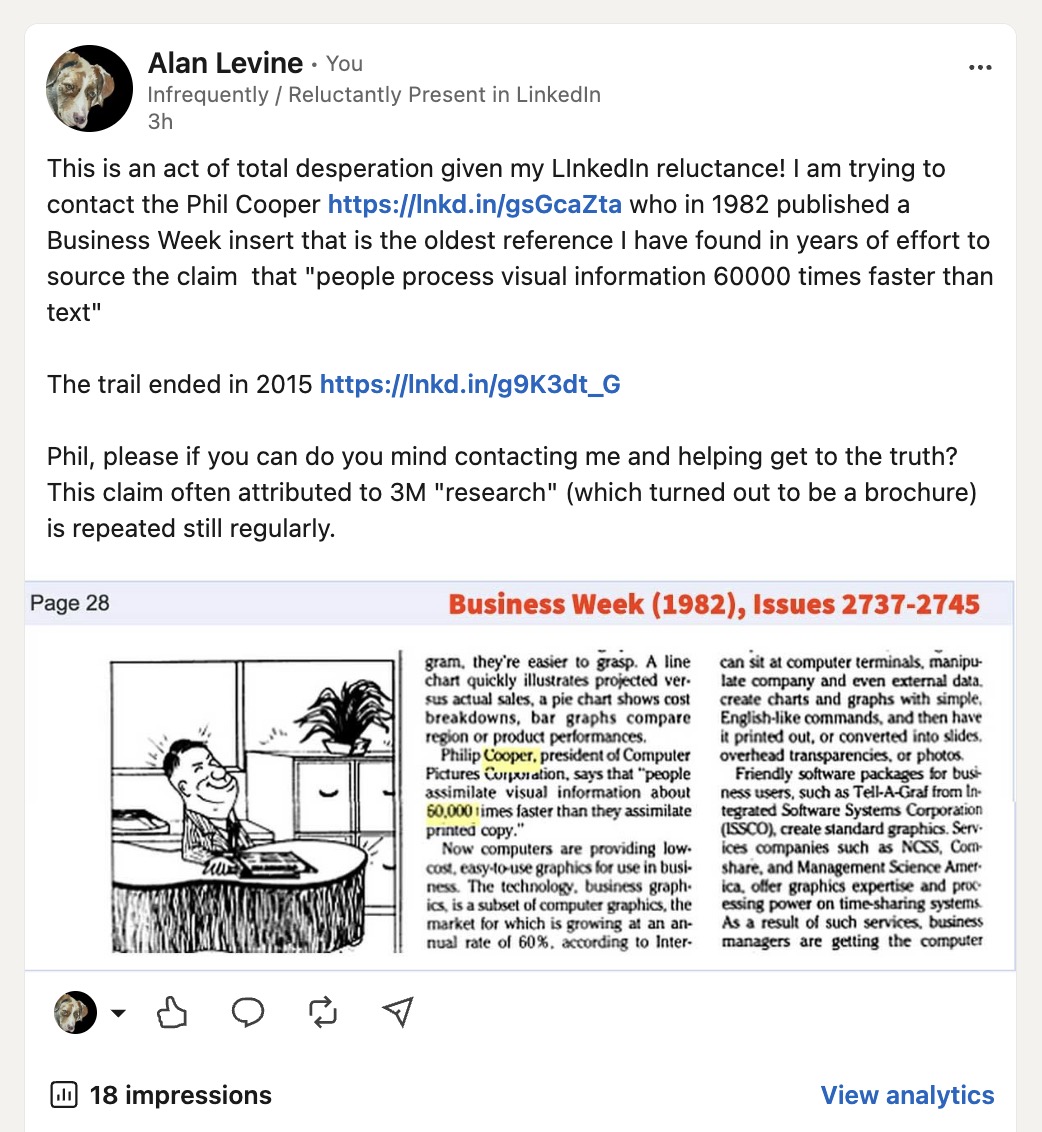
Even if this finds him, I doubt he would really reveal where the statement came from. Frankly, it just has a great sound, the evenness of the 60000 number, and the way it has was said, and repeated and repeated and repeated and repeated that it achieved, for a while, a state of truthiness.
Anyhow, Phil, even if you do not want to make it public, I will honor a request to keep the secret.
Where did this come from?
Phil?
At least this gets me to 17 posts in the chain for the upcoming 17th year of trying.
Featured Image: Screenshot of the 3M Polishing Your Presentation post in 1999 with my own annotations / commentary. on the 60000 times faster claim. Superimposed on top is the Deviant Art image Wonderland: Big Number 60,000 by Nixon1010 shared CC BY
 Share this barking on social media
Glad to see you getting the recognition! Im still seeing this claim in training decks among others. Keep chasing.