
Strap on your seatbelts for another weird web ride back to my early web work days at the Maricopa Community Colleges, with some humble bragging (or maybe not so humble) on some of the big name educators we were able to bring in to our Ocotillo retreats in the late1990s early 2000s.
This starts with a fascinating conversation time for a recent OEGlobal Voices podcast session I did with Barbara Illowsky, an OER pioneer at DeAnza College, but more than that a gem of a human being (ignore her comments about being old when she gets to the part of hiking mountains in Africa)
The connections flowed as Barbara talked about her fortunte that her college President, Martha Kanter, urged Barbara to join her for a trip to Texas to learn about a new publishing platform from Rice University called “Connexions”. She and her colleague Susan Dean authored Collaborative Statistics one of the earliest open textbooks published on what we now know as OpenStax.
Her mentioning Connexions/OpenStax founder Richard Baraniuk triggered my associative link trail because I remembered we had him as a keynote speaker for the system wide year end conference I organized in my time with the Maricopa Center for Learning & Instruction at the Maricopa Community Colleges. With some zipping around the Internet Archive I found the 2005 Ocotillo Retreat that took place at South Mountain Community College.
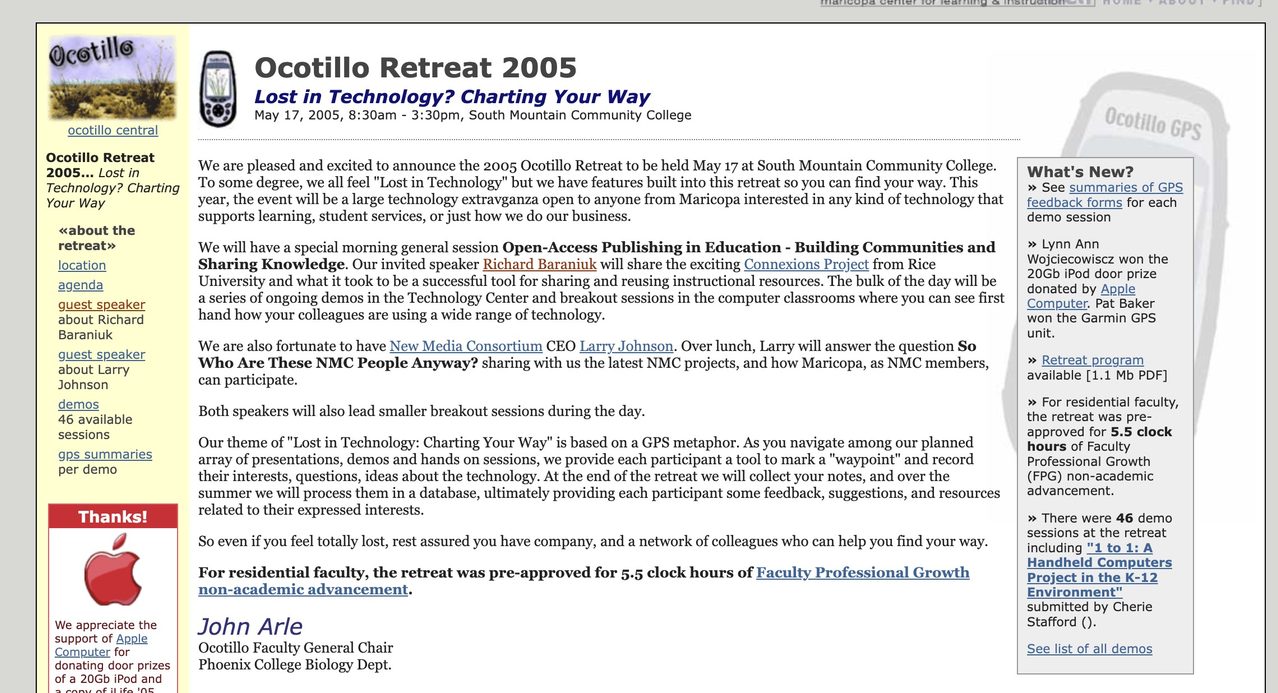
I remember now this metaphor of wayfinding through technology together via the images of a GPS device. Describing what Ocotillo was is actually a whole blog posy and a half, but let me say it was an impressive systemic approach to addressing the impact of technology on teaching and learning through a year long process of topical committees addressing issues in a structure that was faculty led, and supported by technical staff. You will have to wait to a future posy to understand the metaphor of the desert plant. Started in 1987, it was well established by the time I started working at Maricopa in 1992.
But back to the 2005 retreat, But indeed one of our two keynote speakers was Richard Baranuik who presented on Open-Access Publishing in Education – Building Communities and Sharing Knowledge. Again, look at this community college system I was part of in 2005 that was advocating open-access publishing. The description for his session:
A grassroots movement is on the verge of sweeping through the academic world. The “open access movement” is based on a set of intuitions that are shared by a remarkably wide range of academics: that knowledge should be free and open to use and re-use; that collaboration should be easier, not harder; that people should receive credit and kudos for contributing to education and research; and that concepts and ideas are linked in unusual and surprising ways and not the simple linear forms that textbooks present. Open access draws inspiration from the open-source software movement (Linux, for example) and is enabled by recent developments in information technology, in particular the Internet and World Wide Web. This talk will overview open access, its promise, and its current and future challenges. As a case study, I will relate a number of lessons learned over the last five years directing the Connexions Project. Translating the open-access consensus into real software and real legal assemblages has been anything but intuitive.
https://web.archive.org/web/20060221070753/http://www.mcli.dist.maricopa.edu/ocotillo/retreat05/baraniuk.php
The Internet archive also has the PDF version of Bartanuik’s slides I am adding them directly to the blog to share. His presentation and case made for a content commons is prescient. You will find somewhere in there the deeds and info for version 1 of the Creative Commons Licenses.
I want to also draw note to the format of our event. After the keynote, Baranuik offered a hands on demo with Connexions within a program schedule of 45 other demos by Maricopa faculty and staff. I am fuzzy on all the things we build in our web site wth custom PHP and MySQL database, systems for the presenters to enter info about their demos which also ended up being cross-posted into a repository-ish thing we created called the Maricopa Learning eXchange MLX (yet another post TBD).
For example the Ocotillo Retreat web site has an entry for each demo, like Reusable Learning Objects: How they can enhance online learning which automatically was added as a “package” in our MLX “warehouse” a larger collection of resources representing the Maricopa system,
But wait there is more that I totally forget we built. We created a paper and pencil reporting system for retreat participants to record from the sessions/demos they attended that we then were able to organize as GPS Summaries ofAll Presentations. Participants enter an identifying ID number on their badge , the session ID, and responses to 3 questions:
- What is your interest level in this technology? (1-5 rating)
- What are your questions?
- What would you need to integrate this technology?
The summaries of the respomses were used to structure the next year activities of Ocotillo committees- (all our office staff helped enter the hand written responses into maybe a spreadsheet or perhaps into another web tool we built)… see the summary for Baranuik’s keynote and the summary for the Reusable Learning Ibjects demo linked previously. I gotta say I’m impressed with my former self.
This was actually the last Ocotillo retreat I organized because in April 2006 I left Maricopa for my jump to the New Media Consortium. Speaking of which, and irony for $200 Alex, the other keynote speaker we had in 2005 was NMC CEO Larry Johnson.
So I am remembering that for a community college, Maricopa swung some weight in educational technology, check out other “names” we brought in for the Ocotillo Retreats:
- 2004 Ocotillo Retreat: Then EDUCAUSE CEO Diana Oblinger
- 2003 Ocotillo Retreat: Jay Jamrog Human Resource Institute (HRI) University of Tampa
- 2002 Ocotillo Retreat: Alan November
- 2000 Ocotillo Retreat: Murray Goldberg CEO of WebCT vs Matthew Pittinsky CEO of Blackboard
plus a lineup of more big names in 2002-2003 for our Ocotillo Technology Visioning Forums.
And while the marquee speakers we were able to bring to Maricopa is impressive what is more are the outputs over the years of many Ocotillo Committees that worked all year that are reflected in year-end reports and outcomes like a district network wiring standards, structures and policy for Open Entry / Open Exit Courses, explorations of Multimedia Authoring Tools, a Maricopa Change Model, Library Technology recommendations and more than I can ever remember.
All of this is to say, when I almost accidentally got my way into Maricopa in 1992 as an instructional technologist I entered what had been starting in the mid 1980s a progressive and innovative system that supported technology for learning.
Featured Image: Connections flickr photo by cogdogblog shared under a Creative Commons (BY 2.0) license modified with overlay of original Connexions logo found in Internet Archive and Ocotillo logo created by me with my own photo of an ocotillo plant.



 Share this barking on social media